

A card game is any game played with a deck of cards as its main device, on a table or on a screen. Brands use it because the rules are often familiar, each card can carry a product, a character or a fact, and printed cards can lead straight into digital play.
How it works
Wikipedia defines a card game as one that uses cards as the primary device, whether a standard deck or cards made for that game. Cards can be read from one side only, so each player knows their own hand but not anyone else's. Families differ by goal: win tricks, collect matching sets, empty your hand first, hold the best hand as in poker, or play patience alone.
On screen, the software shuffles, deals and enforces the rules while the player drags, taps or flips. Microsoft's Solitaire, shipped with Windows 3.0 in 1990, helped people learn to drag with a mouse. Collectible card games add ownership: players build decks from the cards they hold. A brand version puts its own content on the faces, such as odds, products, athletes or house vocabulary.
Where brands use it
Finance brands use cards to make risk concrete: Prudential dealt a hand of life events to rank by likelihood, and the insurer MAS marked its centenary with MAS Moments, a board game whose chance cards tied life milestones to insurance and investment. Food brands put collectible cards in the pack, as Negroni did with Golocard. Fashion label 45R turned its denim vocabulary into karuta, the Japanese card-matching game, in Denim Karuta. Entertainment brands drop a card battle into a bigger game: in Channel 4's The End, players had to beat each world's guardian at a card battle called Death Cards. On Roblox, NFL Tycoon let players open card packs of fictional players and trade duplicates.
When it fits
A card game suits a brief whose content splits into comparable pieces: odds, products, facts, athletes with statistics. Ranking or matching cards makes people weigh one item against another, which a single trivia game question does not. Familiar rules shorten the tutorial. Collectible cards suit repeat purchase: a set to complete gives a reason to buy again, and a QR code on the back turns each printed card into a trackable visit, the logic of any on-pack promotion. A brand that already owns a card game, as Mattel owns UNO, can treat the rules themselves as the asset.
When not to use it
Skip a turn-based card game where players expect constant movement. For Roblox, Mattel and Preloaded swapped UNO's turns for a real-time team race, aiming for a design "native to Roblox's language" (Preloaded). Deck building rarely pays off in a campaign of a few weeks, since strategy only matters once players hold a collection. For a prize moment, an instant win game is quicker.
Take care with random packs sold for money. In its 2022 response on loot boxes, the UK government asked that loot box purchases be unavailable to children and young people unless a parent or guardian enables them. Check with counsel before selling packs to young players. Printed cards with no digital layer are a physical promotion, outside our library.
Examples from the library
Game Of Odds — Prudential (2015)
Agency: Droga5, with Use All Five (game development) · Platform: Web
Players were dealt five cards, each naming a real-life event such as dating a supermodel or having a bike stolen, and dragged them into order from least to most likely. A scoring screen then revealed the actual odds behind each card, graded how far off the player's instincts were and posted the score to a leaderboard for challenging friends. For a life insurer, the lesson was how badly people judge risk.
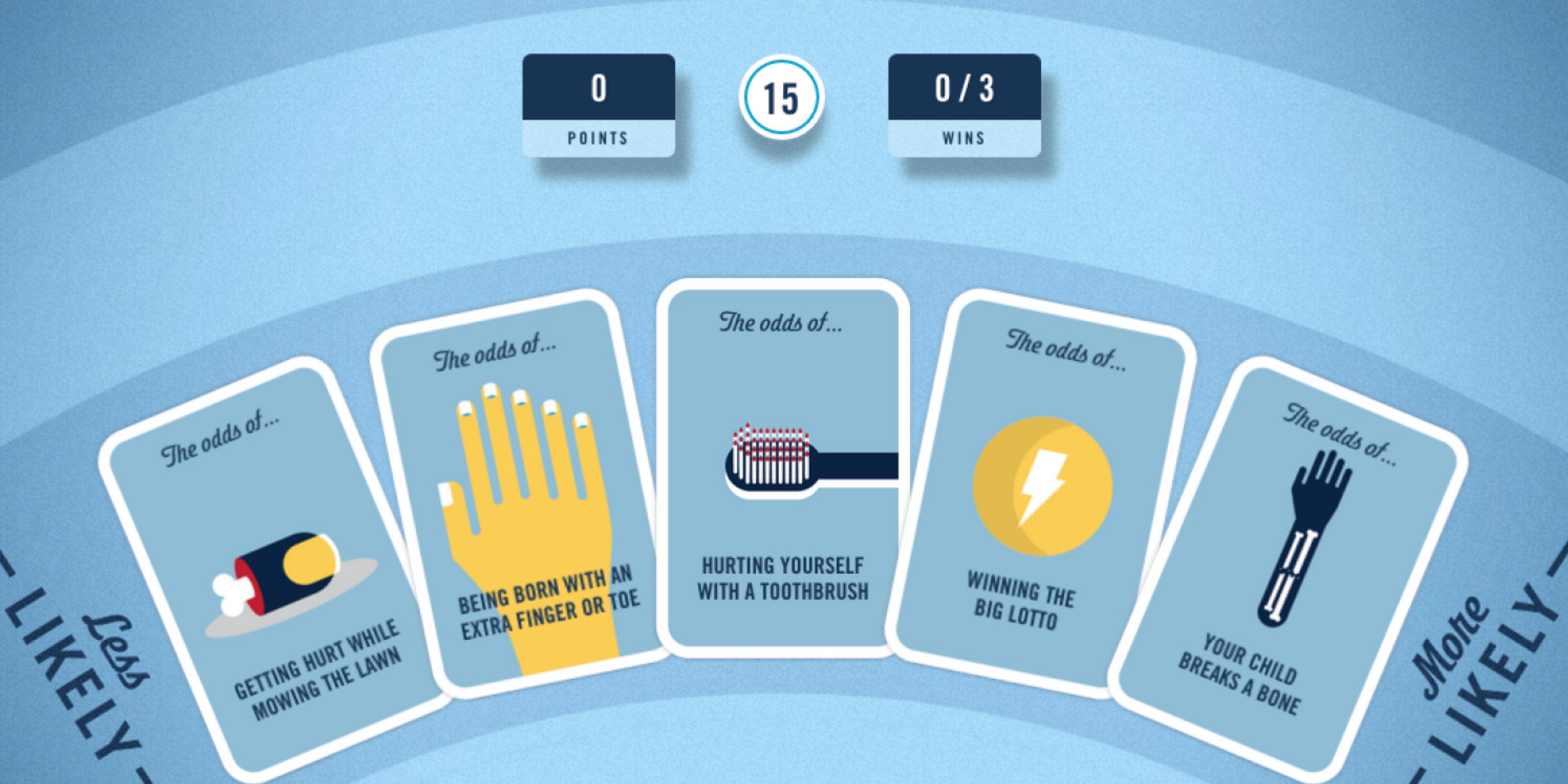
Result: Likes, comments and shares across the campaign rose by 3,337%, according to the agency's Cannes Lions entry. Use All Five, which developed the game with Droga5, lists it as a 2016 Webby Award Honoree.
Golocard — Negroni (2021)
Agency: Promosfera, on the Easypromos platform · Platform: Printed cards, web via QR codes
Each multipack of Golosino, Negroni's sausages for children, held three Golocard cards, each a cartoon athlete from one of nine sports with an element (lightning, wind or wave) and attack, defence and Golosino scores. Children battled each other by element or by score, with no app or sign-up. A QR code on the back of each card opened a mini-site for that sport, with quick facts and a puzzle, memory or hidden-object game.
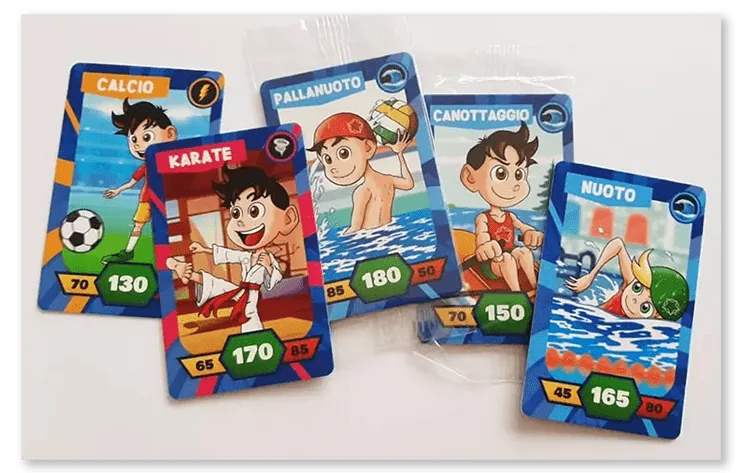
Result: Over July and August 2021 the mini-games drew almost 18,000 participations and more than 140 hours of play across the nine games, and the sport landing pages logged 25,050 visits, with most entries from Italy, according to Easypromos.
Bridge Clash — UNO (2026)
Agency: Preloaded · Platform: Roblox
Mattel wanted UNO's tabletop appeal on Roblox, where younger fans spend their time. Two teams of up to 14 scramble across an arena, grab UNO cards and lay them down in matching colours or numbers, the card game's own rule, to build a bridge to the centre. The first team there carries the Golden UNO Card back to base while rivals use wild powers such as a boxing-glove rocket or a tornado. A round lasts about ten minutes.
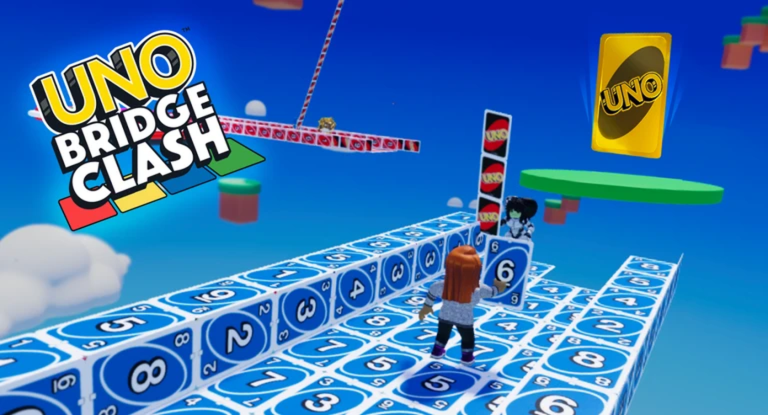
Result: 1 million players in the first month, 55% of them female, according to Preloaded.
FAQ
What are the basic types of card games?
Most belong to a few families, according to Wikipedia: trick-taking games, where players win rounds of cards; matching games, where you collect sets before an opponent; shedding games such as Crazy Eights, sold by Mattel as UNO; comparing games such as poker and blackjack; and patience or solitaire, mostly for one player.
What is a collectible card game?
A collectible card game (CCG), also called a trading card game (TCG), mixes deck building with collecting: players start from a pre-made deck and add cards from semi-random booster packs or trades (Wikipedia). Magic: The Gathering (Wizards of the Coast, 1993), Pokémon and Yu-Gi-Oh! are well-known examples. Blizzard's free-to-play digital Hearthstone (2014) sells packs of new cards for in-game gold or real money.
Is a memory game a card game?
In its classic form, yes. Concentration, also called Memory, Pelmanism or Pairs, lays every card face down, and players flip two per turn to find matching pairs. Negroni's Golocard mini-sites included an on-screen version. See memory game for when it works.