

A simulator game models a real activity, machine or system and lets the player operate it: do the job, drive the car, run the process. For brands, it turns something hard to explain, such as a career, a car's handling or a business risk, into minutes of hands-on experience.
How it works
You take the operator's seat. The rules behave like the real thing, so a wrong decision has roughly the consequence it would have outside the game. Wikipedia describes simulation games as "designed to closely simulate real world activities", usually without strictly defined goals, and lists job, vehicle, medical and dating sims among the branches. Brands use the playful ones too, as KFC did with a dating simulator.
Brand simulators keep the realism and add a game's frame: a mission, a timer, a score. In Airman Challenge players staffed each mission with real Air Force specialists before playing it; in Collapse a virus spread from the player's own street and the game counted the days until society failed. The player leaves knowing what the job involves, how the car feels or how fragile the system is.
Where brands use it
Recruitment is the classic use, because a job simulator works as a playable job preview. In The Game, Dutch law firm Houthoff Buruma had student teams work a 90-minute takeover deal, and IKEA's Roblox store The Co-Worker let players clock in for real co-worker tasks. See recruitment games and lead-gen and recruiting games. Training sims teach a process, as in KFC's VR kitchen The Hard Way, a cooking game that trains its cooks. Product sims let people feel a car or a race: PUMA put a professional F1 racing simulator in its New York flagship. B2B brands simulate the crisis they sell protection against, as Kaspersky did with a ransomware attack simulator. Browse simulation and strategy, installations and AR & VR.
When it fits
Use a simulator when the thing you sell is easier to feel than to describe: a job, a vehicle's handling, a risk your product reduces. It suits briefs about understanding and consideration more than instant reach, and players willing to give it real time. The Air Force set a goal of 20 to 30 minutes' average play for Airman Challenge. End on a clear next step, such as applying, booking a test drive or talking to sales.
Choose the channel by the realism you need. A web simulator reaches the most people. A driving seat or VR rig at a dealer or event feels more convincing but serves far fewer, one player at a time.
When not to use it
Skip it when people give you seconds. In a feed or at a busy stand, an instant win game or a quick quiz does more. For return visits over weeks, a tycoon or idle game is built for that loop. For a measurable skill or habit, build a serious game with a test or a behaviour to track.
Be honest about what you simulate. A recruitment sim showing only the exciting parts is an advert; a realistic job preview gives candidates the good and bad sides (Wikipedia). A sim that demonstrates what a product can do makes an advertising claim; in the US the FTC expects a reasonable basis for objective claims before they run (FTC). Check with counsel before a sim shows braking, safety or security outcomes.
Examples from the library
Airman Challenge — U.S. Air Force (2012)
Agency: GSD&M, Blockdot · Platform: Web
Players picked from 16 missions on a world map, from humanitarian relief in Bolivia to countering cyber attacks in the US (The One Show). Each had to be staffed with real Air Force specialists, and the wrong team failed it. The mission then played as a short skill game built around a career, such as reaction-time targeting as a Reaper drone sensor operator, with XP and promotion through real ranks.
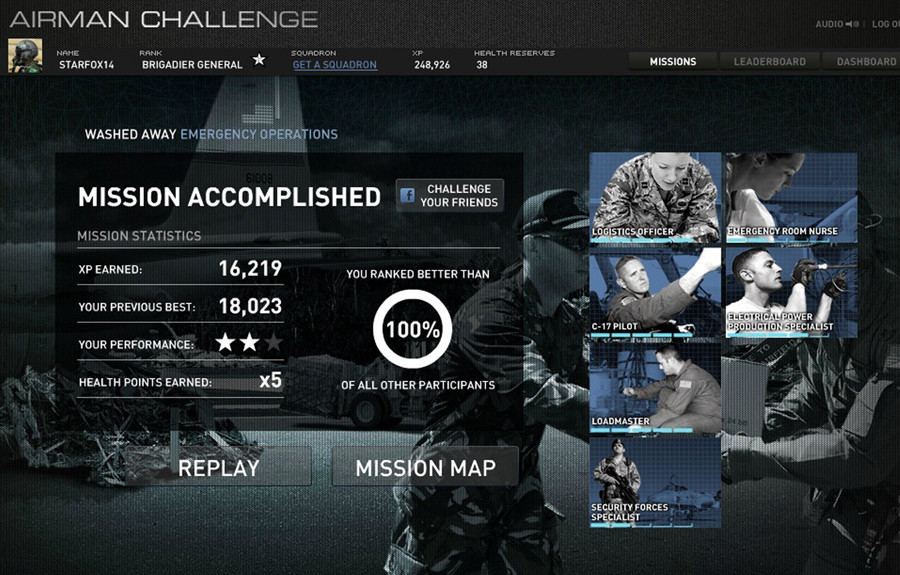
Result: The game drew over 600,000 visitors and more than 225,000 completed missions; 62% were in the 16 to 24 target group (goal: 40 to 60%), and average game time was 34 minutes 11 seconds, according to a project summary on consultant Dan Ferguson's site. The original site no longer serves the game.
Collapse — The Division (2016)
Agency: BETC Digital, Makemepulse, Edan Kwan · Platform: Web
Ubisoft's "end of society simulator" made the player patient zero. You typed in an address, and a map of your own city filled with real hospitals and supermarkets as the infection spread; choices such as which hospital to send the sick to sped it up or slowed it down. Built on OpenStreetMap and IATA flight-route data (Movies Games and Tech), the outbreak jumped between cities until power, transport, banking and healthcare failed.
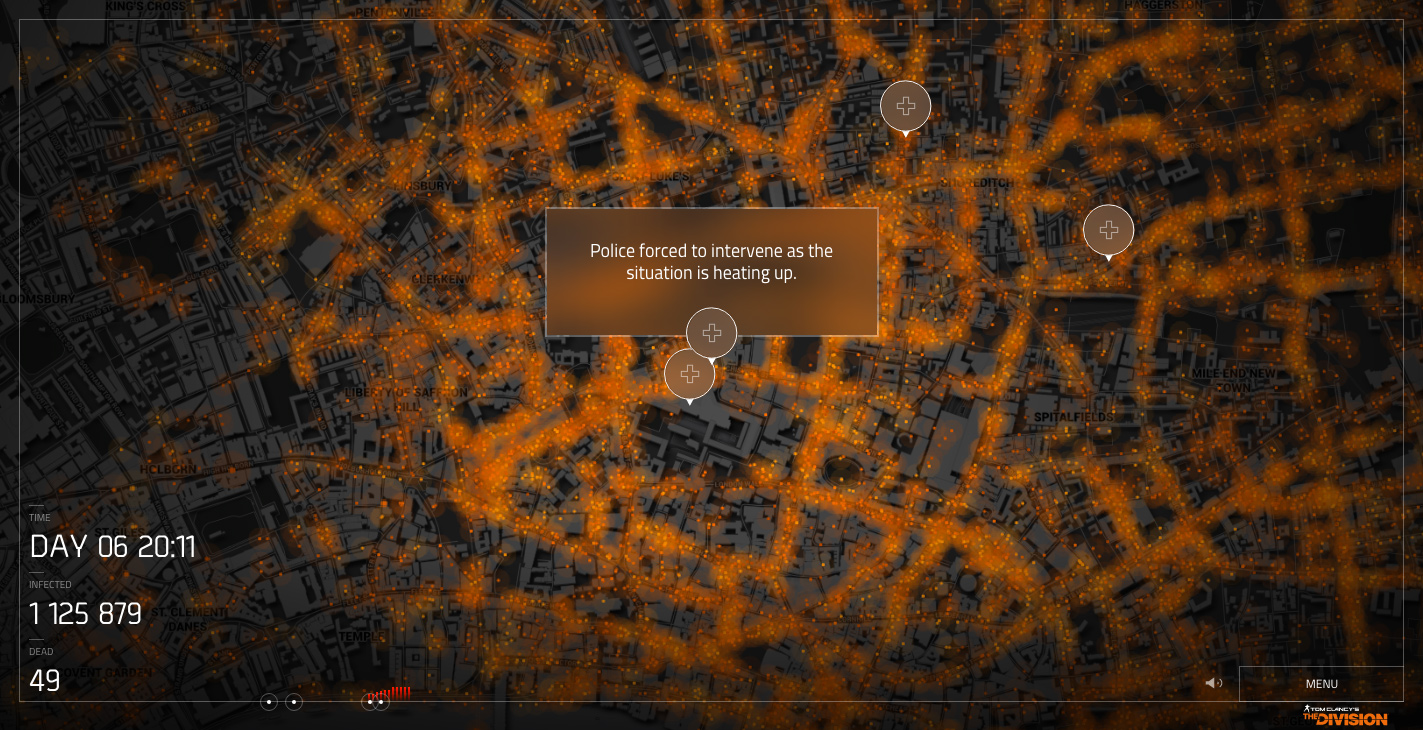
Result: In less than a week 1 million people tried the simulator, and The Division broke Ubisoft sales records, according to the campaign's D&AD entry. Raphaël Perrollier's portfolio page for the project reports 3 million visitors in the first month. The site is offline.
Enter Sandbox — Audi (2017)
Agency: POL, Monks · Platform: VR installation
Visitors shaped hills, jumps and bends in a 400 kg sandbox with children's spades and buckets. A depth-sensing camera scanned the sand into a matching 3D track. They then sat in an Audi Q5 driving simulator with a genuine Q5 steering wheel and seat (The Drum), put on a VR headset and drove the course they had just built. It toured Norwegian Audi dealers from February 2017.
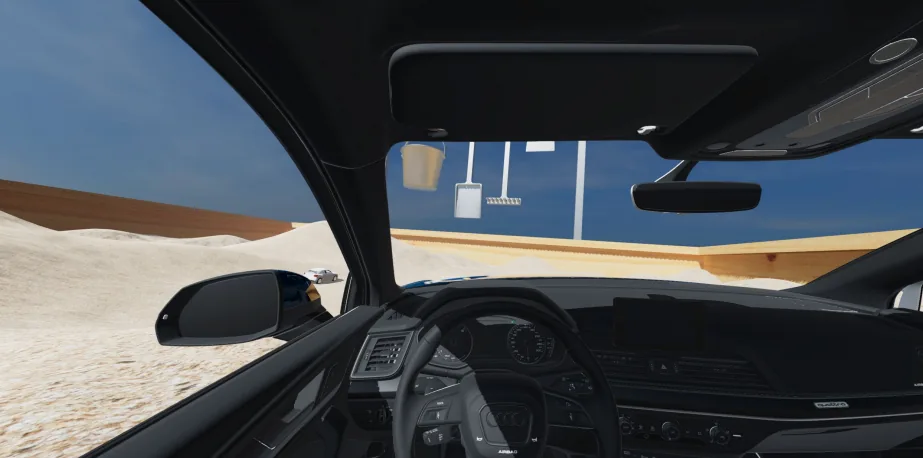
Result: Audi dealers reported a 57% increase in visitors during the sandbox's tour dates, and the new Q5 became the best-selling Audi in Norway, according to the campaign's case summary (Direct New Ideas). The Eurobest entry adds that a Deutsche Welle Facebook share of the campaign video alone drew over 4 million views in a month.
FAQ
Is a simulator game the same as a tycoon game?
Not quite. A tycoon game is one kind of simulation: you manage a business or base and reinvest what it earns, and Roblox lists Tycoon as a subgenre of Simulation. A simulator in the narrower sense hands you the controls. You do the job, drive the car or handle the crisis, rather than watch an empire grow.
What does "simulator" mean on Roblox?
Roblox defines its Simulation genre as games about "real-world systems, processes, and activities", but its Incremental Simulator subgenre means progress through simple repeated actions that raise a counter (Roblox). Warner Bros.' Aquaman Simulator: The Lost Kingdom worked that way: defeat henchmen, earn coins, buy stronger tridents, open new zones. Little about it simulated anything real.
Why do so many games have "Simulator" in the title?
The label goes back at least to the mid-1980s, when Codemasters released BMX Simulator and Grand Prix Simulator (both 1986), and Your Sinclair parodied the trend with Advanced Lawnmower Simulator in 1988 (Wikipedia). Brands use the joke too: GAME's Christmas Shopper Simulator played in the same knowingly broken style as Goat Simulator, with toppling shelves and flying shoppers.