











Collapse
Open the game- Brand
- The Division
- Year
- 2016
- Objective
- Engagement
- Industry
- Entertainment
- Mechanic
- Simulation & Strategy
- Platform
- Web
- Agency
- Edan Kwan
- With
- Makemepulse
- With
- BETC DIGITAL







Objective
Ubisoft and BETC Paris built Collapse to seed awareness ahead of Tom Clancy's The Division's March 8, 2016 launch, translating the game's premise — a virus that unravels society — into a scenario players could believe rather than dismiss as fiction. The goal was to pull in an audience wider than core gamers by making the outbreak personal: not a fictional world, but the player's own city, hospitals, and airport.
Solution
The player opens the site and types in their real address, instantly becoming patient zero of a fictional virus called Variola Chimera. A map of their own city fills the screen, populated with real nearby hospitals, pharmacies, supermarkets, and banks as the infection radiates outward from their front door. Along the way the player is prompted to make calls — which hospital to send the sick to, which country to flee toward — and each choice speeds up or slows down the spread. The outbreak then jumps onto real flight routes to other cities and countries, and one life-support system after another (power, transit, banking, healthcare) fails, ending in a global collapse with a final tally of how many days it took. Players can restart with a different home city or different decisions to compare outcomes and see which places prove most fragile or most resilient.
Results
The simulator was tried by 1 million people in under a week, reaching 3 million visitors in its first month and over 60,000 daily visitors by month two. The Division went on to break Ubisoft's sales records, with sales up nearly 130% and more copies sold in its first 24 hours than any previous Ubisoft release.
- 1
The player lands on the Collapse experience and is framed as the one who will trigger a society-ending pandemic: a simulator of civilizational collapse in which the player becomes patient zero.
- 2
The player enters a real location — an address or city, chosen from over 3,800 cities worldwide — and becomes patient zero for a fictional supervirus, Variola Chimera, three times deadlier than smallpox, which begins spreading from that point.
- 3
The simulation renders the player's own area using real map data — nearby hospitals, pharmacies, supermarkets, banks, and airports — and shows local infection effects, such as how many people the player infects on the way to the hospital or how fast the local pharmacy runs out of medicine.
- 4
At intervals the simulation pauses for consequential choices, such as which hospital to visit or which country to flee to, and each decision alters the pandemic's speed and spread.
- 5
The outbreak escalates in stages, moving from the player's neighborhood to the whole city and then abroad, with international spread following real airline flight routes.
- 6
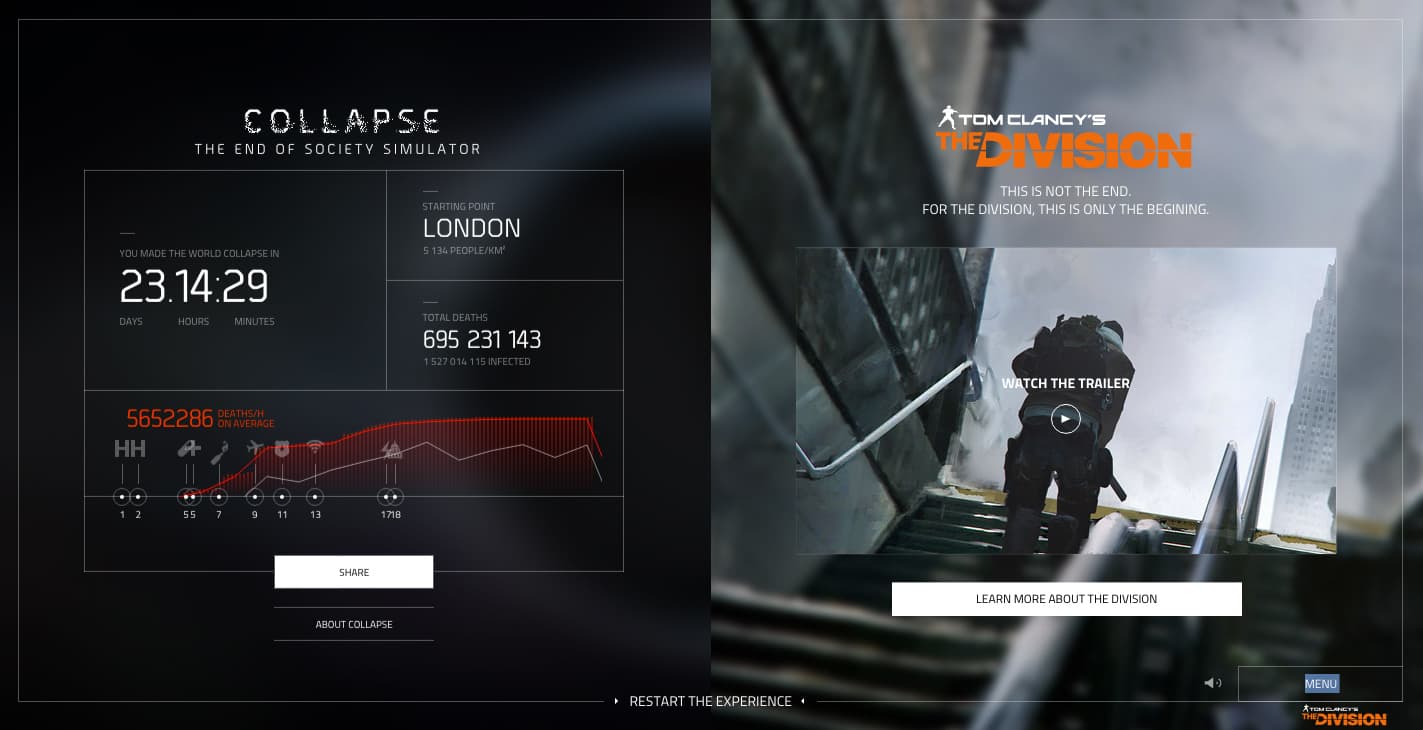
The player watches critical systems fail one after another over a matter of days — power, transport, communications, banking, and hospitals — as a cascading breakdown.
- 7
The experience ends with a tally of how many days it took the player's outbreak to collapse civilization, sometimes under a month, and the player can restart with a different epicenter or different choices to compare outcomes and find the most vulnerable and safest cities.