

A voice game is a game you play by speaking, singing or shouting, either to a voice assistant such as Alexa or into the microphone of a phone or computer. For brands, the voice is the controller: saying the brand name, singing along or cheering for a team is the move that scores.
How it works
Voice games come in two families. On a smart speaker the game is a conversation: the player asks Alexa to open a skill, hears a question or a scene and answers aloud; a skill can also add visuals and touch (Alexa Skills Kit documentation). MIT Technology Review's 2019 round-up featured a voice-only space adventure and a skill that referees sibling arguments.
In a browser or an app, the game listens through the microphone, which it can open only after the player grants permission (MDN). It can read the words, through speech recognition such as the Web Speech API, or measure only the loudness and length of a shout or the pitch of a singer. The phrase also names voice-acting and dubbing games; this page covers games you control with your voice.
Where brands use it
The library tags 22 games as voice-controlled, usually with an engagement or awareness objective. Smart-speaker cases are rare; the clearest is Amazon's own Echo Escape. Most are web games that open the player's microphone.
Food and drink brands make the name the challenge: Carlsberg's Say "Carlsberg" Win Beer had a billboard tap in Ho Chi Minh City pour a beer for anyone who pronounced it correctly. Automotive sponsors use the cheer: Toyota fans shouted "Goooal" to drive a pickup down a pixel road in Goal To The Gold Cup. Singing works too. IKEA Spain's Nanä asked players to sing a lullaby to put the neighbours to sleep, and YouTube Music's FreddieMeter, still playable, scores how close a fan's voice comes to Freddie Mercury's.
When it fits
Voice fits when the thing to remember is spoken. Carlsberg built its game around a name Vietnamese speakers found hard to say; IKEA UAE's 2026 TikTok effect The Swedish Test scored players on product names up to BJÖRKSNÄS.
It suits groups in one room. Amazon's Dave Isbitski said voice "can help make gaming more communal", MIT Technology Review reported, and Coca-Cola and Oreo both built for families around one screen. Sponsors use it where fans already shout: Toyota players sat inside a real Tundra in stadium fan zones, and Kia's Get Mean had a booth during the Australian Open. For a stand, see our trade show booth games round-up.
Keep rounds short, and open the game in the mobile browser from a QR code, billboard or ad.
When not to use it
Don't tie the game to one assistant: the platforms keep changing. Google shut down Conversational Actions on 13 June 2023 (Google). Amazon ended its Alexa Developer Rewards Program in June 2024, saying fewer than 1% of developers used it (Engadget), and in February 2025 announced Alexa+, a generative-AI assistant.
Skip voice where players can't make noise: offices, commutes, late at night. A player who refuses the microphone prompt cannot play, so add a tap fallback, as Delta Lloyd's The Optimist did for devices without a microphone. A quiz works without one as a tap-to-answer trivia game.
If children may play, mind COPPA: an audio file with a child's voice is personal information, and services directed at children need verifiable parental consent before collecting it, with a narrow exception. Check with counsel.
Examples from the library
Echo Escape — Amazon (2017)
Agency: AKQA, UNIT9 · Platform: Installation at New York Comic Con, plus a Twitch livestream
Teams of up to six entered a five-room escape experience, cast as operatives in a plot from the Prime Video series Tom Clancy's Jack Ryan. They wore wireless mics and had no screens or buttons: every move was a command to Alexa, to kill the lights, run a search, place a call or pull up a video feed. A run took about 20 minutes; the room was dismantled after the four-day event.
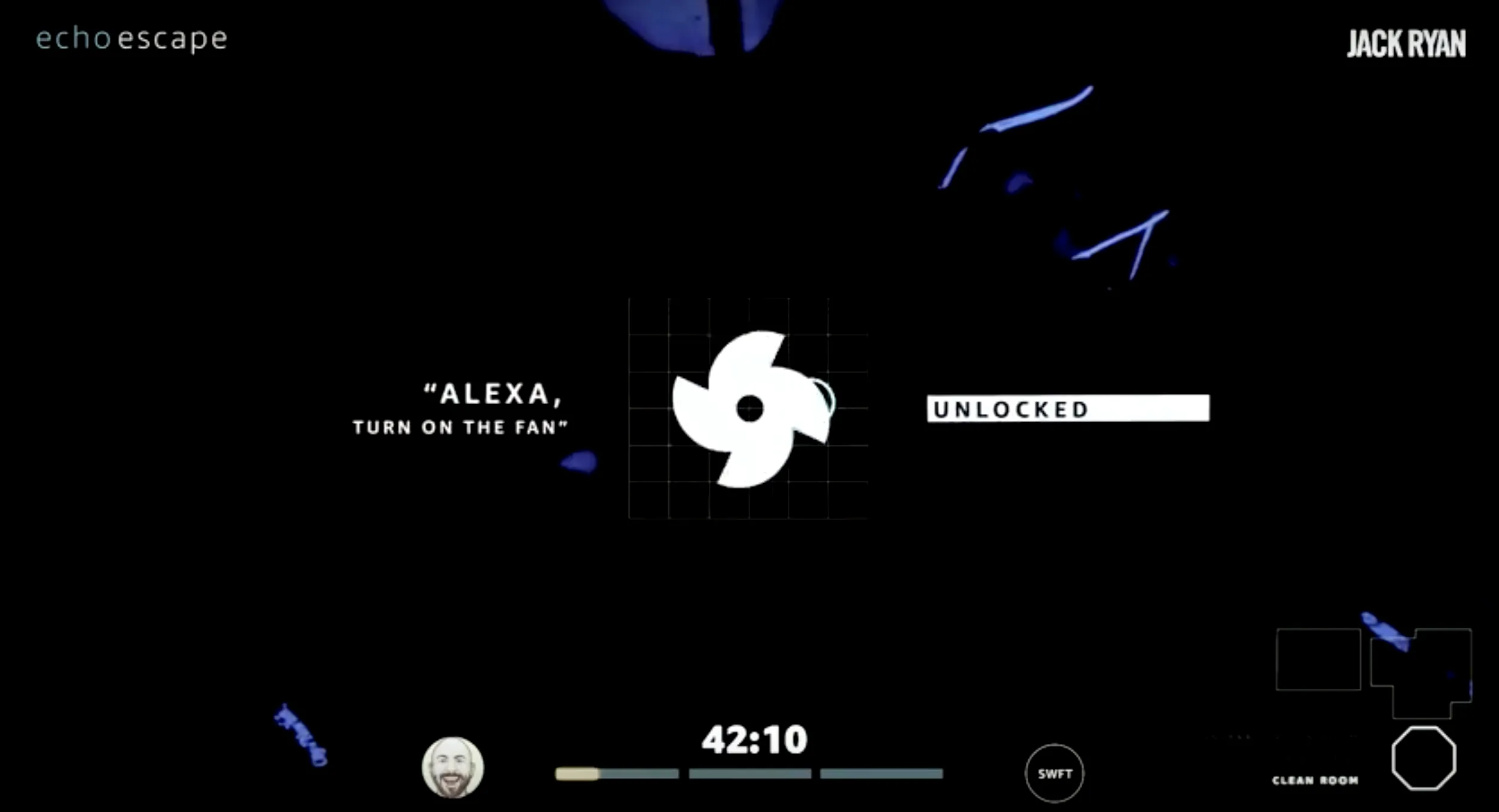
Result: More than 5,000 people queued to play, with reservations claimed within the first hour of opening. The three-hour Twitch broadcast drew over 1.5 million online participants, more than 1 million of whom intervened to help or hinder the streamers, according to AKQA.
The Yes Or No Game — Oreo (2020)
Agency: Publicis (Digitas, Buenos Aires) · Platform: Mobile and desktop browser, Argentina
Oreo turned an old family word game, in which nobody may say "sí", "no", "blanco" or "negro" (yes, no, white, black), into a voice bot. Families gathered round one phone or laptop while an AI host asked questions out loud and listened for the forbidden words. A round ran to 20 questions, with three Oreo cookies on screen as lives. Scores went to a national leaderboard, and top scorers won Oreo prizes.
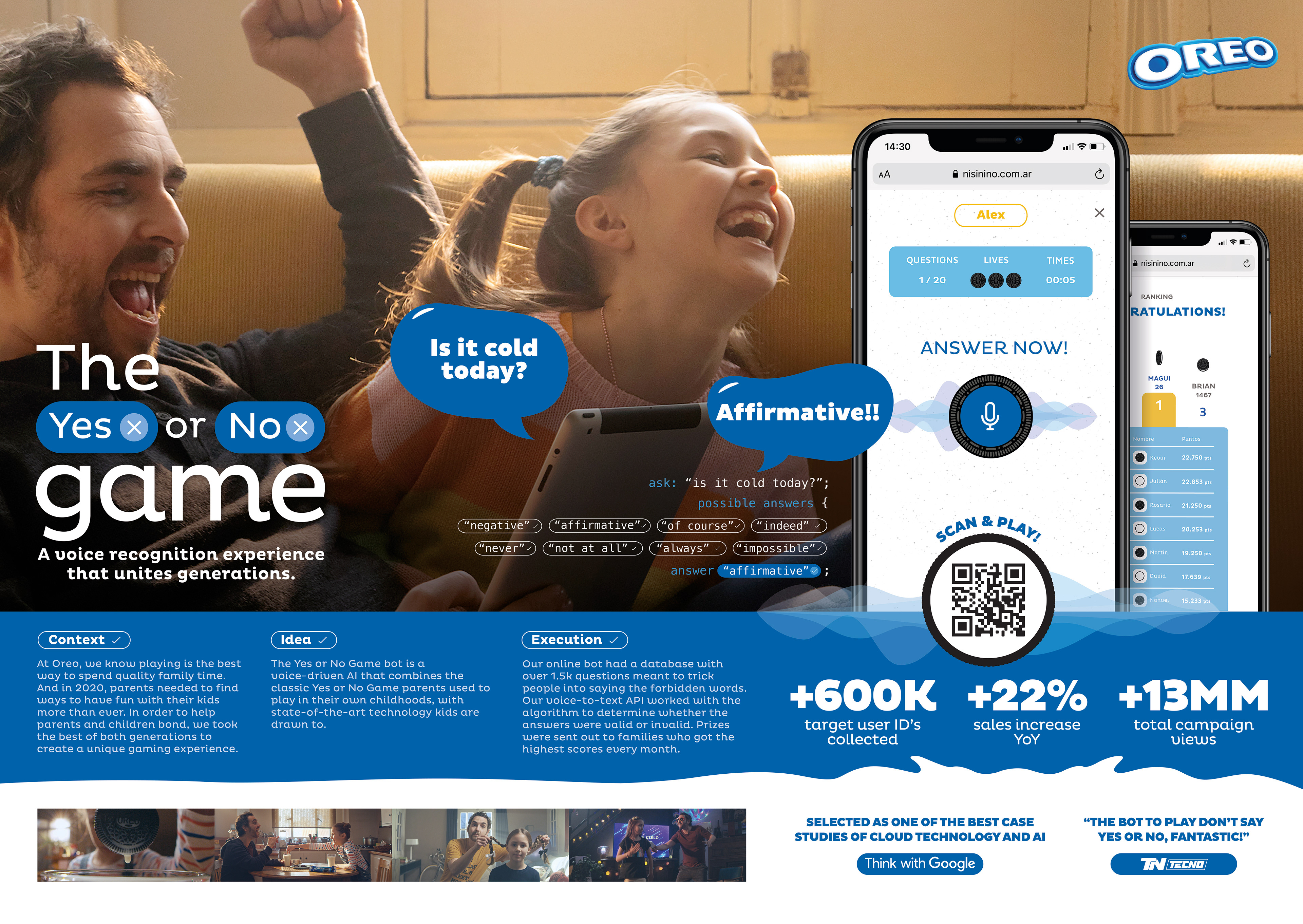
Result: More than 600,000 target user IDs collected, a 22% year-on-year sales increase and more than 13 million campaign views, according to the agency's case board. It won Silver for sweets, snacks and desserts at the Effie Awards Argentina, according to a portfolio page for the campaign.
Chinese New Year Games — Coca-Cola (2022)
Agency: Ogilvy (Shanghai), UNIT9, Le Polish Bureau · Platform: Mobile web inside WeChat, opened from a QR code on limited-edition cans in China
Families scanned the code on a Year of the Tiger can and a game hub opened inside WeChat. With the phone set down on the table, its camera and microphone read everyone at once. In the voice game the whole family shouted together to send a tiger leaping further; others used blinks and head turns. Each round earned tiger coins to redeem for prizes. The games can no longer be played.
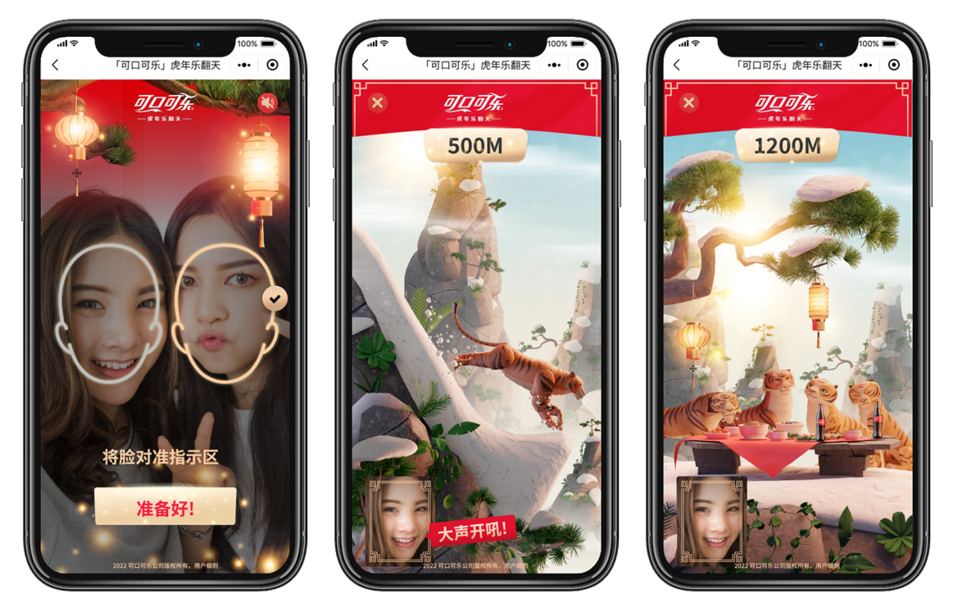
Result: Ogilvy Shanghai's ROI Festival 2022 entry reports that the game drew 10.7 million views with a 78% unique-visitor engagement rate, and that over Spring Festival Coca-Cola's category share overtook pre-pandemic 2019 levels, up 1.6 points in volume and 0.3 points in value.
FAQ
What is an Alexa skill?
Amazon describes skills as "like apps for Alexa": programs built with the Alexa Skills Kit that a user opens by asking Alexa, on Echo speakers, Fire TV and other Alexa-enabled devices. Games are one skill type, alongside music and smart-home skills. In 2024 Amazon said over 160,000 skills were available, Engadget reported.
Can brands still build voice games for Google Assistant?
Not as conversational games. Google removed Conversational Actions, the format for third-party conversational apps on Google Assistant, on 13 June 2023 (Google). App Actions and smart-home integrations survived, but they connect the Assistant to apps and devices rather than host a game. A microphone game in the mobile browser needs no assistant at all.
Does a voice game record the player?
It depends on the build. A browser game must ask before it opens the microphone, and speech recognition can use the platform's service or run locally in the browser, MDN explains. Google said FreddieMeter's audio "doesn't get uploaded to any servers" (Google). If children may play, check with counsel.