

DOOH stands for digital out-of-home: advertising on digital screens in public places, from roadside billboards and bus shelters to station, mall and cinema screens. Because a computer drives each screen, it can also run a game that passers-by play with their body or phone, turning a poster site into a live demonstration.
How it works
DOOH is often one-way: a spot plays in a loop and can change with the time of day, the weather or the audience. The IAB's 2024 definition also covers screens that show "interactive content", and that is where a game comes in. A camera or sensor reads the person in front of the screen, or their phone becomes the controller. At a Shanghai metro station, Nescafé's screen had commuters step side to side to fill a bottle with falling coffee drops in 30 seconds, then scan a QR code for a real bottle from the vending machine beside it. In Dubai Mall, shoppers joined over WiFi and tilted their phones to aim at aliens on a giant OLED wall. In Toronto sports bars, a TELUS screen above the urinals ran its ad loop until someone stepped up, then switched to a football game steered by a sensor in the urinal.
Where brands use it
Screens now take a large share of outdoor money. Digital earned 68% of UK out-of-home revenue in the second quarter of 2026, according to Outsmart, and 36.3% of US revenue in 2025, according to the OAAA. In our library 49 games carry the billboard and DOOH tag, many of them installations in stations, malls, shop windows and city squares. Sports moments recur: Coca-Cola played its 2018 World Cup sponsorship on a station screen, while TELUS, without sponsor rights, went to bars in 2014. Food and drink brands use screens to put a product in people's hands, and sportswear and tech brands use them for product launches.
When it fits
Playable DOOH suits a brand activation around a launch or sponsorship in one place, when the brand wants a public demonstration more than a database. Pick a site where people already wait or linger: a station concourse, a mall atrium, a lunch-hour street. Keep rounds short; Nescafé gave its players 30 seconds. Plan for the people watching and for the film, because they can be most of the audience: Nike's Los Angeles race counted far more impressions from its Snapchat version than from the square itself. Give people elsewhere a way to play too, through a phone version, a lens or a QR code game.
When not to use it
Skip a playable screen when the brief is volume. Most serve one player or a small group at a time: ESPN's windows peaked at 40 games an hour over lunch, and Coca-Cola's Zurich set logged over 1,000 interactions across two days. For reach, sign-ups or sales at scale, a playable ad or a QR code game lets thousands play at once on their own phones. Skip it too if you can only buy standard network slots: they rotate short spots, six seconds on JCDecaux's UK rail digital six-sheets, while a game holds the screen for as long as someone plays. Camera games also film passers-by, so plan for consent: Coca-Cola's set carried a sign saying that anyone entering the area agreed to be filmed and photographed.
Examples from the library
MNF Interactive Storefront — ESPN (2009)
Agency: Wieden+Kennedy · Platform: Installation
Street-level windows in New York, Chicago and Boston let passers-by pick a quarterback from the coming Monday Night Football game, who then threw passes straight at them. A gesture-recognition system judged each catch made with bare hands, ESPN commentators called the streak, and a single drop shattered the on-screen glass and ended the run. Scores went to a leaderboard shared by all three cities, and the screens counted down to the next game.
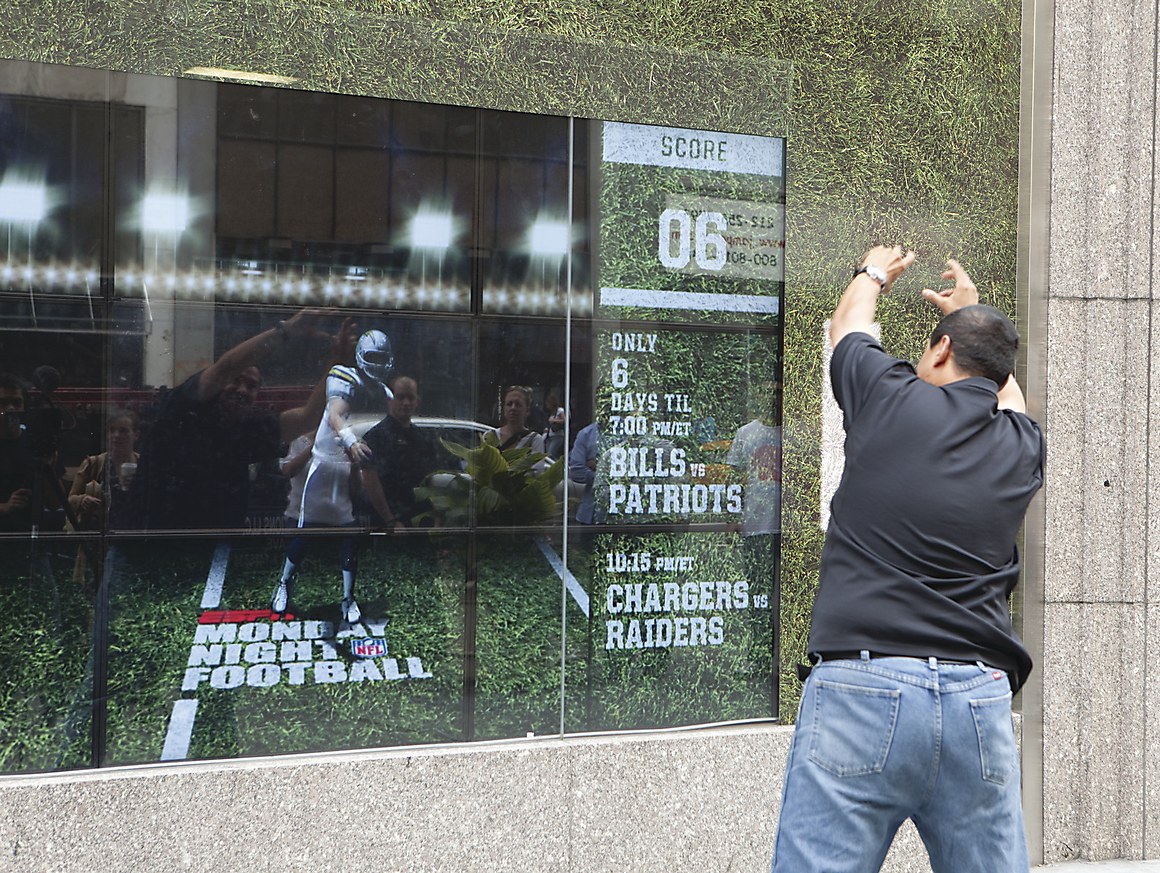
Result: Lunch-hour play peaked at 40 games per hour, and by the end of the five-week run players had more than doubled the top leaderboard scores, according to the project's Communication Arts entry.
Kicks-Off — Coca-Cola (2018)
Agency: MediaCom / Grand Visual · Platform: Installation
People crossing Zurich's main station stepped onto a patch of artificial grass and saw themselves life-size on a large screen next to Switzerland striker Xherdan Shaqiri. After a few tricks he waved them in for a quick exchange of passes, feints and shots on goal, and the round ended with a photo together. Leaving contact details brought a copy of the photo and entry into a draw for an official World Cup match ball.
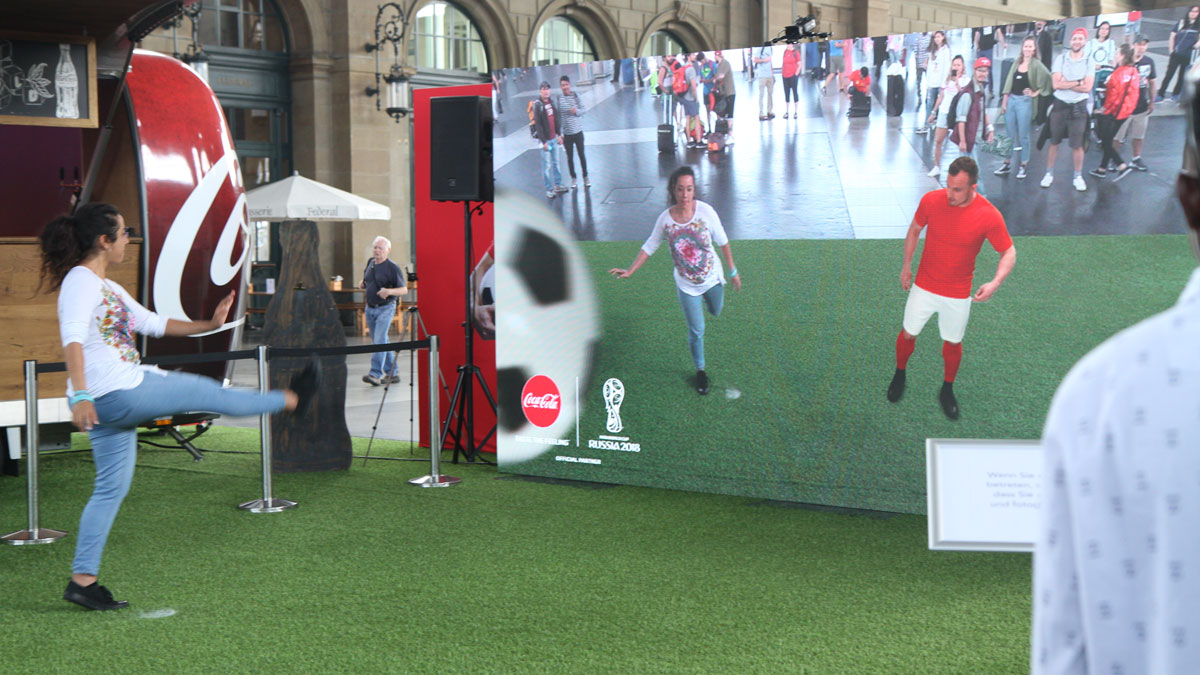
Result: Over 1,000 interactions across two activation days a week apart, according to the DOOH creative studio Grand Visual.
Game Of Go — Nike (2018)
Agency: Monks, Wieden+Kennedy · Platform: Installation
On Microsoft Square in Los Angeles, players laced up the unreleased Epic React shoe and stepped onto one of three giant custom-built treadmills. Motion tracking turned each stride into an avatar racing two rivals over a virtual 400 metres through foam, bubbles and fur, shown live on the big screens above the square. Runners left with a video of their race, and anyone elsewhere could run the same race through a Snapchat lens.
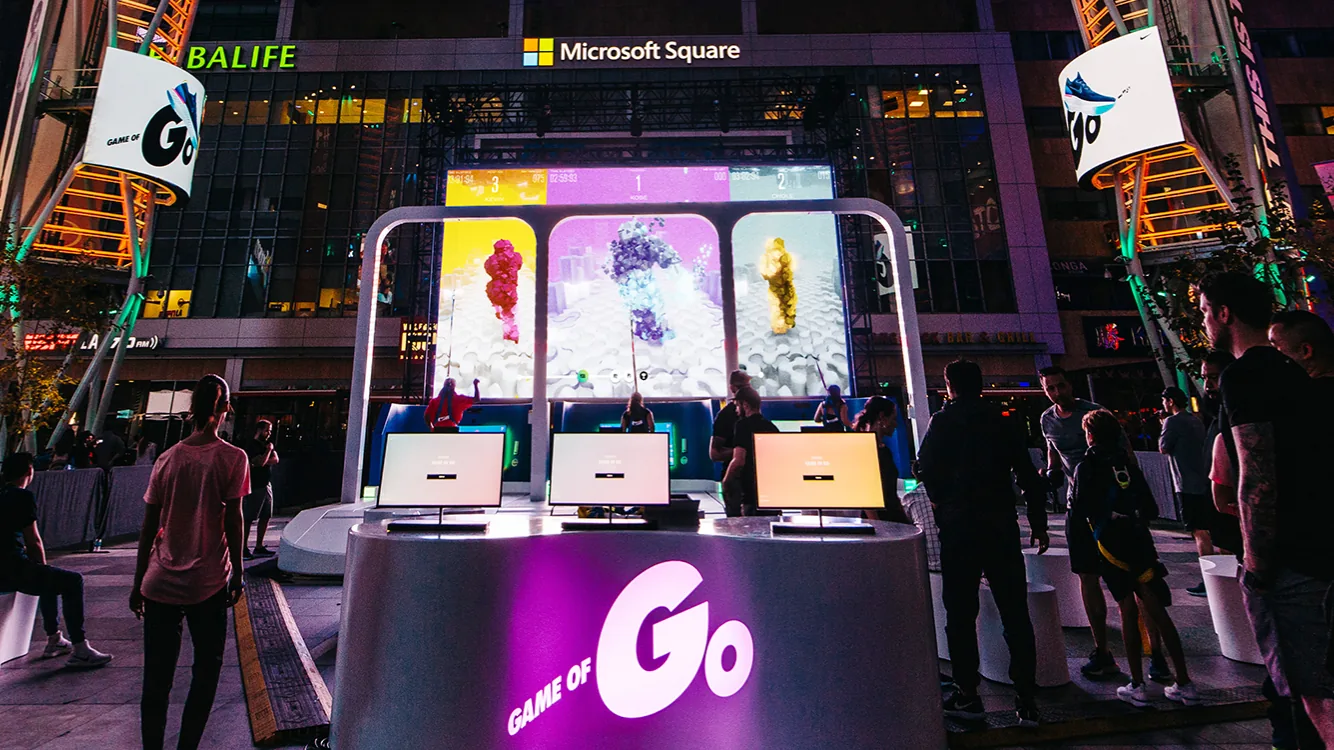
Result: The three-day activation brought 4.5 million TV and 1.5 million out-of-home impressions, and the Snapchat game 25.6 million digital impressions, a case write-up in The Drum reported; RTR Sports puts the TV audience at 4.4 million.
FAQ
What does OOH stand for in advertising?
OOH means out-of-home: advertising people see outside their homes. The OAAA, the US industry body, counts digital and static billboards, street furniture, transit, place-based media and cinema in it. DOOH is the digital part of OOH, the screens rather than the printed posters.
Are billboards OOH or DOOH?
Both kinds exist. A printed billboard is OOH. A digital billboard, whose content changes on screen, is DOOH. The IAB states that static billboards, including static signs with QR codes, do not qualify as DOOH, and neither do ads on personal devices, even when people see them outside the home.