

An advergame is a video game a brand commissions to advertise a product, service or organisation, with the brand built into play as the hero, the setting or the prize. People choose to spend minutes with it rather than seconds, and brands have made advergames since the early 1980s.
How it works
You play a game in which the brand is the thing you play with, not a logo at the edge of the screen. Dictionary.com defines an advergame as an online game that promotes a brand by integrating it into the game, and dates the word to 1995–2000. The UK's advertising rule-maker, CAP, describes advergames as "electronic games that are used to advertise a product, brand or an organisation".
Advergaming is older than the word, and it was never only online. In Tapper (1984), an arcade cabinet made for bars, you pour Budweiser for thirsty customers. In Pepsiman (1999), the hero's health is a shrinking Pepsi logo. A good advergame then hands the player something to take into the real world: a coupon, a code, a prize entry or a link to the shop.
Where brands use it
Most games in this library are advergames in the broad sense; the exceptions are licensed games that publishers made and sold, and brand builds inside games the brand does not own, covered under in-game advertising. Food and drink and entertainment brands have commissioned the most, followed by tech, fashion and automotive brands. Most aim at engagement or awareness; fewer chase sales directly, and some, such as armed forces and employers, use them for recruiting.
The channel has followed the audience. Cartridges and arcade cabinets came first, then CD-ROMs in cereal boxes, then web games on campaign sites in the browser era of the 2000s. Today the same brief often lands inside a platform people already use, as the Roblox and Fortnite collections show. Our history of advergames traces the whole arc.
When it fits
An advergame fits when you want people to spend real time with a product, and you can give them a reason to come back or a reward that leads to a purchase. It suits launches, seasonal pushes and long-running brand worlds. Plan sessions in minutes: Chipotle's Roblox restaurant (below) averages 10.56 minutes a session.
Decide distribution before design. Chex put its game in the cereal box, Kool-Aid mailed its cartridge to children who saved proof-of-purchase points, and Chipotle opened its game on National Burrito Day. Choose the place your audience already goes: a Roblox experience, a QR code game on the pack, or a web game behind a TV spot.
When not to use it
Skip an advergame for food high in fat, sugar or salt when many players are under 16. UK rules bar such ads from any medium whose audience is more than 25% under-16s, and in 2018 the ASA upheld a complaint against Swizzels' Squashies World game because its age gate was unlikely to deter under-16s.
For reach or data this month, an instant win game, spin-the-wheel or trivia quiz is faster and cheaper. If players already live in someone else's game, in-game advertising reaches them without building one.
Don't build one without a plan to keep it running. Adobe stopped supporting Flash Player at the end of 2020, and only two of the library's 96 games from the 2000s are confirmed playable today. The still playable collection shows what survived.
Examples from the library
Chex Quest — Chex (1997)
Agency: Digital Café · Platform: PC, on a CD-ROM in the cereal box
Instead of a toy, boxes of Rice, Wheat and Corn Chex carried a CD-ROM with a five-level first-person shooter built on Doom's engine. Nothing dies: your zorcher teleports the slimy Flemoids away, health comes from water, fruit and vegetables, and armour is a box of Chex. Coupons and ads sent players to chexquest.com for hints and recipes. A remastered Chex Quest HD followed on Steam in 2020.
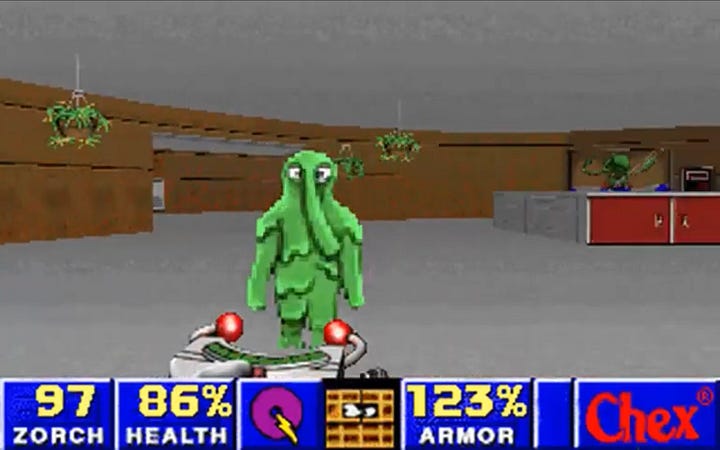
Result: During the six-week promotion, incremental volume over base rose 295% and Chex's volume share grew 48% on the previous year, according to a 1998 Promotional Marketing Association case study cited by Wikipedia. The 2020 HD relaunch brought a 10% sales lift during its promotion and 2 million minutes of brand engagement, according to the agency Martin Williams.
America's Army — U.S. Army (2002)
Agency: in-house (U.S. Army) · Platform: PC, free download
The Army wanted teenagers and young adults to try soldiering inside the online shooters they already played, without a recruiter's pitch. You start in basic training: a rifle range, an obstacle course, a scripted assault on a town. Pass and you join online squads fighting round-based missions under rules of engagement; shoot a teammate and the game docks your Honor score. Online play for the last version, Proving Grounds, shut down on 5 May 2022.
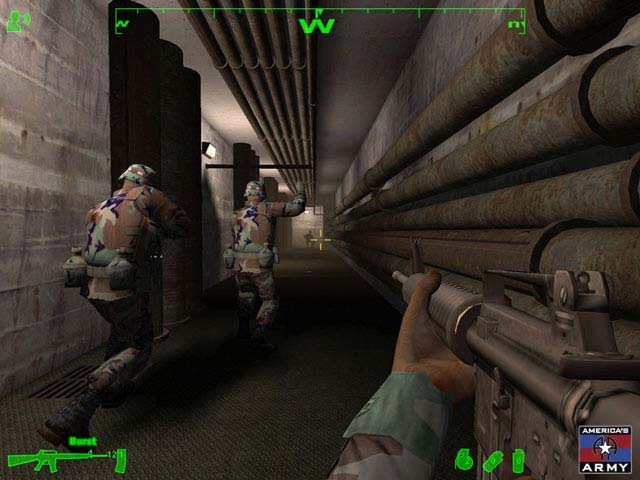
Result: By its fifth anniversary in June 2007, the game had more than 8.5 million registered users in over 60 countries, more than 40 million downloads and more than 200 million hours of play, according to the U.S. Army.
Burrito Builder — Chipotle (2022)
Agency: none credited · Platform: Roblox
Launched on National Burrito Day, the game puts you behind the counter of Chipotle's first Denver restaurant in 1993. Orders appear as ingredient pictures; you drag the right ones onto a tortilla sliding down the line, then roll it with the arrow keys before the timer runs out. Each correct burrito pays Burrito Bucks; on launch day, 100 of them bought one of 100,000 codes for a free entrée on the Chipotle app or website.
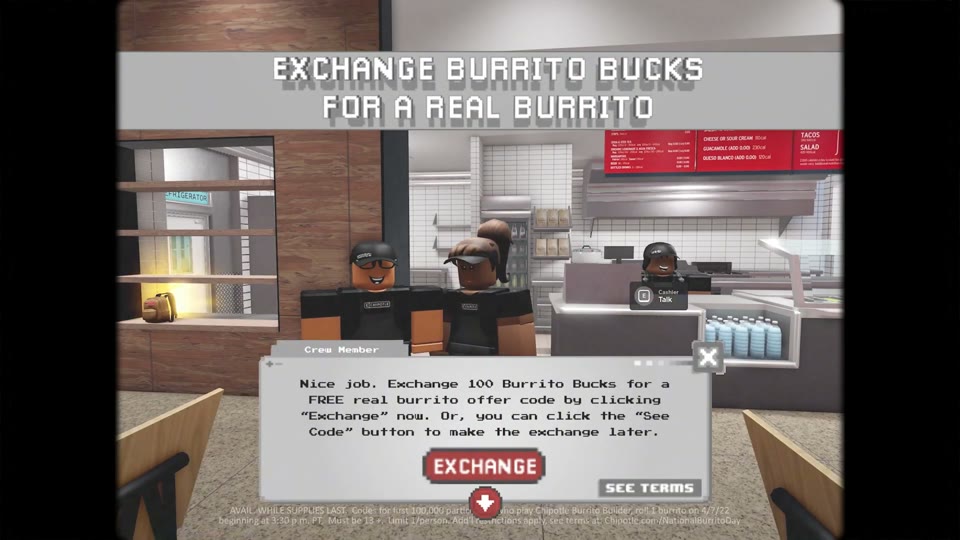
Result: All 100,000 free-entrée codes were claimed within 30 minutes, and the game drew 1.1 million gameplays in less than 24 hours, with up to 27,000 people playing at once, according to The Meta Key.
FAQ
What is the difference between an advergame and in-game advertising?
An advergame is a game the brand owns, built around its product. In-game advertising rents space inside someone else's game, such as a billboard beside a race track or a branded item, and that game would work just as well without it. Take the brand out of an advergame and little game is left. Our longer comparison goes further.
Is an advergame the same as a branded game?
In practice, yes. Advergame is the older word, common in the browser era and still used by researchers and regulators such as CAP. Branded game is the plainer modern name, and playable marketing covers the wider field, from quick prize formats to full games. In this library all three describe a game a brand commissioned for a marketing task.
Do advergames have to be labelled as ads?
Often, yes. In the UK, the CAP Code covers advergames in paid-for space and, when they are directly connected with selling, on a brand's own site, apps and social channels. Most complaints have asked whether a game was obviously an ad and how much it appealed to children. Roblox asks creators to disclose ads in simple, easy-to-understand language. Check the rules in each market before launch.