
A branded game is a video game that a company commissions or owns to meet a marketing goal, with its brand, product or characters built into the play. It is the plainer modern name for an advergame. Brands use branded games for awareness, sales, sign-ups and recruitment.
How it works
The player finds the game through an ad, a pack, a QR code, a social post or a platform's discovery page, and usually plays for free. The brand can be the hero, the setting, the vehicle or the prize. A round ends in a score, a new level, a result to share or a reward such as a discount code.
The idea is old. In 1997, boxes of Chex cereal carried Chex Quest on a free CD-ROM: a non-violent shooter built on Doom's engine, where the player "zorches" slime creatures away and picks up a box of Chex as armour. For the longer story, see the history of advergames.
The difference from an ad placed in someone else's game: the brand pays for and owns the whole game, and the game itself does the marketing job.
Where brands use it
In our library, entertainment and food and drink brands commission the most, followed by tech and telecom, fashion and beauty and automotive. Most aim at engagement or awareness; fewer are tied directly to sales, loyalty or recruitment and lead generation.
The browser is the most common home: 684 of the 1,159 games in the library are web games. Brands also release apps, build worlds inside platforms players already use, such as Roblox and Fortnite, and put games on screens at events and in shops (installations).
When it fits
Choose a branded game when you want people to spend real time with the brand, or to do something more than once: come back, register, apply, collect. Sessions can run to minutes rather than seconds. Visitors to The Coke Zero Game spent 9.5 minutes on the site on average.
It suits audiences who already play, on the platforms they use. A game on the brand's own site needs media to bring players in, as Capri-Sun's TV spots did for Disrespectoids (below).
Allow time. One studio, Peek & Poke, quotes 1 day to 4 weeks for a mini-game, 2 to 12 weeks for a white-label game and 3 to 36 months for a fully bespoke one.
When not to use it
Skip it when a specific claim must stick: a meta-analysis of 38 data sets found that people remember less brand and product information from advergames than from other ad formats.
Skip it without a distribution plan: nobody stumbles on a new game. To reach players inside games they already play, buy in-game advertising or a playable ad.
Take care with children: the same study found younger consumers easier to persuade, and complaints to the UK regulator have concerned appeal to children and whether games are clearly identifiable as ads.
Skip it if no one will maintain it. Since Adobe blocked Flash content from 12 January 2021, many web games in our library can no longer be played. Budget for hosting and updates, or a planned shutdown.
Examples from the library
Disrespectoids — Capri-Sun (2009)
Agency: Fuel Industries · Platform: Web
Each TV spot ended with a kid mutating into a "Disrespectoid" and sent viewers to RespectThePouch.com. There, players picked a mutant and dropped into its mini-game, such as Bobblehead Fred's Crash Course, earning achievements that unlocked new content and cartoon episodes. New characters and games arrived as new spots aired. Capri-Sun turned a problem habit, kids popping its pouches in school cafeterias, into its own entertainment. The site is now offline.
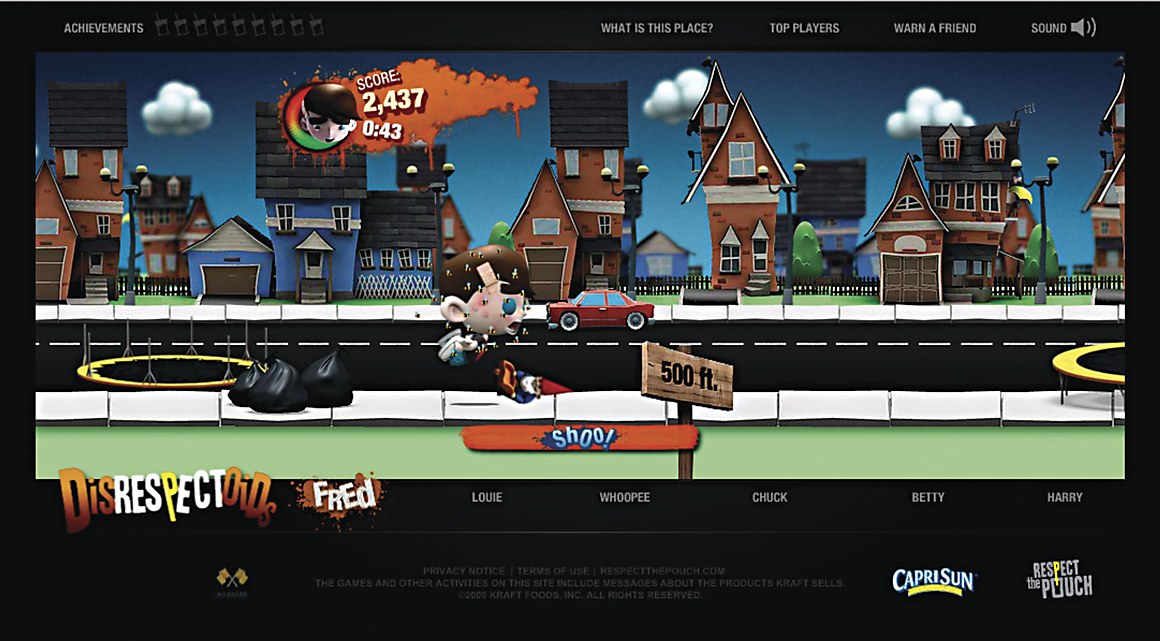
Result: According to Communication Arts, the site drew over 2.5 million unique visitors and more than 11 million game plays since launch. The campaign's award entry cites Nielsen data showing Capri-Sun's market share grew by 2 points and that the brand held over half of the kids' beverage category.
GT RIDE — Kia (2013)
Agency: Artificial Rome, LA RED · Platform: App
Players wave a phone or tablet through the air for about ten seconds, and the motion becomes a 3D race track with rises, drops and tunnels. Then they race it in a pro_cee'd GT, Kia's first high-performance model, steering by tilting the device. Each track saves and posts to Facebook as a challenge for friends to beat. The game ran on iOS, Android, its own website and Facebook, and is no longer online.
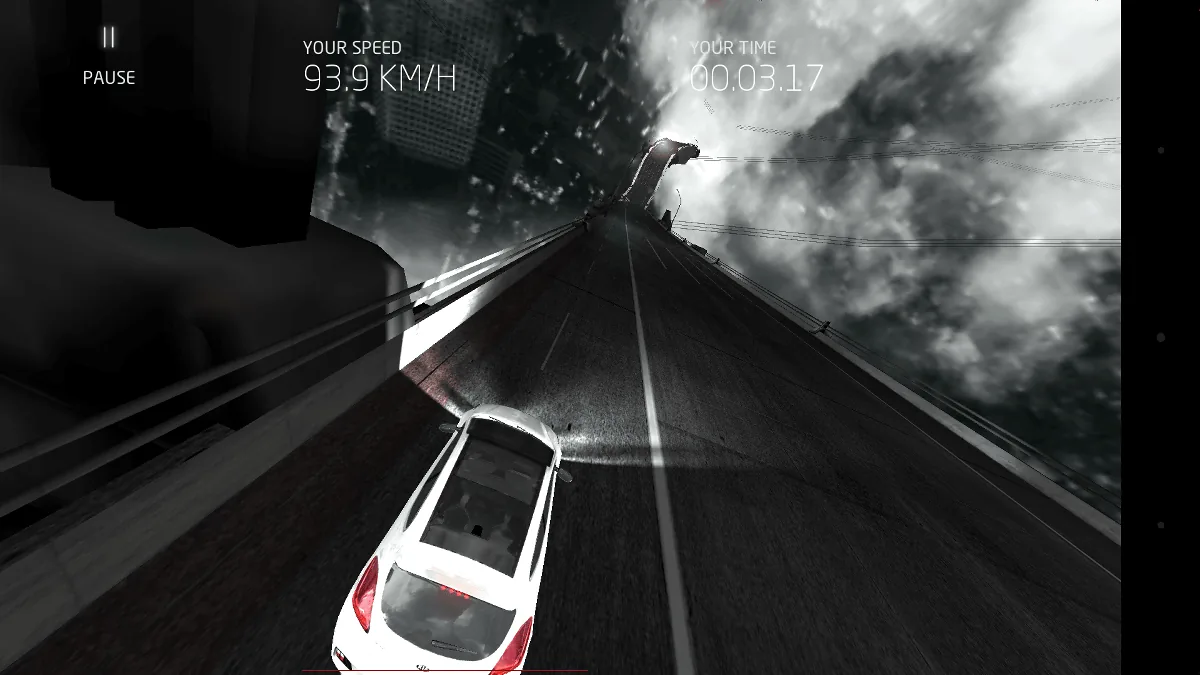
Result: According to LA RED, the app was downloaded more than 200,000 times worldwide, players created more than 80,000 tracks and raced them around 300,000 times, and a Facebook community of more than 30,000 users formed around the game.
The Co-Worker — IKEA (2024)
Agency: Mother, The Gang · Platform: In-game (Roblox)
Players walk into a full IKEA store rebuilt on Roblox, with the showroom, the Swedish Food Market and the Bistro. They clock in to a department and play mini-games based on real co-worker jobs, such as serving food, guiding shoppers and designing room sets, levelling up and earning promotions. Moving to another department keeps the progress. Alongside the game, IKEA offered 10 paid virtual co-worker roles at £13.15 an hour.
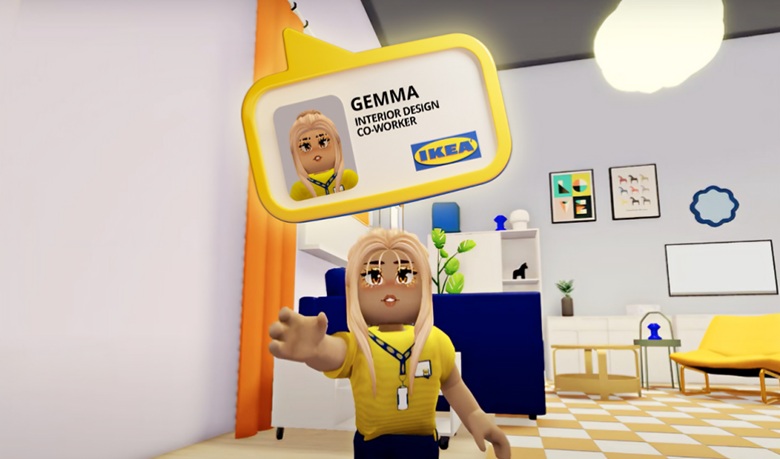
Result: IKEA says the paid roles drew over 178,000 applications in a two-week window. According to The Gang, 6.7 million visitors explored the store, real-world job applications to IKEA UK stores rose 50%, and traffic to the careers site grew more than fourfold.
FAQ
Is a branded game the same as an advergame?
In practice, yes. The UK regulator's advice describes advergames as games "used to advertise a product, brand or an organisation", and the IAB definition quoted on Wikipedia stresses a game designed around the product. Advergame is the older word, still used by regulators and researchers; branded game is the plainer modern name, and we use the two for the same thing. Playable marketing is the whole discipline.
Do branded games work?
On attitude, yes; on detailed recall, less so. A 2021 meta-analysis in the Journal of Advertising found that people view advergames more favourably than other ad formats and that the games can drive choice, but players remember less of the product information. Set goals the game can move, such as time spent, sign-ups or redemptions, and measure them.
How is a branded game different from gamification?
A branded game is a game in its own right. Gamification adds game elements such as points, badges and leaderboards to something that is not a game, like a loyalty app or a fitness tracker. Gamification fits an existing habit; a branded game asks people to choose to play.