

A motion-controlled game is played by moving: a camera, a floor sensor or the motion sensors in a controller or phone read the player's body, gestures or swings instead of buttons. For brands it turns a stand, shop or fan zone into a short performance that others stop to watch.
How it works
Wikipedia defines a motion controller as an input device that tracks motion with accelerometers, gyroscopes, cameras or other sensors. Brand games use three kinds. Camera games read the whole body: Microsoft's Kinect, launched for the Xbox 360 in November 2010, tracked 20 joints per player with a depth sensor (Wikipedia). Today software such as Google's MediaPipe Pose Landmarker finds 33 body landmarks in live video, including in a web page. Handheld games read a wand, a Joy-Con or the phone itself, which carries the same sensors. Floor games read a board, a pad or a treadmill underfoot.
For the player it feels like this: step onto a marked spot, see a character copy you, then swing, jump or lean to score. The round ends with a leaderboard place, a prize ticket or a clip to share.
Where brands use it
In our library 37 games carry the motion-tracking tag, many of them installations. Sports sponsors make the body the controller. At the 2017 US Open, American Express's Air Tennis had fans rally against an AI opponent with no racket, a motion sensor reading each player's shape and build (Adweek). At the NBA's 2024 All-Star fan festival, AT&T's Dribble Town & Splashville tracked a real ball and the player's body with depth cameras. Shops use it for footfall: in Singtel stores, SpongeBob BubblePop gave players 60 seconds to pop bubbles with their bodies, and reaching the target score printed a ticket for a collectible (Make Studios). Tech and telecoms brands are frequent users. Nike went underfoot: a treadmill drove Reactland in its stores.
When it fits
Use it when the product or sponsorship is about the body: sport, fitness, a running shoe, or a device whose sensors are the point. It suits fan zones, stands and shops where a crowd gathers, because the player's performance is the advertisement. Keep moves simple enough to try cold and rounds short. It works for families: Sport New Zealand's games below drew queues of children. Give players something to keep; AT&T texted each a highlight video. In a permanent venue it can run unstaffed, as Royal Caribbean's brief required. For stands, see our guide to trade show booth games; for the wider idea of the physical driving the digital, see phygital.
When not to use it
Skip it when the brief is reach. Stations serve one player or a handful at once; Air Tennis took up to eight. For thousands, a playable ad or web game played on their own phones does better; on a stand with no room to move, look at a touchscreen game. Avoid hardware you cannot replace: Microsoft stopped making Kinect for Xbox One in 2017 (Wikipedia). Not everyone can jump or swing: the accessibility standard WCAG 2.5.4 asks that anything worked by moving a device or gesturing at a camera also works through ordinary controls, unless the motion is essential. Some phone browsers must ask permission, after a tap, before a page reads the motion sensors (MDN). Camera games film passers-by, so plan for consent.
Examples from the library
Sasu's Mystical Quest — Royal Caribbean (2019)
Agency: Demodern – Creative Technologies · Platform: Installation on the cruise ship Spectrum of the Seas
In a gaming zone on board, guests stepped onto an LED balance board facing a tall screen. Shifting their weight steered Sasu, a character in a neoprene suit, through underwater worlds; jumping made Sasu leap obstacles, and shaking the board freed Sasu from a kraken's tentacles. Scores went to a leaderboard next to the zone. Guests who could not stand on the board played an accessible version with large controls.
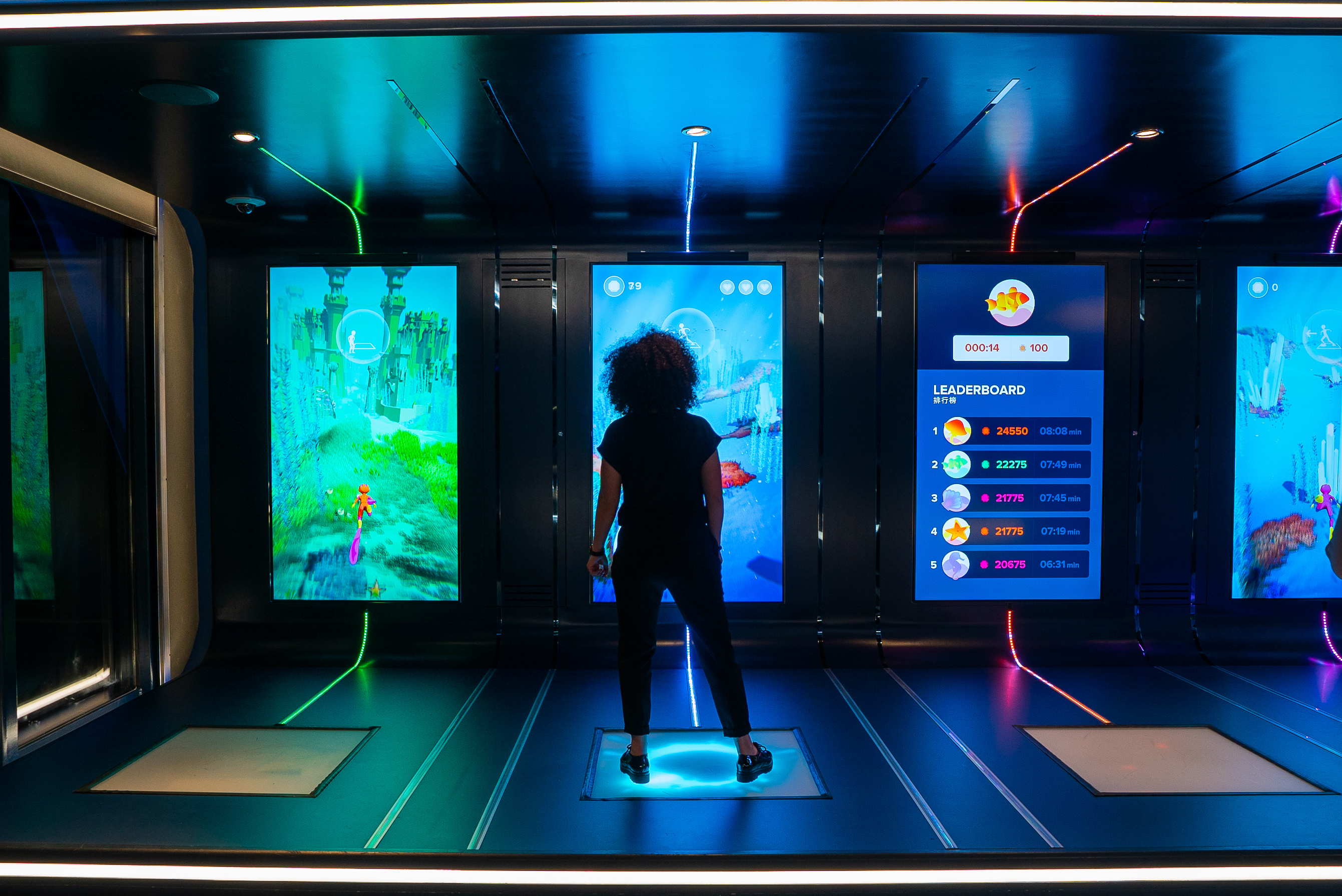
Result: By the time the game was handed over to Royal Caribbean, 548 hours of play had been recorded and 16 versions of the character tested, according to Demodern.
8-bit Tokyo Olympics — Sport New Zealand (2021)
Agency: Saatchi & Saatchi; production by Method Studios · Platform: Installation in an Auckland fan zone
With travel restrictions keeping New Zealand fans out of Tokyo, Sport New Zealand's area of an Auckland fan zone had four big screens, where players picked surfing, baseball, karate or hurdles. There was nothing to hold: a camera read the player's body, so paddling, swinging a bat, throwing or sprinting on the spot moved an 8-bit character in real time. The moves were simple enough to join without instructions, and a photo spot by the screens fed the event hashtag.

Result: 25,000 people passed through the fan zone over the 16 days of the Games, among them 5,000 students bused in from Auckland-region schools to try karate and baseball on the simulators, according to the Asia New Zealand Foundation; that is fan-zone attendance, not plays of the game. Method, which built the games with Saatchi & Saatchi, says they drew queues of children.
Play Through — Dell (2016)
Agency: Y&R · Platform: App for iPhone and Android
Launching Dell's sponsorship of the Match Play golf tournament, the app made downtown Austin a nine-hole street-view course with holes such as "Keep Hole 5 Weird" (Adweek). For each shot the player picked a club and angle, checked the wind, then swung the phone like a club or swiped. As the ball flew, cards on real bars and sights popped up with Foursquare ratings, and a GPS mode let anyone in the US tee off where they stood.
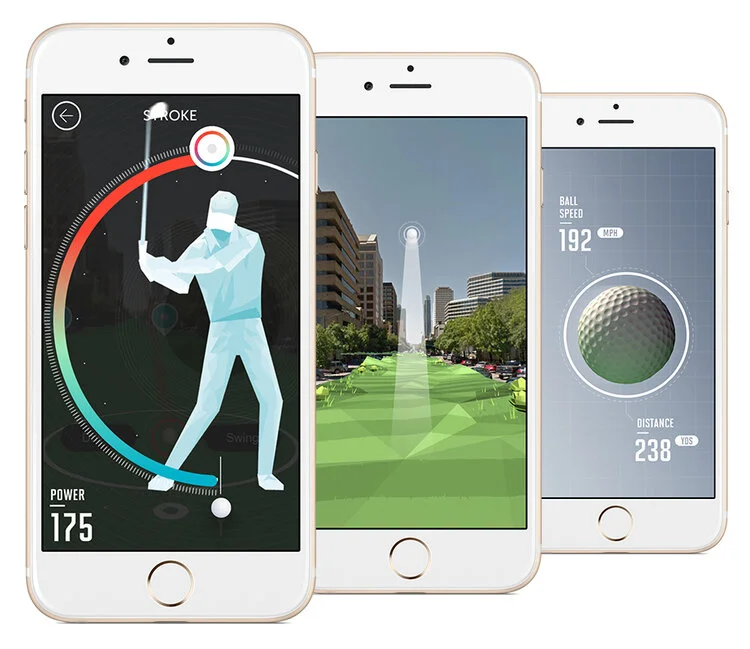
Result: The launch drove over 2 million video views and 114,559 tee shots, according to the project page of Mike Spiegel, freelance creative director and writer on the campaign.
FAQ
Is a motion-controlled game the same as a VR game?
No, though they can overlap. A VR game puts the player inside a headset. A motion-controlled game can run on an ordinary screen, a billboard or a phone: the camera, the floor or the device reads the movement. At events that matters, because the crowd sees what the player sees.
Do you still need a Kinect to build one?
No. Microsoft ended production of Kinect for Xbox One in 2017 and discontinued its successor, the Azure Kinect developer kit, in 2023, according to Wikipedia. Recent installations in our library use depth cameras, as AT&T's did in 2024, or a camera, as Sport New Zealand's did. Pose-tracking software such as MediaPipe has versions for Android, iOS, Python and the web.
Can a motion-controlled game run on a phone?
Yes. Phones carry the accelerometers and gyroscopes that motion controllers use, so the phone itself becomes the controller: Dell's golfers swung it like a club, and Vodafone's Party Starter scored festival fans dancing with it in hand. In a web game, plan for the browser's permission prompt and offer a tap or swipe alternative.