

An interactive billboard is an outdoor advertisement that reacts to the people in front of it: to a touch, a voice, a movement, a gaze or a phone pointed at it. For brands it turns a poster site into a short public game, sometimes with the prize handed over on the spot.
How it works
A passer-by sees a poster that asks for something: say a word, hold a stare, scan. The billboard answers. In one kind of build the board senses the player itself through a camera, microphone, touch surface or sensor; Wikipedia even notes printed posters with conductive ink that play sounds when touched. In the other, the player's phone does the work: its camera recognises the poster and lays an AR game over it, or a QR code opens the game in the browser. Rounds are usually short, and some end at the board with a prize: a beer from a tap, a voucher, the phone on display.
Interactive is not the same as dynamic. Much DOOH runs one way: the US billboard company Lamar says its digital billboards rotate ads "every 6 to 8 seconds" and can stream live data, but a passer-by only watches.
Where brands use it
Our billboard and DOOH tag, shared with the DOOH page, covers 44 games. Most come from food and drink, entertainment and tech brands, and most aim at engagement. Food and drink brands use the board for sampling, because the prize can be the product. Tech brands demonstrate a feature in public, as Samsung did (below). Broadcasters play too: ESPN's 2015 Eye Test, a webcam vision test, also ran as a bus shelter where fans called out the shrinking faces of footballers. A screen can also be the doorway rather than the game: Doritos put a QR code for its Minecraft film tie-in on more than 135 digital screens in Dutch cinemas. More posters and screens are in our QR code games guide and the Installations collection.
When it fits
It suits a launch with one product truth that a stranger can test in a single action: a phone that knows when you look away, a name that is hard to say, a new flavour. It works best when the reward is the product, handed over at the board. Choose a site where people walk and wait, such as a station hall or a pedestrian square. Treat it like a guerrilla stunt and plan for two audiences. The few who play need a round they can finish. The many who watch, there or later on film, are the real reach: Samsung's board had 28 challengers and a recap film with 4 million views. Give everyone else a way in, as M&M's did with its packs and Carlsberg with a microsite.
When not to use it
Skip the roadside. Drivers should not play, and in the US, signs along Interstate and federal-aid primary highways fall under State/Federal agreements that restrict "flashing, intermittent, or moving" lights, the Federal Highway Administration explains. Skip it when the brief is volume, or when you can only buy rotating slots in a screen network: our DOOH page sets out both limits, and a QR code game lets thousands play on their own phones. Be wary of building on someone else's app: M&M's ARcade lived inside Blippar, which shut its servers in 2018. A street board cannot check who is playing, so for alcohol and other age-restricted products, check the rules with counsel.
Examples from the library
All Eyes On The S4 — Samsung (2013)
Agency: HEIMAT, Perfect Fools, Who's Mcqueen Picture GmbH · Platform: Billboard at Zurich's main station, then on tour in Switzerland
To launch the Galaxy S4 in Switzerland, Swisscom set a phone into a billboard at Zurich's main station and dared passers-by to look at it for an hour. Its Smart Pause sensor was the referee: look away and the game was over. The crew staged distractions, from a burning hot-dog stand to stunt riders, while friends sent Twitter or Instagram messages to the screen. Lasting the hour won the phone; quitting earned a voucher that grew with the time held.
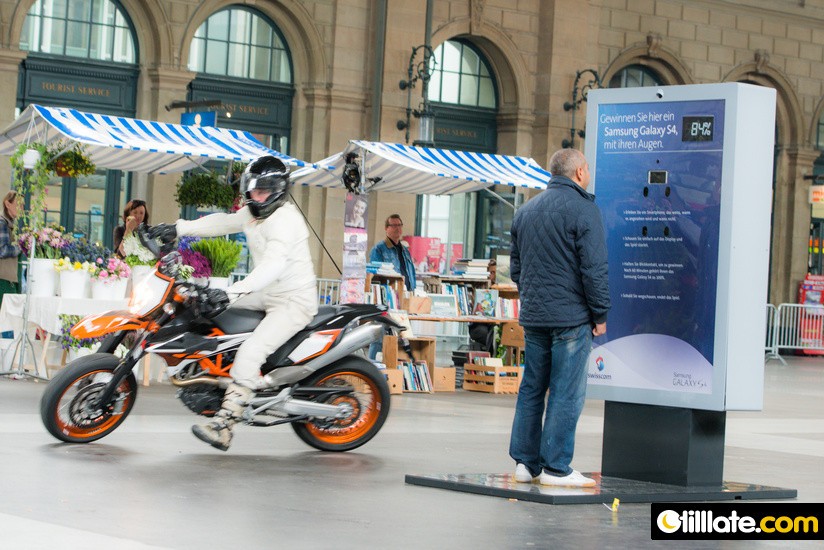
Result: According to the agency's release in Horizont, 28 people took on the challenge and five held out the full hour. Netzwoche put the recap film at 4 million views, and Rackfish's case page counts about 1.5 million live-stream views and more than 12 million ad impressions in Switzerland. The work won a Merit at the 2014 One Show.
ARcade — M&M's (2017)
Agency: Weber Shandwick, Blippar (production) · Platform: Times Square billboards, scanned with the Blippar app
To launch M&M's Caramel, the brand made its Times Square billboards the way into a game. Passers-by downloaded the free Blippar app and pointed their phone at a board, and a retro arcade cabinet appeared on screen with three games: Caramel Cannon, Caramel Crawl and Square Smash. Anyone who could not get to Times Square could open the same games by scanning a bag of M&M's Caramel, as Marketing Dive reported.
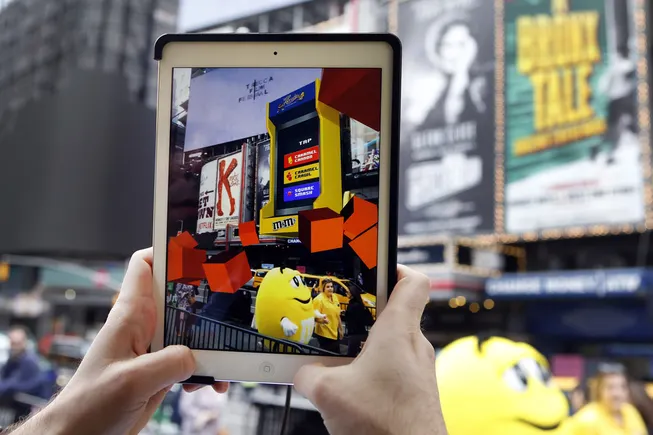
Result: More than 26,000 people came by Times Square on 11 May to interact with the experience, and the programme generated over 392 million traditional media and social impressions, according to the Shorty Awards entry from Weber Shandwick and M&M's.
Say "Carlsberg" Win Beer — Carlsberg (2022)
Agency: Happiness Saigon, BLISS Maker Studios (voice AI) · Platform: Billboard in Ho Chi Minh City, plus a voice microsite
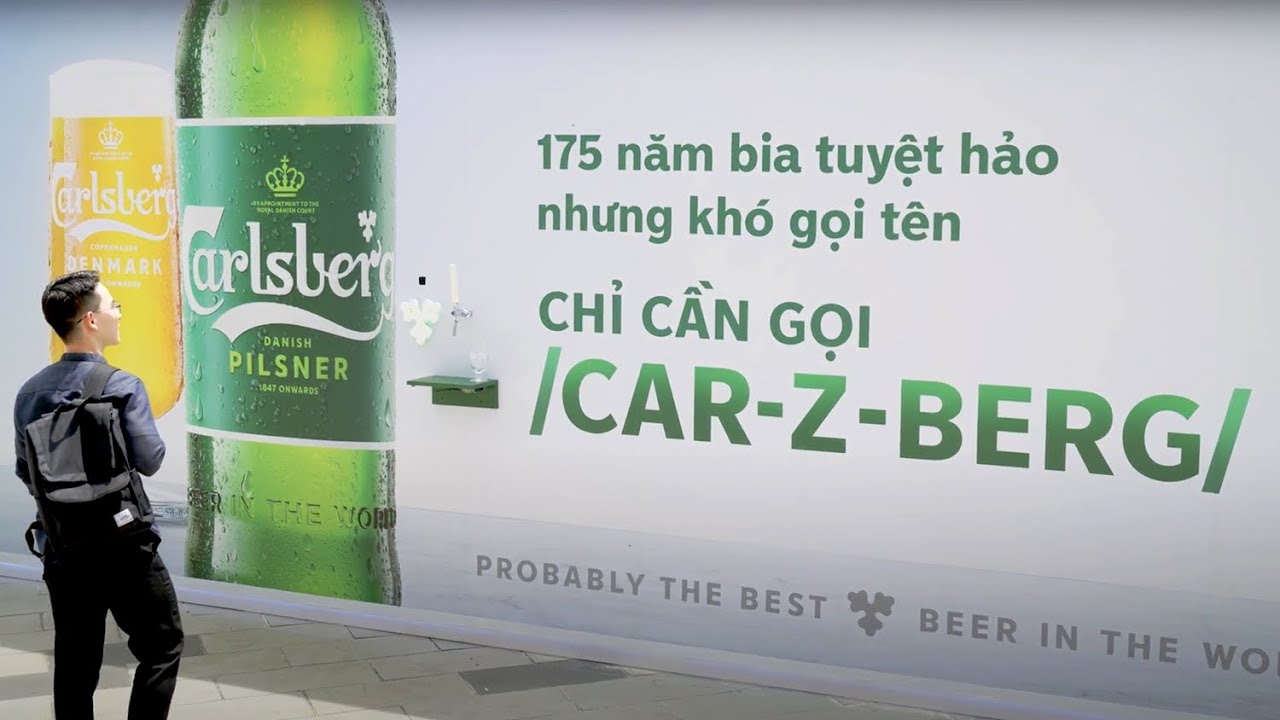
Carlsberg's name is hard for Vietnamese speakers to say, so the brand made saying it the game. A billboard in Ho Chi Minh City spelled it /CAR-Z-BERG/ beside a voice-activated tap: say it right and the tap poured a beer. A custom voice model, trained on hundreds of people saying the name, judged each attempt, Campaign Brief Asia reported. The brand also ran a microsite where anyone in Vietnam could speak into their phone to win a free beer.
FAQ
What is an example of an interactive billboard?
Carlsberg's 2022 board in Ho Chi Minh City: say the brand's name correctly and a tap set into the poster poured you a beer. Other boards in our library dared passers-by to stare at a phone for an hour (Samsung, Zurich) or to scan a Times Square billboard to open an arcade game (M&M's).
What are you not allowed to put on a billboard?
Rules vary by country, so check with counsel. In the UK the ASA notes that what is acceptable in a magazine with a relevant audience might not be on an untargeted poster, which children can see. CAP Code rule 18.15 bars alcohol ads from media where over 25% of the audience is under 18. In the US, major-highway signs fall under state controls required by the Highway Beautification Act.
Is an interactive billboard the same as DOOH?
They overlap. DOOH means advertising on digital screens in public places, and it is often one-way: a loop of spots. Some interactive billboards are DOOH screens with a camera or sensor added, but a printed poster that opens an AR game or a QR code, or a custom board with a tap, can be interactive without being digital out-of-home.