

A second screen is the phone, tablet or laptop people use while they watch TV. For brands, a second-screen game runs on that device in step with a live broadcast, often during the ad breaks, so the moment viewers look away from the television becomes time spent with the brand.
How it works
A report for Ofcom, the UK communications regulator, defines second screens as "a class of connected devices or applications that are designed to be complementary to TV watching or radio listening", as informitv reported. A 2010 BBC R&D definition, quoted by Econsultancy, adds that the content is "contextual and synchronised" with the main screen. The phrase also means an extra computer monitor (Wikipedia); this page is about the TV sense.
For the player, the TV gives the cue: a QR code in the ad, a push notification as a spot airs, a match nearing its decisive moment. The phone opens a web page or an app, and a round lasts as long as that moment: an ad break, a corner of a Grand Prix lap or a whole match. The player answers trivia, predicts, races or stares, scores points, climbs a leaderboard and usually earns prize-draw entries.
Where brands use it
Many cases sit around live sport, where a big audience watches at the same time. Brands in automotive, food and drink and finance use the Super Bowl ad breaks; Ally Bank's The Big Save, one of our banking and fintech games, had viewers scoop augmented-reality dollar bills from their living-room floor during commercials. Sponsors use it to make their rights do more: Heineken asked Champions League fans to call each match moment before it happened, Skoda ran Tour du Sofa alongside the Tour de France on Dutch TV, and McDonald's opened app coupons for the seconds an F1 leader spent in its Golden Zone. The library tags 37 games as TV second-screen work, most with an engagement objective.
When it fits
It fits a brief tied to one live broadcast that millions watch at once: a final, a Grand Prix, a talent-show night. The audience is already holding the phone. In a Nielsen survey of its Media Enthusiast Community, published in December 2018, 45% of respondents said they watched TV while using digital devices "very often" or "always". The format suits brands that cannot outspend rivals on airtime: Volkswagen bought only the first ad in each break and kept viewers for the whole break, and Twix bought none. Size each round to the window, about three minutes for an ad break, and run it in the mobile browser from a QR code so nobody installs anything. Choose an app when you want registered users to keep, as Chevrolet did.
When not to use it
Skip it when there is no shared live moment. Viewers who stream on demand watch at different times, so a synchronised round has no crowd; a playable ad or a QR code game on the pack works on any schedule. Expect low uptake for an app tied to a show: the Ofcom report put the X Factor app at 547,500 downloads, about 5% of the programme's audience. Don't compete with the programme itself. Econsultancy's Ben Davis doubted viewers want extra content while the show is on; many of the strongest cases in our library play only in the breaks. Plan for spikes: Chevrolet's app handled more than 1,500 answers per second during questions. Prize draws come with legal rules that differ by market; see sweepstakes.
Examples from the library
Game Time — Chevrolet (2012)
Agency: Goodby, Silverstein & Partners · Platform: iOS and Android app, timed to the Super Bowl XLVI broadcast
Each player registered and got a personal licence plate number. During the game the app sent a push notification just before each Chevy commercial, then a trivia question about that spot, alongside polls about the teams. Correct answers entered prize draws, with 20 Chevrolets among the prizes. The hook: if your plate appeared on a car in a Chevy ad, that car was yours.
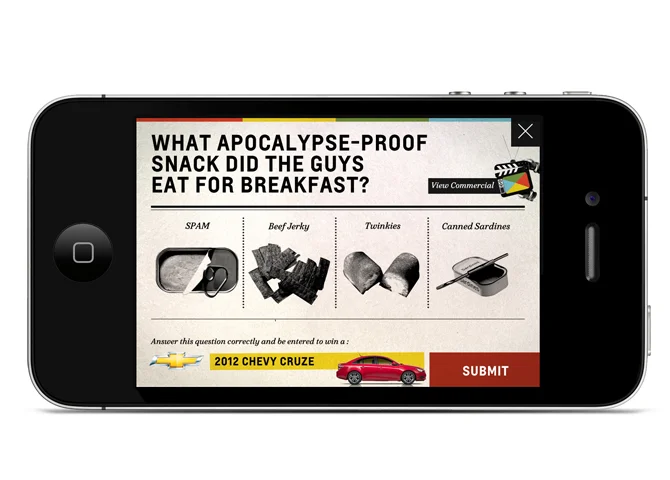
Result: Over 703,000 registrations, 25 million trivia questions answered and nearly 1.6 million hours spent in the app, according to the agency's release on its Gold Lion in the first Mobile category at Cannes in 2012. More than 130,000 people played at the same time, mobiForge reported.
Golf Ad Break Championship — Volkswagen (2021)
Agency: DDB, Art of Play, PHD · Platform: Mobile browser, opened from a QR code in a TV ad in Australia
Volkswagen took the first ad in the break and put a QR code on screen. Scanning it opened a racing game in the phone's browser, no app needed. Three practice tracks stayed open at any time, but the prize circuit ran only while the break lasted, about three minutes, against everyone else watching. Beating the qualifying time entered the player in a draw for a new Golf GTI.
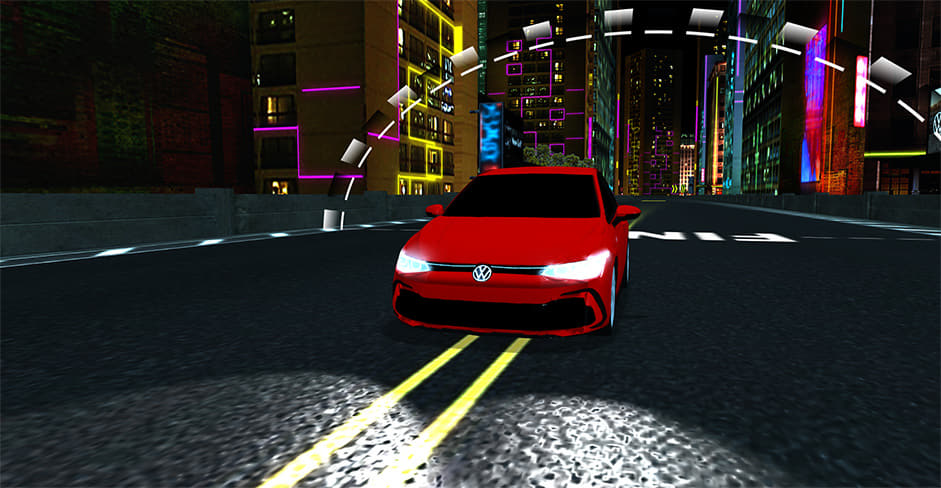
Result: Over 70,000 plays, more than 90,000 visits to the campaign page and over 5,000 hours of active game time. Dealer callbacks rose 436%, stock enquiries 97% and test drives 725%, and Golf sales went up 55% in the active campaign period, according to DDB Sydney's Spikes Asia entry.
Second Screen Staredown — Twix (2025)
Agency: adam&eveDDB, UNIT9 · Platform: Mobile browser, during the Super Bowl LIX ad breaks
Twix bought no Super Bowl airtime. Fans opened the Twix site on their phones and faced two gold bars with human eyes. From the first ad break after kick-off, the camera tracked the player's gaze: the longer they held the stare, the more entries they earned in a draw for two solid gold bars worth about $170,000. The bars heckled players with recorded lines, and a warm-up opened six days before the game.
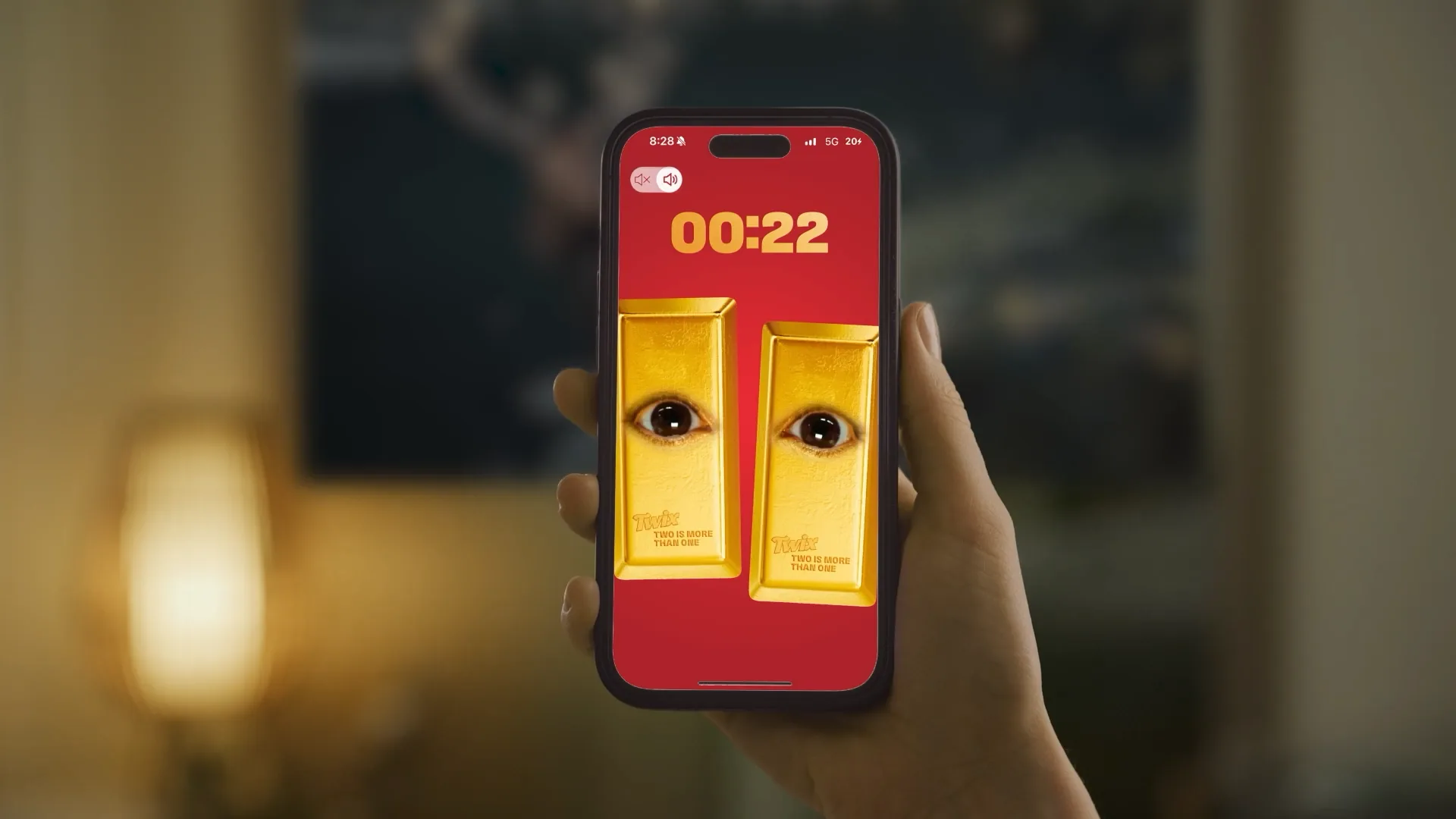
Result: 760,000 entries on game day and more than one billion global impressions, according to the D&AD entry. Fans stared for 25 minutes 31 seconds on average, and the activation generated the equivalent of $329 million in paid media, according to UNIT9.
FAQ
What does second screen mean?
It has two meanings. In computing, it can mean an extra monitor connected to the same computer. In media and marketing, it is a phone, tablet or laptop used while watching TV. In Nielsen's 2018 survey, 71% of respondents had looked up information related to the TV content they were viewing.
What is a second screen experience?
Content made for that device and timed to what is on the main screen: live polls, statistics, trivia, predictions or a game. The BBC R&D definition calls it "contextual and synchronised" with the broadcast. The strongest brand versions give viewers something to do in the ad break and a reason to come back for the next one.
How does a second-screen game know what is on TV?
In the cases above, the brand's team times it to the broadcast. Chevrolet's app sent a notification just before each Chevy spot. Volkswagen's studio, Art of Play, built a system to turn the prize race on and off from an online control panel, it explains on Awwwards. Twix started play at the first break after kick-off.