

Guerrilla marketing is promotion that wins attention through surprise rather than media spend: a stunt in a station, a raid on a rival's ads, or a ride on a big event the brand does not sponsor. Games suit it, because people stop for a challenge they would walk past as an ad.
How it works
Wikipedia defines guerrilla marketing as a strategy in which a company uses "surprise and/or unconventional interactions" to promote a product or service. Jay Conrad Levinson's 1984 book Guerrilla Marketing popularised the term: firms invest energy, time and creativity instead of money. The article groups street, ambient, ambush, viral and stealth marketing under it.
For the player, a guerrilla game turns up where nobody expects a game. A billboard in a station dares you to stare at it for an hour. An app asks you to point your camera at a competitor's poster and set it on fire. A phone game runs only during the ad breaks of a broadcast the brand bought no airtime in. The stunt runs for a limited time; films, press and shares carry it further as earned media.
Where brands use it
Ambush stunts around big sporting moments recur. TELUS, not an official FIFA sponsor, put a urinal-controlled football game into Toronto sports bars during the 2014 World Cup. Twix ran a staring contest through the Super Bowl LIX ad breaks without buying airtime. Street placement is the other strand: the game hides on real walls, windows and objects in public, as in Decode Jay-Z below. The library holds 44 games built around billboards and public screens; browse Awareness, Product launch, the Installations collection or our playable marketing examples.
When it fits
Guerrilla suits a challenger with less money than the market leader. Burger King Brazil faced a rival spending four times more on advertising, Valens Research reported, so it turned the rival's ads into its own media. It suits a launch that needs talk more than frequency, and a feature you can prove in public: Samsung's Smart Pause, which senses when someone looks at the screen, made a staring contest an honest demo. Plan the film and the live stream before the stunt, because few people are there on the day. Tie the reward to the business, such as a coupon dropped into the app's cart.
When not to use it
Skip it when the brief needs steady frequency, precise targeting or data at scale; a stunt is a burst. It also carries real risk: Wikipedia calls it "a high risk, high reward strategy" for big companies. In 2007 Boston police mistook LED placards promoting Aqua Teen Hunger Force for bombs and closed part of Interstate 93; Turner Broadcasting and its agency agreed to pay $2 million (Wikipedia). Anything placed in public space needs permission; check with counsel before a game touches a rival's ads or an event's name. For the same surprise on a site you have booked, run an interactive billboard or an experiential stand; for reach on a schedule, a playable ad.
Examples from the library
Decode Jay-Z — Jay-Z (2010)
Agency: Droga5, Vertigo · Platform: Website on Bing Maps, with pages placed in 15 cities
Random House was launching Jay-Z's memoir Decoded, and Bing wanted people using its search and maps. Each day the site posted fresh clues as five to ten new pages went live, printed on real surfaces: a pool bottom in Miami, a jacket lining in a Gucci window. Players tracked each page down on Bing Maps with a hot-cold meter, or found it in person and texted its code. Every find was a chance to win that page signed by Jay-Z.
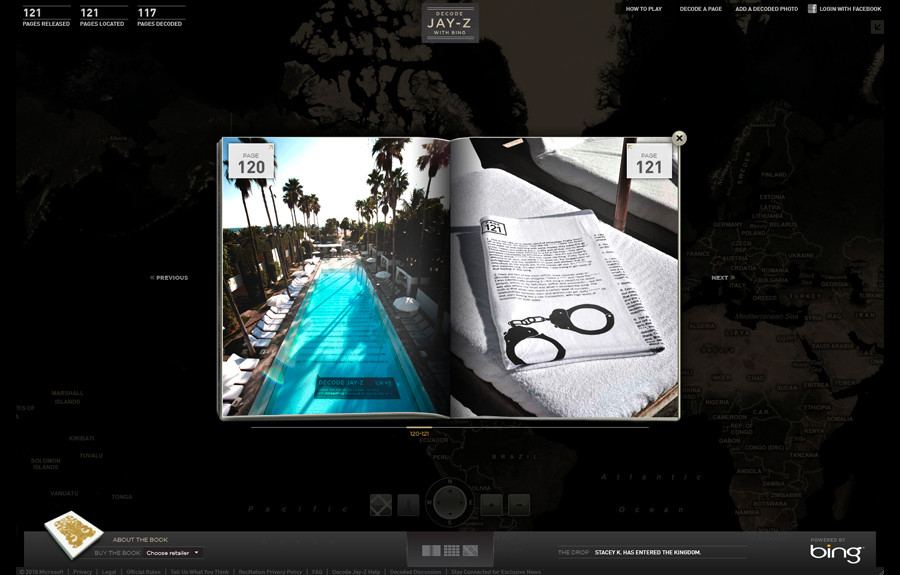
Result: Bing.com traffic rose 11.7% over the campaign month, and Decoded debuted at No. 3 on the New York Times bestseller list and stayed on it for more than 19 weeks, according to a case write-up. Our case record also gives an average of 11 minutes per site visit.
All Eyes On The S4 — Samsung (2013)
Agency: HEIMAT, Perfect Fools, Who's Mcqueen Picture GmbH · Platform: Billboard installation in Zurich main station
Swisscom and Samsung built a real Galaxy S4 into a billboard in Zurich's main station and dared passers-by to look at it for an hour. The phone's Smart Pause sensor judged each run: look away and the game ended. The crew staged distractions, from a burning hot-dog stand to stunt riders, while viewers at home sent tweets onto the screen. Last 60 minutes and the phone was yours; quit early for a discount voucher.
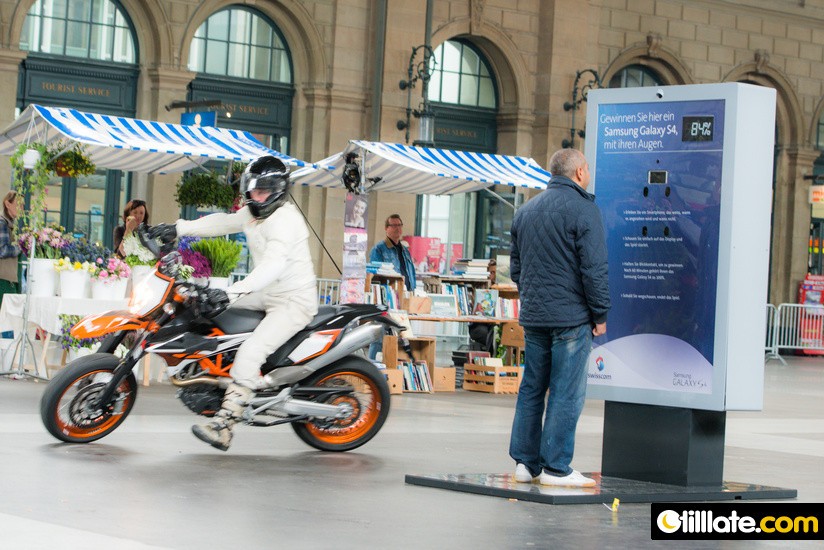
Result: 28 people took the challenge and five lasted the full hour, according to the agency's release reported by Horizont. The recap film reached 4 million views (Netzwoche) and the live stream about 1.5 million (Rackfish). The brief, says the One Show entry, was to create a buzz and reach the masses through earned media.
Burn That Ad — Burger King (2019)
Agency: DAVID São Paulo · Platform: Augmented-reality feature in the Burger King app, Brazil
A banner in Burger King's Brazilian app opened the phone's camera. Players pointed it at any competitor's ad, from a billboard or tray liner to a social post, and the app set it alight on screen and burned it away to reveal a Burger King ad. Each burned ad earned a coupon for a free Whopper, dropped straight into the BK Express order-ahead cart. Each player could redeem the offer once.
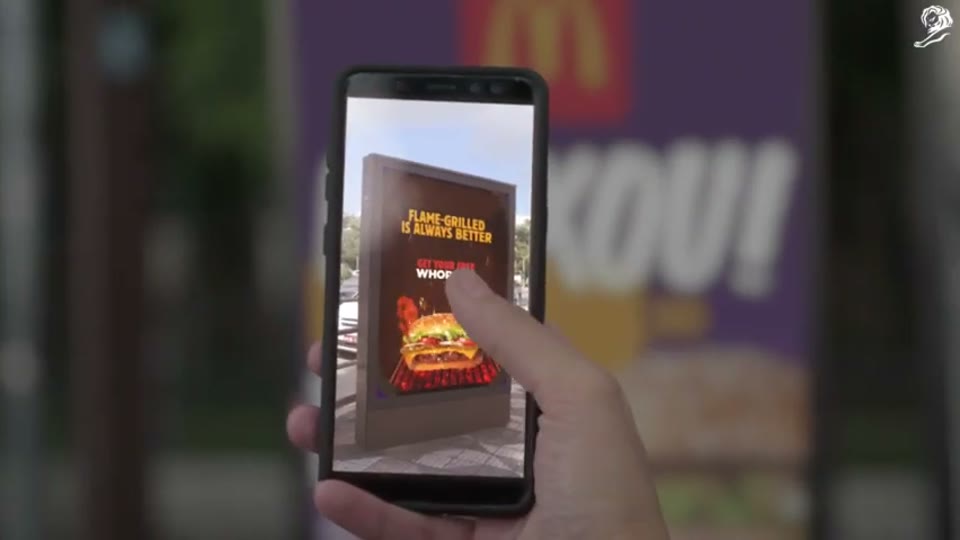
Result: Players burned over 400,000 rival ads, in-app sales rose 55% during the campaign and about 1.5 million free Whoppers were given away, Valens Research reported.
FAQ
Is it guerrilla, guerilla or gorilla marketing?
Guerrilla. The word is Spanish, a diminutive of guerra, "war", coined during the Peninsular War; in English it sounds like gorilla, hence the mix-up. Wiktionary lists guerilla, with one r, as an obsolete alternative form, though it still turns up. The marketing sense borrows the image of a small side outwitting a bigger one.
Is ambush marketing the same as guerrilla marketing?
Ambush marketing is one kind of guerrilla marketing. Wikipedia describes it as linking a brand to an event it has no official tie to, typically where rivals of the official sponsors try to build that association. Ally and Twix both played on Super Bowl ad breaks without buying airtime.
Is guerrilla marketing legal?
It can be. Wikipedia notes that using public space must be authorised to be legal, and some cities forbid guerrilla campaigns outright. Hidden promotion is out in the UK: the CAP Code requires marketing to be "obviously identifiable as such". Events add rules: a UK statute barred traders from suggesting an unauthorised association with the 2012 London Olympics. Rules differ by market; check with counsel.