


An advergame is a video game a brand commissions to promote itself, with the product, mascot or offer built into the play rather than placed beside it. Advergaming dates to early-1980s arcades and consoles, though the word only appeared around 2000. This guide traces it era by era, from Tapper to Roblox, with sourced campaign results.
Our library holds 1,089 campaign games: one from the 1990s, 89 from the 2000s, 529 from the 2010s and 435 from 2020 onwards, plus 35 undated. Nothing older is in it, so for the early years we rely on published histories.
- 1978PoloCarol Shaw’s game for a Polo campaign; the promotion was cancelled and the game never finished.
- 1983–1984Kool-Aid Man and TapperKool-Aid Man reaches the Atari 2600; Tapper’s early machines use real Budweiser tap handles as controllers.
- 1990sMascot games7 Up’s Cool Spot (1993), Pepsiman on PlayStation (1999) and Chex Quest in cereal boxes.
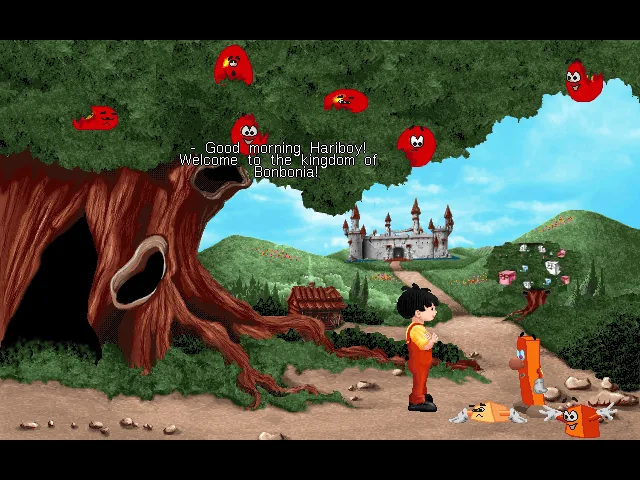
- 1996Hariboy’s Quest on CD-ROMHaribo’s point-and-click adventure, the only 1990s game in our library.
- 2000The word ‘advergame’Word Spy’s earliest citation: a National Post article about Clearnet.
- 2000–2009The Flash years85 of our 89 games from the decade are web games, The Coke Zero Game (2008) among them.
- 2006Console games at the counterBurger King: buy a value meal, add $3.99, take home an Xbox disc.
- 2010–2019Apps and social feeds103 of our 529 games are mobile apps, Oreo’s Twist, Lick, Dunk (2012) among them.
- 2020 onwardsRoblox and Fortnite99 of our 435 games are built inside other games, about half of them on Roblox.
What is an advergame?
The UK's advertising code body, CAP, describes advergames as electronic games used to advertise a product, brand or organisation, and its code covers them on brand websites, as downloadable apps and, in some cases, on brand social channels as well as in paid space (ASA).
What matters is ownership. In an advergame the brand is the publisher; in-game advertising rents space inside someone else's game, as we explain in advergames vs in-game advertising. Our bar is a real mechanic, a business objective and a brand that paid for it.
The word is younger than the practice. Word Spy's earliest citation is a National Post article of 13 March 2000 about the Canadian telecom Clearnet putting "advergames" on its website (Word Spy).
The first advergames: arcades, consoles and cereal boxes (1978–1999)
Herman Tulleken's Game Developer history, built on a list of about 100 advergames, starts with Polo, which Carol Shaw was developing for a 1978 Polo campaign; the promotion was cancelled and the game never finished. It dates the first advergames in actual use to 1983 (Game Developer).
One of them was Tapper, a Bally Midway arcade cabinet whose early machines used real Budweiser tap handles as controllers. Wikipedia gives its arcade release as February 1984 and says a re-themed Root Beer Tapper followed because the original was seen as advertising alcohol to minors (Wikipedia). Mattel's Kool-Aid Man reached the Atari 2600 in September 1983, at first only by mail order (Wikipedia).
The 1990s belonged to mascots. Virgin Games' Cool Spot (1993) starred 7 Up's Spot (Wikipedia), and KID's Pepsiman came out on PlayStation in Japan in March 1999 (Wikipedia). Chex Quest, a shooter built on the Doom engine, went free inside Chex cereal boxes; Game Developer says 42 million copies were distributed (Game Developer), Wikipedia a more cautious "at least 5 million" (Wikipedia).
Hariboy's Quest — Haribo (1996)
Developer: Condor Software · Mechanic: Adventure & Quest · Platform: PC (CD-ROM)
The only 1990s game in our library is a point-and-click adventure from Haribo. You guide Hariboy through Bonbonia, a sweet kingdom of Haribo characters, with the Golden Bear as companion. By combining objects, you try to recover three missing books of the company's formula before a band of pirates does. Adventure Gamers lists it as a 1996 PC promotion (Adventure Gamers). We found no published results.
The Flash years: advergames on the open web (2000–2009)
In the 2000s the advergame moved into the browser: 85 of our 89 games from the decade are web games. In 2009 the One Show gave North Kingdom a Bronze Pencil for The Coke Zero Game in a category called Brand Gaming (The One Club).
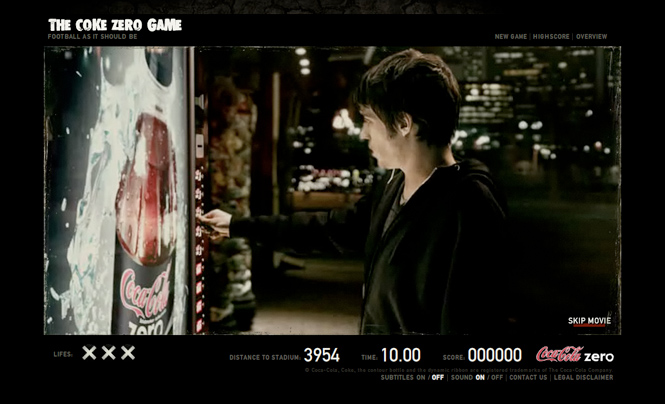
The Coke Zero Game — Coca-Cola (2008)
Agency: North Kingdom · Mechanic: Mini-games · Platform: Web
Built for Coca-Cola Germany around UEFA EURO 2008, it was a live-action film that handed you the controls four times as Tim raced to the stadium before kick-off. You timed a jump, kept a ball up, smashed walls and played giant pinball, and your timing decided which version of the next scene you saw.
Result: 1,400,000 completed games and an average of 9.5 minutes on the site (Design Chapel); the campaign later ran in more than ten markets beyond Germany (Design Chapel).
Console games sold at the counter (2006)
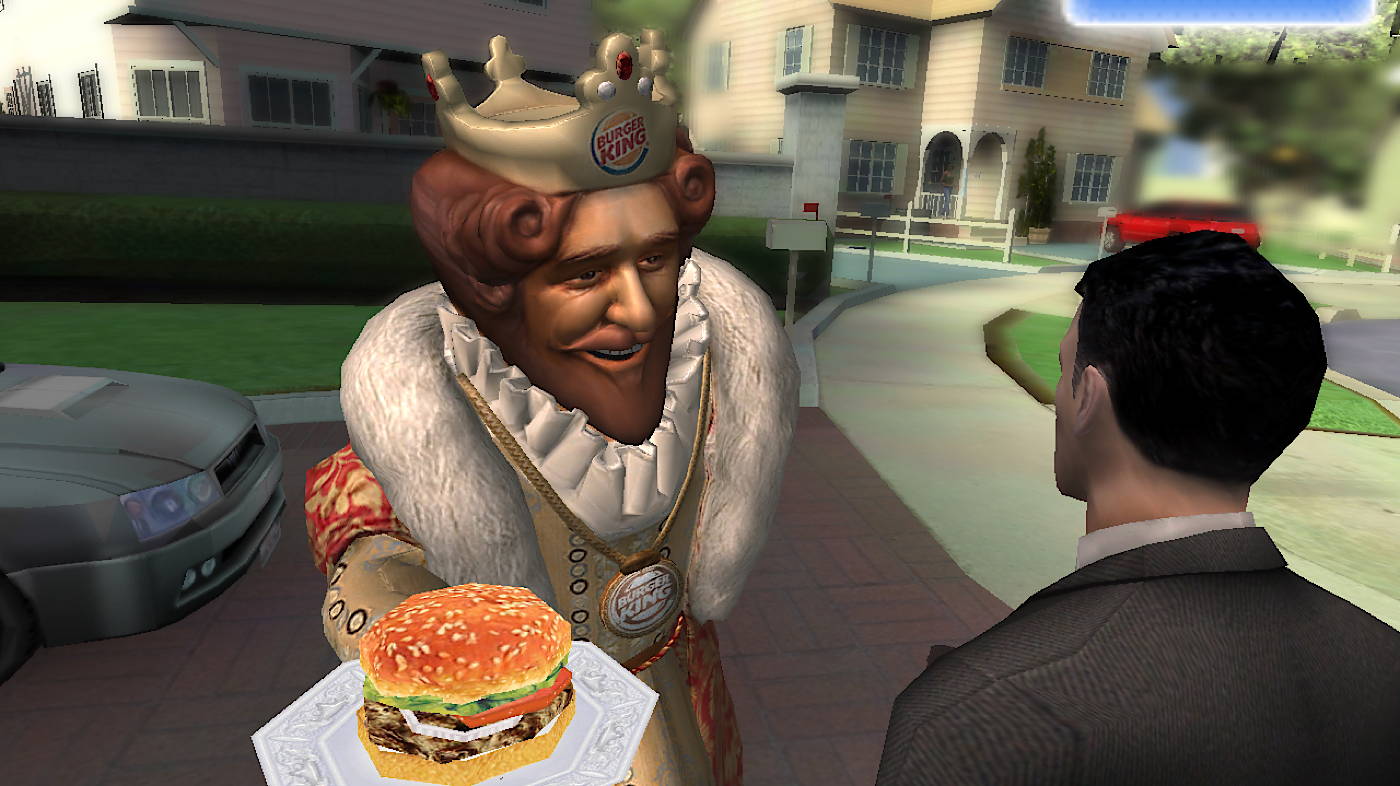
Sneak King / PocketBike Racer / Big Bumpin' — Burger King (2006)
Developer: Blitz Games · Agency: Crispin Porter + Bogusky · Mechanic: Arcade & Action · Platform: Xbox and Xbox 360
Burger King sold three console games over the counter: buy a value meal, add $3.99, take home a disc (Game Developer). The discs went on sale in November 2006 and ran on both Xbox and Xbox 360 (EGM). In Sneak King you play The King, creeping up on strangers to hand them a burger unseen; the others are a miniature-bike race and a bumper-car brawl.
Result: 2.5 million copies in the first five weeks and a place among the top 10 best-selling games of 2006, per Ad Age figures cited by EGM (EGM). Burger King's own results for the quarter to 31 December 2006 counted more than 3.2 million copies sold and credited the games, with the Value Menu, for higher sales and traffic (SEC filing). A 2012 Game Developer blog post, by contrast, called the promotion a failed experiment (Game Developer).
Apps and social feeds (2010–2019)
The 2010s are our largest decade, with 529 games: 316 on the web, 103 mobile apps and 37 on social platforms. In app stores a brand game could carry in-app purchases and ads, and some brands asked it to pay its way.
Twist, Lick, Dunk — Oreo (2012)
Agency: PikPok · Mechanic: Arcade & Action · Platform: App
Launched in late 2012 around Oreo's 100th birthday, the game turned the eating ritual into swipes (PikPok). Cookies flew at you; you twisted them apart, licked the cream and dunked them in milk, collecting rare flavours for boosts and posting scores to a Facebook leaderboard. It is one of the brand birthdays in our company anniversary guide.
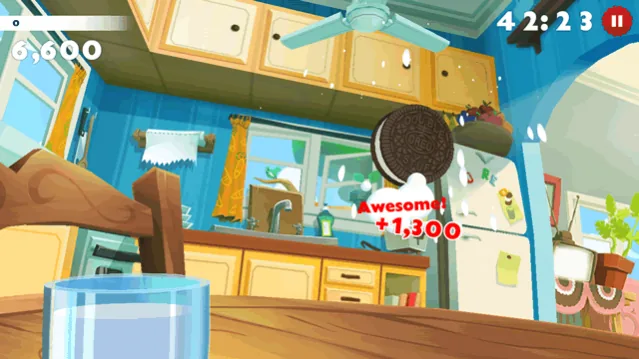
Result: 7 million downloads and 5.1 billion virtual cookies dunked, by Mondelēz's count, as reported by Mobile Marketer in a piece on the company's plans for a "commercially viable" Sour Patch Kids game (Mobile Marketer).
AR and installations: playing with your body (2010s)
The same decade added 39 installations and 28 AR or VR games to our library: play that happens in a shop, at an event or through a camera.
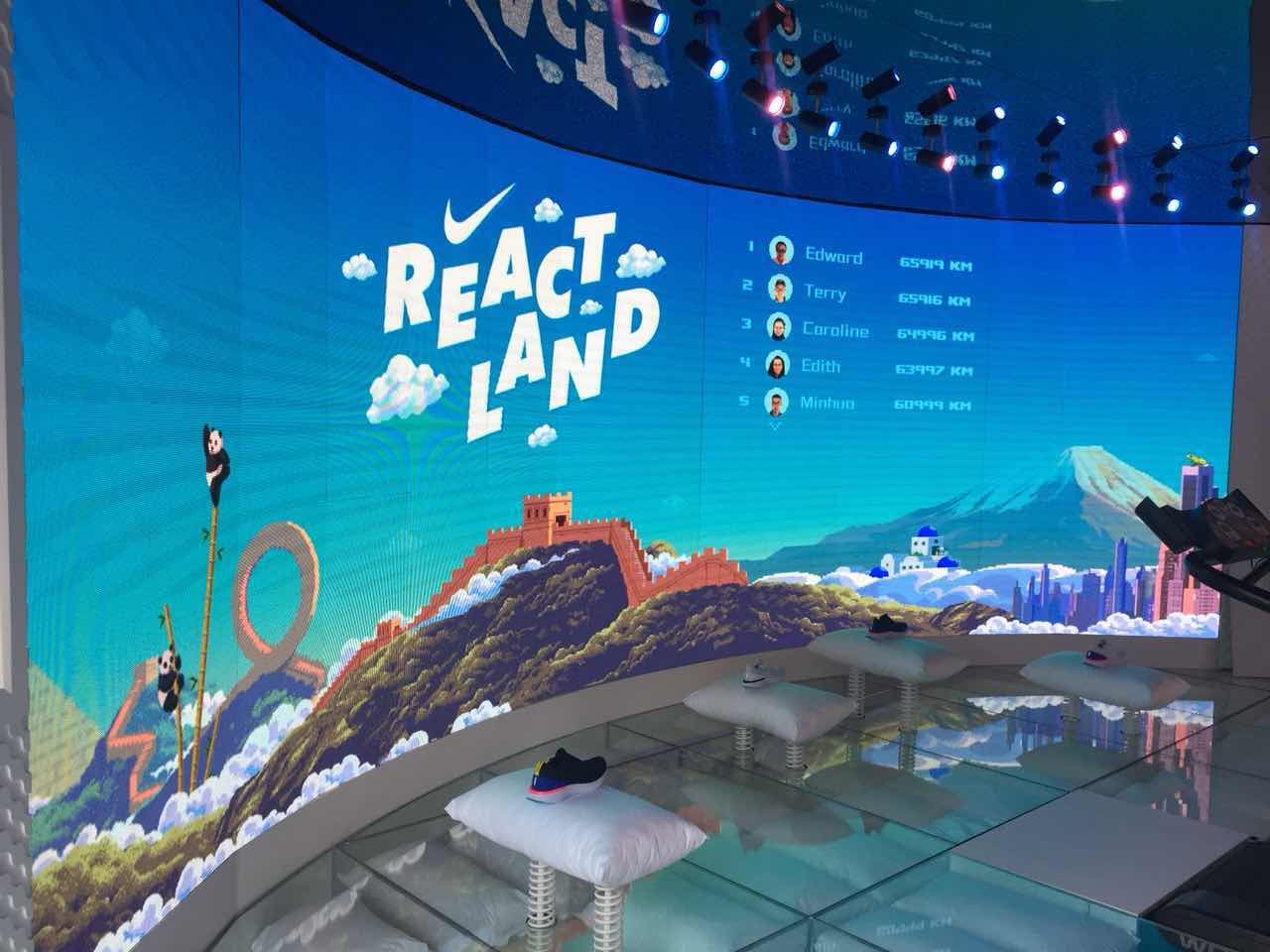
Reactland — Nike (2018)
Agency: Wieden+Kennedy, UNIT9 · Mechanic: Racing & Sports · Platform: Installation
Nike shoppers in China put on Epic React shoes, had their photo turned into an avatar and ran on a treadmill facing a big screen. Running moved the avatar through a world designed to echo the sole's softness and bounce, a hand controller made it jump, and each run ended with a leaderboard place and a 10-second video to share (Wieden+Kennedy).
Result: "48% of players bought the shoes" after playing, according to the agency, over one month in four stores and one pop-up in China (Wieden+Kennedy).
Roblox, Fortnite and the platform era (2020 onwards)
Since 2020 the game often lives inside other games: 99 of our 435 games from 2020 onwards are filed under in-game, against five in the whole of the 2010s. About half of those 99 are on Roblox, the subject of our guide to brands on Roblox, with Fortnite next. For Super Bowl LV in 2021, Verizon put a replica of Raymond James Stadium into Fortnite: 5G Stadium drew more than 40 million visitors, according to Momentum's case study (The Drum).
Burrito Builder — Chipotle (2022)
Developer: not credited in Chipotle's announcement · Mechanic: Simulation & Strategy · Platform: In-game (Roblox)
For National Burrito Day 2022, Chipotle put players behind the counter of its first restaurant, opened in Denver in 1993. You drag the right ingredients onto a tortilla before it reaches the end of the line, then roll it with the arrow keys. Burritos earn Burrito Bucks, and the first 100,000 players to roll one earned enough for a real entrée code (Chipotle). The game is still playable; the code offer has ended.
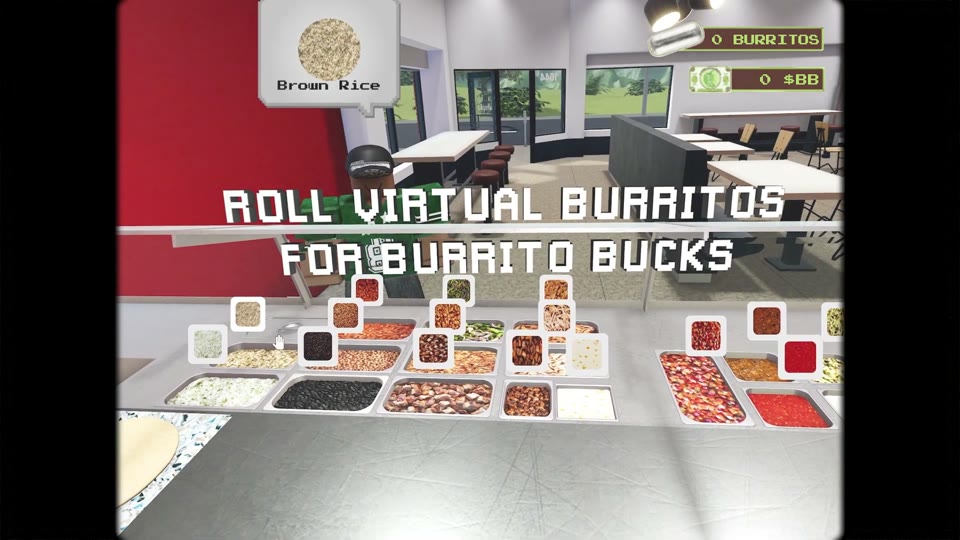
Result: the 100,000 codes were claimed within 30 minutes, with 1.1 million gameplays in under 24 hours (Metakey); the Rolimons tracker logs a launch-day peak of 25,918 players at once (Rolimons).
The Co-Worker — IKEA (2024)
Agency: Mother, The Gang · Mechanic: Simulation & Strategy · Platform: In-game (Roblox)
IKEA UK rebuilt a store on Roblox and made recruitment the game. You pick a department, clock in and play mini-games based on real co-worker tasks, from tidying the showroom to serving in the Swedish Bistro. By the time the game opened on 24 June 2024, IKEA had also picked 10 players for paid roles in the virtual store at £13.15 an hour (IKEA).
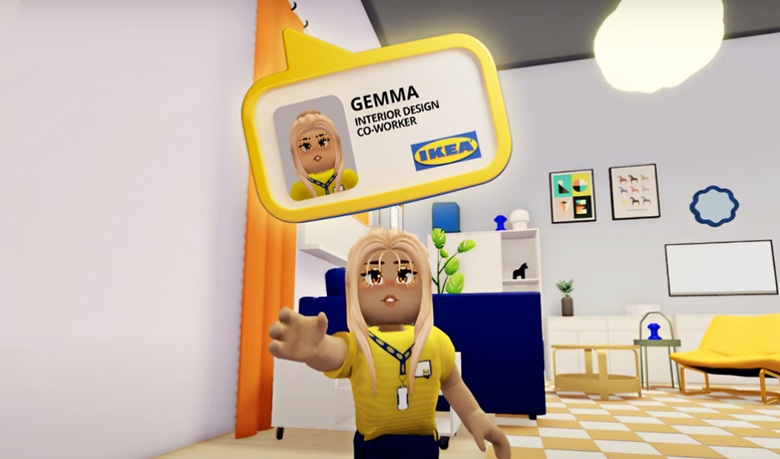
Result: more than 178,000 applications for the paid roles, 6.7 million visitors and a 50% increase in real-world job applications, which the agency calls IKEA's most successful recruitment campaign ever (The Gang).
Advergames by era at a glance
| Era | Main channels | Games in our library | Example | Result |
|---|---|---|---|---|
| 1978–1999 | Arcade, console, PC disc, cereal box | 1 | Chex Quest | At least 5 million copies |
| 2000–2009 | Browser, console disc | 89 (85 web) | Burger King on Xbox | 2.5 million copies in the first five weeks |
| 2010–2019 | Web, apps, social, installations | 529 (103 apps) | Nike Reactland | 48% of players bought the shoes |
| 2020 onwards | Web, Roblox, Fortnite | 435 (99 in-game) | IKEA The Co-Worker | 50% increase in real-world job applications |
Why did the word "advergame" fade?
The browser games that defined the word have mostly gone. Adobe stopped supporting Flash Player on 31 December 2020 and blocked Flash content from 12 January 2021 (Adobe). At our last check, only 2 of our 89 games from the 2000s can still be played.
The word also carries baggage. Tulleken notes that advergames are often clones or reskins of hit games, and cites research that they work especially strongly on children, who may not realise they are being advertised to (Game Developer). The ASA says it has had very few complaints about advergames, and those have tended to concern their potential appeal to children (ASA).
And the game stopped being a separate object: it sits among player-made worlds on Roblox, among every title in an app store, inside a Nike shop. Marketers now say branded games or gamification; we call the category playable marketing.
What the advergames that worked have in common
- The product is the verb. Twist and dunk a cookie, roll a burrito, run in the shoe, work an IKEA shift. Players rehearse the brand instead of looking at it.
- The game ends in a real-world step. A value meal, an entrée code, a pair of shoes, a job application. That step is where the business result comes from.
- Distribution is part of the idea. Burger King had its restaurants, Coke Zero rode EURO 2008, Nike had its stores, Chipotle and IKEA went where players already were.
When an advergame is the wrong tool
- Children and restricted products. Tapper got a root beer version because the original was seen as advertising alcohol to minors. If you may not market your product to children, a cartoon game invites exactly that audience.
- No way to reach players. Without a channel like those above, a microsite game rarely finds an audience.
- A lighter format will do. A quiz, spin-the-wheel or scratch card is a campaign game too: fast, cheap and good for reach and data capture. If that is the goal, a bespoke build is the wrong tool; deeper games earn more time and repeat play.
- No plan for after launch. Most browser games of the 2000s are gone. Budget hosting and archiving up front, or expect the game to vanish with the campaign.
FAQ
What does advergaming mean?
Advergaming means using a video game as advertising: a brand commissions the game and builds its product, mascot or offer into the play. The UK's advertising code body, CAP, describes advergames as electronic games used to advertise a product, brand or organisation. Unlike in-game advertising, which buys space inside someone else's game, an advergame belongs to the brand. Browse examples in our games library.
What are some examples of advergames?
Well-documented advergames include Tapper for Budweiser in arcades, Chex Quest in cereal boxes, Burger King's Xbox games sold with value meals (2006), The Coke Zero Game on the web (2008), Oreo's Twist, Lick, Dunk as an app (2012), Nike's Reactland in shops in China (2018) and IKEA's The Co-Worker on Roblox (2024). For thirteen recent cases with their briefs and results, see our playable marketing examples.
What was the first advergame?
There is no settled answer. Game Developer's history starts with Polo, which Carol Shaw was building for a 1978 Polo campaign; the promotion was cancelled and the game never finished. It dates the first advergames in actual use to 1983, including Tapper for Budweiser, although Wikipedia gives Tapper's arcade release as February 1984. Mattel's Kool-Aid Man reached the Atari 2600 in September 1983.
Are advergames still made?
Yes, though usually under other names, such as branded games or playable marketing. Our library holds 435 campaign games from 2020 onwards: 232 browser games and 99 built inside other games such as Roblox and Fortnite. Recent examples include IKEA's The Co-Worker and Chipotle's Burrito Builder, both on Roblox; Burrito Builder can still be played. The in-game worlds collection gathers more.
Browse the campaign games that can still be played or the in-game platform list, and if you made one we have missed, send it to us.