

Conversion rate is the percentage of people or sessions that complete a chosen action, such as registering, claiming a discount code or buying, out of all those counted at the start. In a campaign game it ties play to business results, but only once the action, base and attribution rule are fixed.
How it works
The formula is conversions divided by the starting count, times 100. Google Ads divides conversions by ad interactions in the same period: 50 conversions from 1,000 interactions is 5%. The rate can pass 100% when one interaction may count several conversions. Google Analytics 4 now calls the action a key event and offers two rates: sessions with a key event divided by all sessions, and users who performed one divided by all users. Wikipedia's definition divides by website visitors.
A campaign game is a funnel, and every step has its own rate. People see the invitation and click it (that step is click-through rate), start, finish (see completion rate), leave an email, claim a code, redeem it and buy. Vendor case studies often quote one conversion rate without naming the step; in our records it is most often sessions to registrations.
Where brands use it
Online shops judge sales games by orders placed with a code the game handed out; 92 games in the library report a sales result. Grocers with apps watch redemption: 68% of winners in Coop Denmark's Christmas 2023 app games redeemed their prize in a store, according to Playable. Lead generation and recruitment games count registrations and marketing permissions: the U.S. Air Force's 2012 Airman Challenge set a 10% target for registration through Facebook Connect and reported 22%. Many rates in our records come from game-platform vendors such as Playable and Drimify, whose case studies use the word for different steps: registration in one, purchase in the next.
When it fits
Use it when the brief names one next action you can count: a registration, a claimed code, an order, an application. It works best on owned channels (email, the brand's site or app), where one system sees both player and purchase. Give every player a unique code or a login so an order can be traced to the game, as Klekt did below. Write the formula and a target into the brief before launch; Airman Challenge reported its results against targets like that 10%. To learn what the game added, keep a control group: Google's Conversion Lift compares a test group that sees the ads with a control group that doesn't. Alka Insurance left 20,000 customers out of its Christmas Calendar campaign for the same reason.
When not to use it
Don't make it the headline when the brief is awareness or liking; a brand lift study or dwell time says more. Don't compare rates across vendors or steps: Sinful's 73%, quoted beside registrations, and Somfy's 2.57% engagement-to-sale rate measure different things. A rate above 100%, like Klekt's 103% below, means the top and the bottom of the fraction count different things; ask for both numbers. Don't treat players versus non-players as proof: people who choose to play may have been keener buyers already, so use a control group. If only buyers can play, as in Generali's MATTA Fair Slam Dunk, the sale came first and the game cannot claim it. And don't chase the rate alone: Optimizely warns that pop-ups and dark patterns can lift one number while hurting others.
Examples from the library
Slice It, Spin The Bottle & Kinky Or Vanilla — Sinful (2023)
Agency: Playable · Platform: Web
Sinful cannot run standard product ads on Meta for most of its catalogue, so the retailer sends ad, email and homepage traffic to short games. In Slice It, the 2025 birthday game, players choose a back-up prize, then have 15 seconds to open 20 falling gifts. Spin the Bottle lands on a prize or discount tier; The Kinky One is a swipe quiz that returns a personality type. Each ends with an email field and a code for checkout.
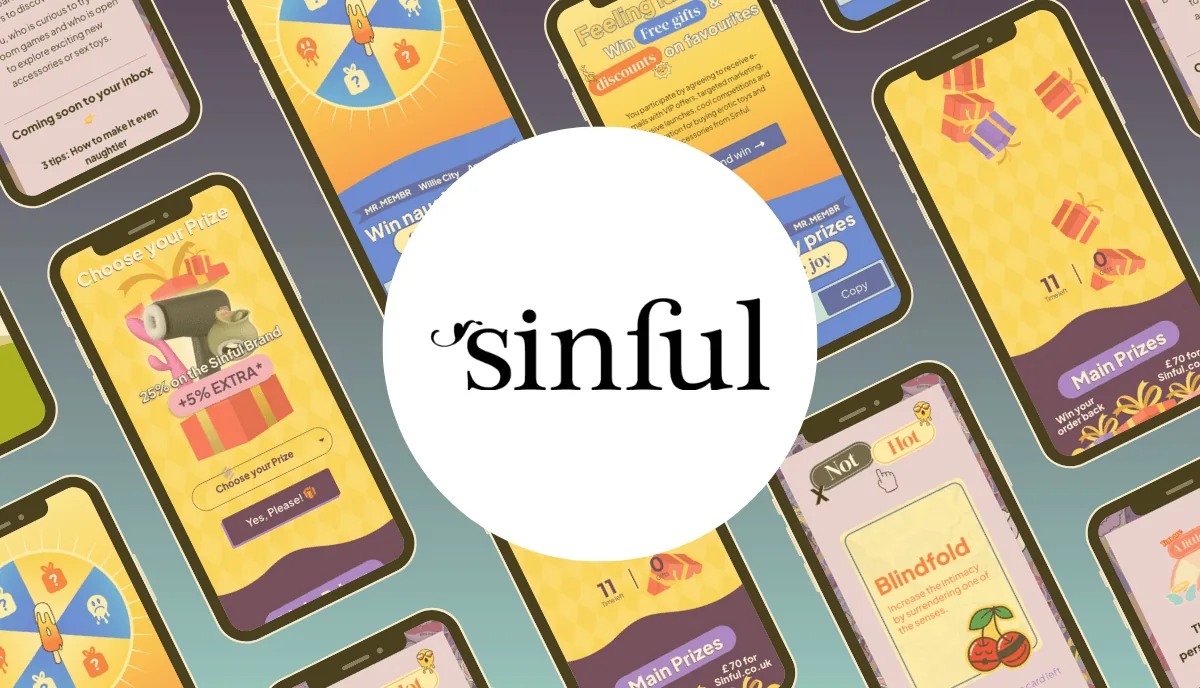
Result: Slice It drew 41,000+ sessions and 32,000+ registrations, an "approx. 73%" conversion rate, and players' average conversion rate was 1.2 percentage points above non-players', according to Playable. Playable defines neither rate (32,000 of 41,000 would be 78%), and players chose to play, so the gap does not prove the game caused the difference.
Holiday Kalendar — Klekt (2021)
Agency: Playable · Platform: Web
The sneaker resale site gave Black Friday buyers one spin on a wheel of fortune, sent by email after their order: 5%, 10% or 15% off the next order, or Crep Protect gear, as a unique code. In December a 12-day advent calendar asked one question a day, such as which Nike SB Dunk collaboration came first that year, for a draw with prizes like €100 of site credit. The campaign has ended.
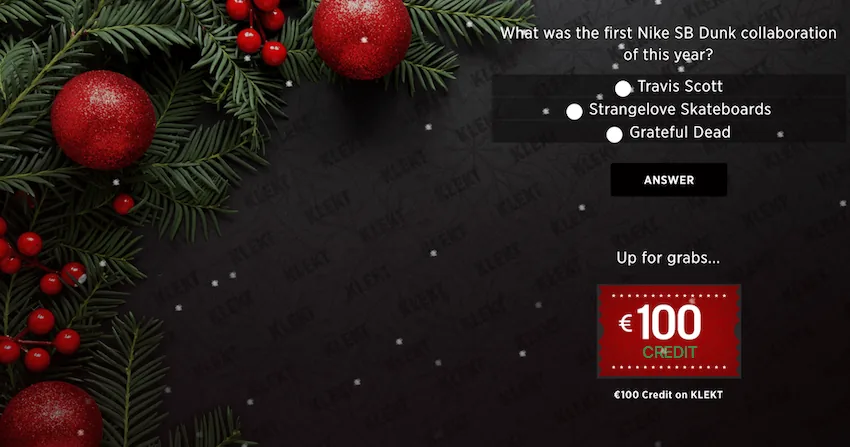
Result: Of 1,600 codes claimed within a month, 16% turned into a second order, and average order value rose 17%, according to Playable. The calendar drew more than 11,000 registrations at what Playable calls a 103% conversion rate, with no formula given.
100% Winning Draw — Somfy (2026)
Agency: Drimify · Platform: Web
On Somfy's French online shop, players gave their name and email, with an optional newsletter box, and spun a slot machine for the 15th anniversary of the TaHoma smart-home hub. The reels always stopped on a win: a code for 10 to 30% off, or a free TaHoma switch for 15 players. Codes arrived by email, valid on orders of €149 or more. The promotion has ended.
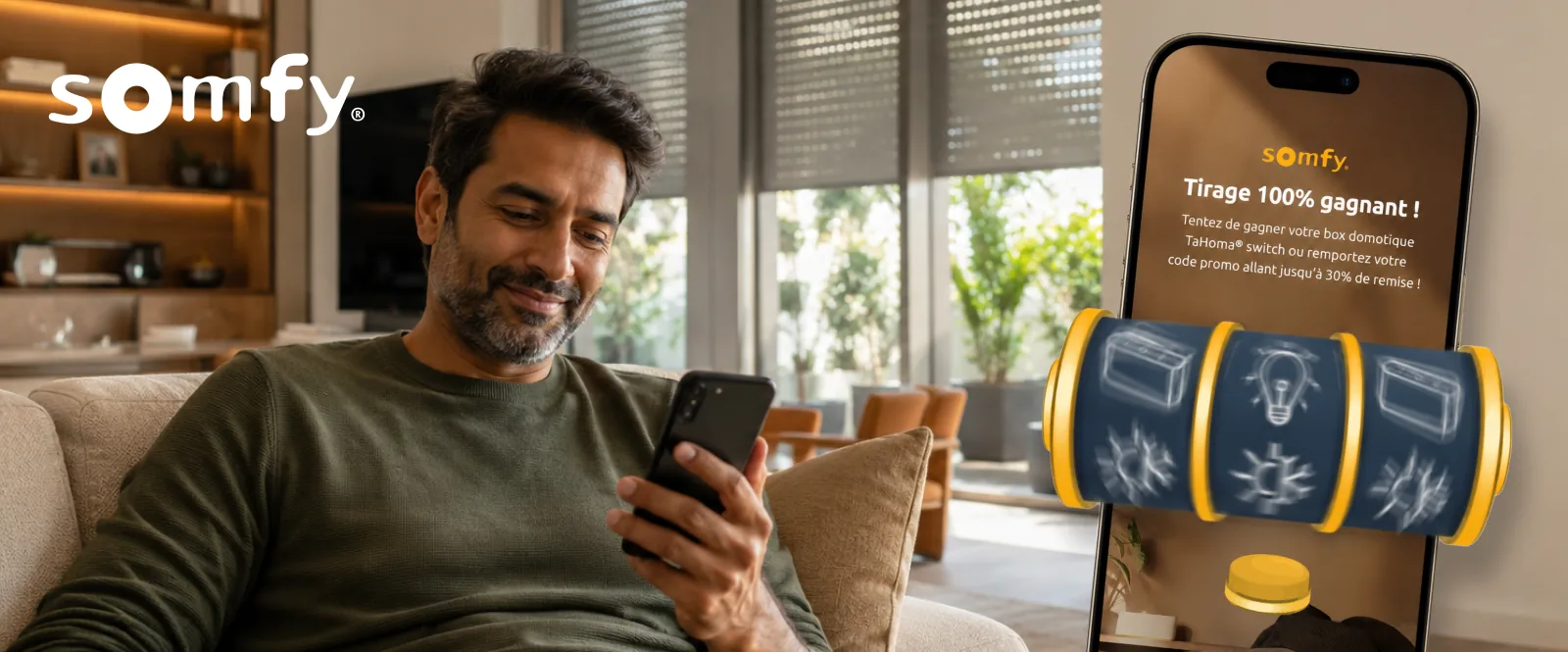
Result: About 850 of the roughly 33,000 players who finished the game went through to checkout, a 2.57% "engagement-to-sale rate", with around €200,000 in attributed revenue, according to Drimify. Drimify sets this against "an industry average of 1.4%", which its link traces to a Statsig post giving 1.4% for home-decor e-commerce in general, not for people holding a fresh discount code. It does not say how sales were tied to the game.
FAQ
How are conversion rates calculated?
Divide the people or sessions that completed the action by the number you started with, then multiply by 100. If 2,000 people open a game, 1,400 register and 70 buy with their code, the registration rate is 70% and the purchase rate is 3.5% of players, or 5% of registrants. Always name the base.
What is a good conversion rate?
It depends on the step and the base. Unbounce's 2024 Conversion Benchmark Report puts the median landing-page conversion rate at 6.6% across all industries, from more than 41,000 landing pages and 57 million conversions. Registration rates in game vendors' case studies often run far higher, partly because the player has already chosen to play. Compare first with your own earlier campaigns, then with our playable marketing statistics.
Is conversion rate the same as exchange rate?
No. People also say conversion rate for the exchange rate, the rate at which one currency is exchanged for another, which is what currency converters show. In marketing, and on this page, it is the share of an audience that completes a chosen action.