


Of the 1,089 branded games in The Well Played Awards library, 517 (47%) publish any result, mostly counts of plays, visits or minutes. Only 98 mention sales or redemption, and 16 brand lift. Web games make up 61%, 66 in-game projects have run on Roblox or Fortnite since 2021, and just 50 can still be played.
Every figure is counted from the library's live game pages on 12 October 2026: their tags, plus the results our researchers took from case studies, trade press and award entries. Five cases show different kinds of result; the method and its limits close the piece. For the category itself, see what playable marketing is.
How has the number of branded games changed over time?
Games launched that year2025–2026: still being reported
1,054 of the 1,089 games have a launch year. The oldest is Hariboy's Quest, a 1996 CD-ROM adventure for Haribo. A first wave brought 252 games in 2011–2014; output dipped in 2015–2019, then rose every year to 84 games in 2024, the busiest year. The 50 games from 2025 and 19 from 2026 probably reflect reporting lag more than decline, because case studies appear months after launch.
Which platforms do branded games use?
| Period | Games | Web | App | In-game | Installation | AR & VR | Social |
|---|---|---|---|---|---|---|---|
| Before 2010 | 90 | 94% | 1% | 3% | 1% | 0% | 0% |
| 2010–2014 | 292 | 59% | 27% | 1% | 5% | 3% | 6% |
| 2015–2019 | 237 | 61% | 11% | 1% | 11% | 8% | 8% |
| 2020–2026 | 435 | 53% | 8% | 23% | 7% | 6% | 3% |
| All games | 1,089 | 61% | 13% | 10% | 7% | 5% | 5% |
"All games" includes 35 undated games.
The browser never lost its lead. Apps peaked in 2010–2014 at 27% and fell to 8% in 2020–2026. The sharpest change is in-game: 8 such projects predate 2020, mostly console or PC titles, against 99 since. Of all 107, 66 took place on Roblox or Fortnite, rising from five in 2021 to 21 in 2024; see our guides to brands on Roblox and brands in Fortnite.
Which mechanics and industries are most common?
| Mechanic | Games | Share | Industry | Games | Share |
|---|---|---|---|---|---|
| Arcade & action | 257 | 24% | Entertainment | 266 | 24% |
| Adventure & quest | 162 | 15% | Food & drink | 239 | 22% |
| Racing & sports | 145 | 13% | Tech & telecom | 134 | 12% |
| Puzzle | 136 | 12% | Fashion & beauty | 114 | 10% |
| Quiz & trivia | 118 | 11% | Automotive | 102 | 9% |
| Simulation & strategy | 104 | 10% | Retail | 62 | 6% |
| Mini-games | 100 | 9% | Finance | 41 | 4% |
| Music & rhythm | 27 | 2% | Travel & hospitality | 19 | 2% |
| Other or untagged | 40 | 4% | Other or untagged | 112 | 10% |
Mini-game formats doubled their share, from 6% in 2010–2014 to 12% in 2020–2026. Entertainment plus food and drink account for 505 games, nearly half the library. Fashion and beauty grew from 5% of games in 2010–2014 to 15% in 2020–2026; automotive fell from 16% to 5%.
What are brands trying to achieve with games?
| Objective | Games | Share | Publish results |
|---|---|---|---|
| Engagement | 534 | 49% | 46% |
| Awareness | 281 | 26% | 44% |
| Product launch | 125 | 11% | 42% |
| Sales | 66 | 6% | 56% |
| Lead gen & recruiting | 32 | 3% | 72% |
| Loyalty | 22 | 2% | 82% |
| Other or untagged | 29 | 3% | 59% |
Three in four games are briefed as engagement or awareness. Loyalty and lead-generation games publish results most often, probably because the measure is built into the mechanic: a reward redeemed, a form filled in. Sales is the weak spot. Of the 66 games with a sales objective, only 14 mention sales or redemption in their results.
How many branded games publish results?
517 games (47%) carry a results statement. Our researchers verified 117 of them against a source and partly verified 233, so 350 games (32% of the library) have results we could at least partly check. Reporting has improved, from 28% of pre-2010 games to 59% of those from 2020–2026.
Platform matters more. 81% of in-game projects publish results, against 61% of installations, 59% of apps, 46% of social games, 40% of AR and VR games and 39% of web games. In-game and app records often quote platform counters (visits, favourites, downloads, ratings); a microsite has no public counter.
What do branded game results measure?
We sorted the 517 results statements by keywords: "plays" or "visits" mean participation, "redeemed" or "voucher" redemption, "recall" or "consideration" brand lift, and so on. A statement can fall into several groups; 29 matched none.
Sales and redemption together cover 98 games: 19% of those with results, 9% of the library. Since 2010 both have grown: sales are mentioned in 11% of results from 2010–2014 and 20% from 2020–2026, data capture in 4% and 18%. Before 2010 the shares were higher (28% and 20%), but only 25 games from those years publish results. Gamification platforms drive part of that: 30 of the 73 games reporting data are credited to Playable or Drimify.
Five published results, from play counts to brand lift
Disrespectoids — Capri-Sun (2009)
Agency: Fuel Industries · Mechanic: Mini-games · Platform: Web
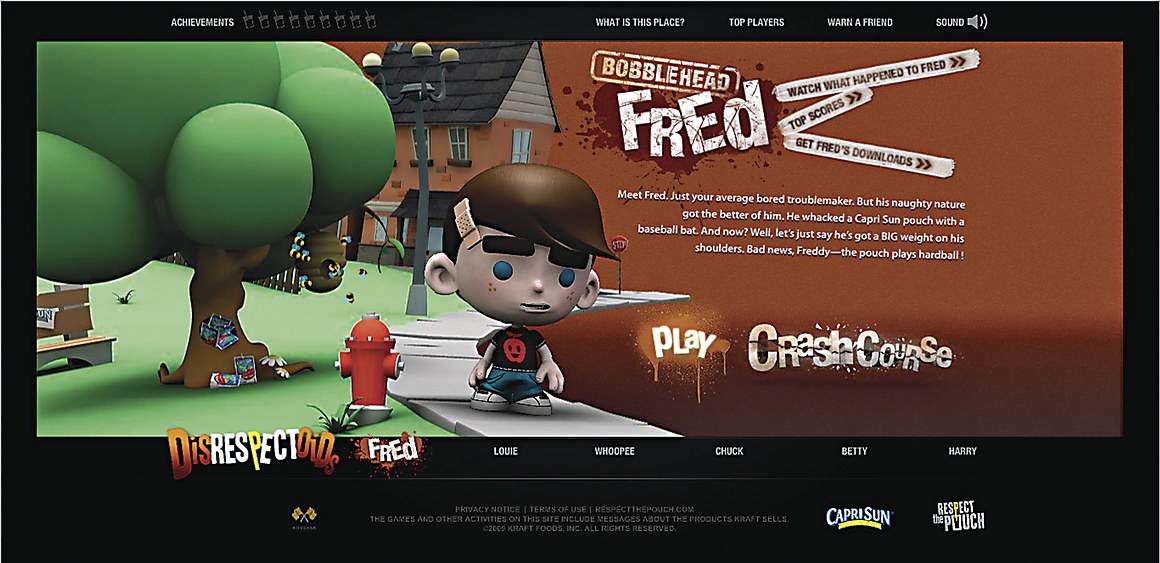
Each Capri-Sun TV spot ended with a kid mutating into a "Disrespectoid" and sent viewers to RespectThePouch.com. There, players picked a mutant, played its mini-game and earned achievements that opened new content and cartoon episodes.
Result: more than 2.5 million unique visitors and over 11 million game plays since launch, with visits averaging more than 16 minutes in Comscore data for July to September 2009 (Communication Arts). The IAC award entry for the campaign's cartoon webisodes cites Nielsen for a 2-point rise in Capri-Sun's market share (IAC).
Take Home The Fun — M&M's (2019)
Agency: Chaos Theory Games, Traffik · Mechanic: Arcade & action · Platform: AR & VR
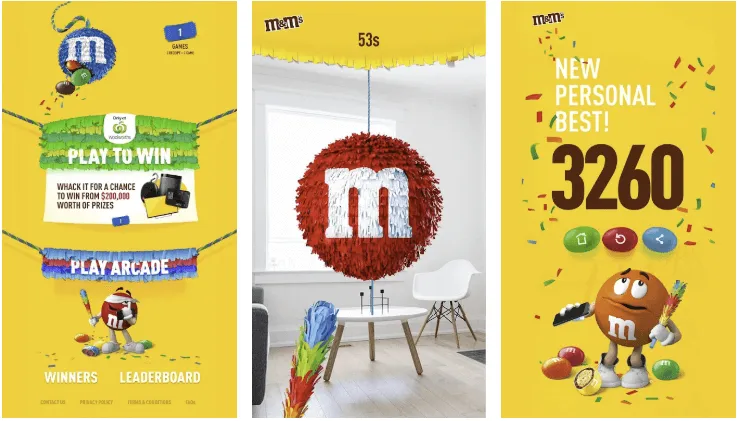
This game counted purchases as it went. M&M's players in Australia spent their free attempts tapping an AR piñata on their phone screen until it burst. Each round after that needed the barcode and receipt from a real pack, so every extra round left a record of a pack bought. Hits added to a shared leaderboard with prizes.
Result: over six weeks, 12,000 game sessions, 49,000 piñatas broken and 6,600 product barcodes redeemed, according to the studio (Chaos Theory Games).
Nickmas & Super Bowl LVIII On Roblox — NFL (2023)
Agency: Gamefam · Mechanic: Quiz & trivia · Platform: In-game
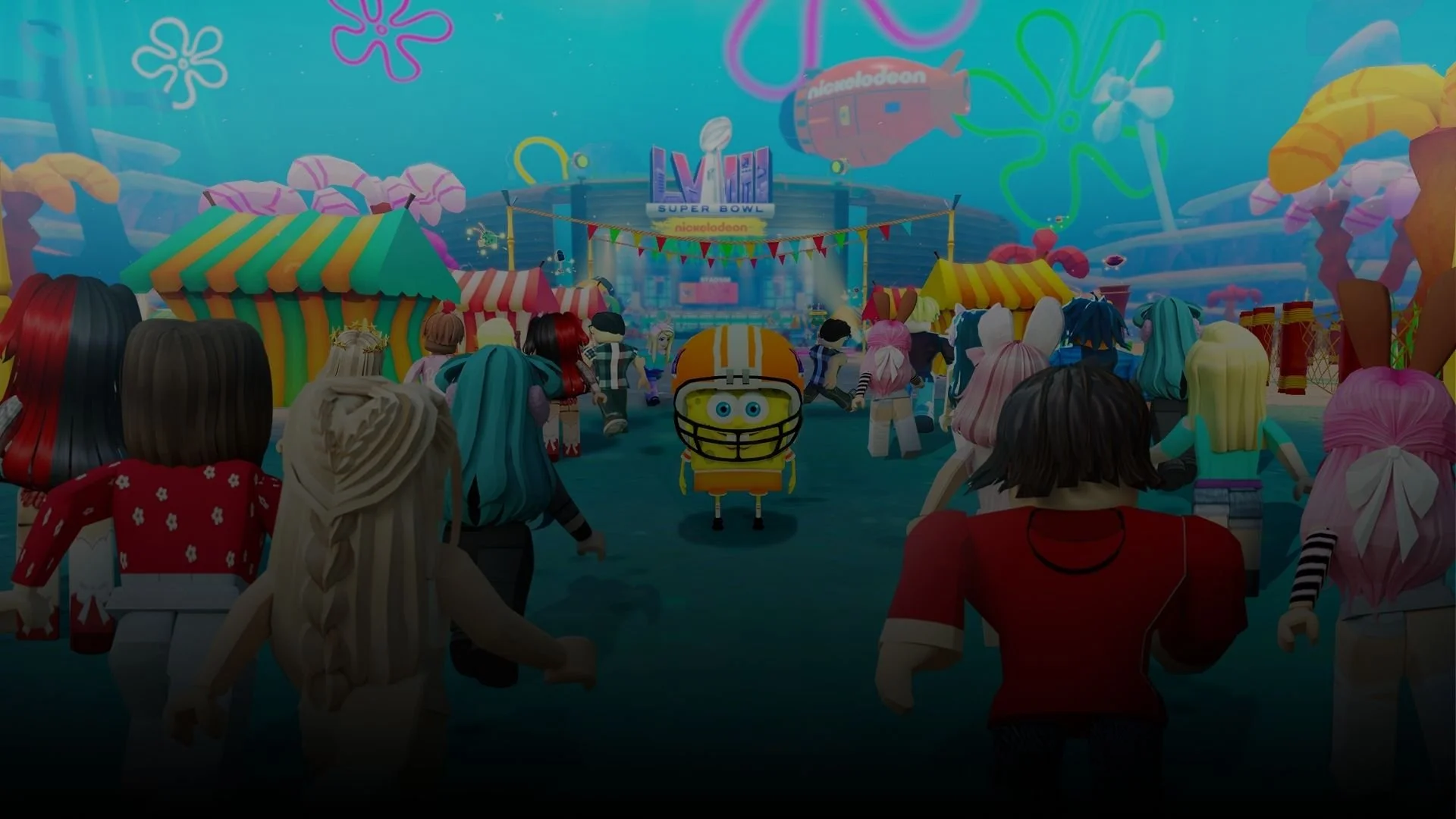
Rather than build a single branded game, the NFL let players meet Nickelodeon characters in football kit inside Roblox games they already played, such as Super NFL Tycoon. A quest started in one game finished in another, with trivia on real NFL match-ups and virtual merchandise as rewards.
Result: across 29 days, more than 75 million visits, over 985 million gameplay minutes, 5.4 million quests completed and 210,000 virtual items redeemed (The Drum). TV audiences quoted in the same entry belong to the broadcasts, not the game.
Body Royale — Philips (2025)
Agency: The Gang · Mechanic: Arcade & action · Platform: In-game
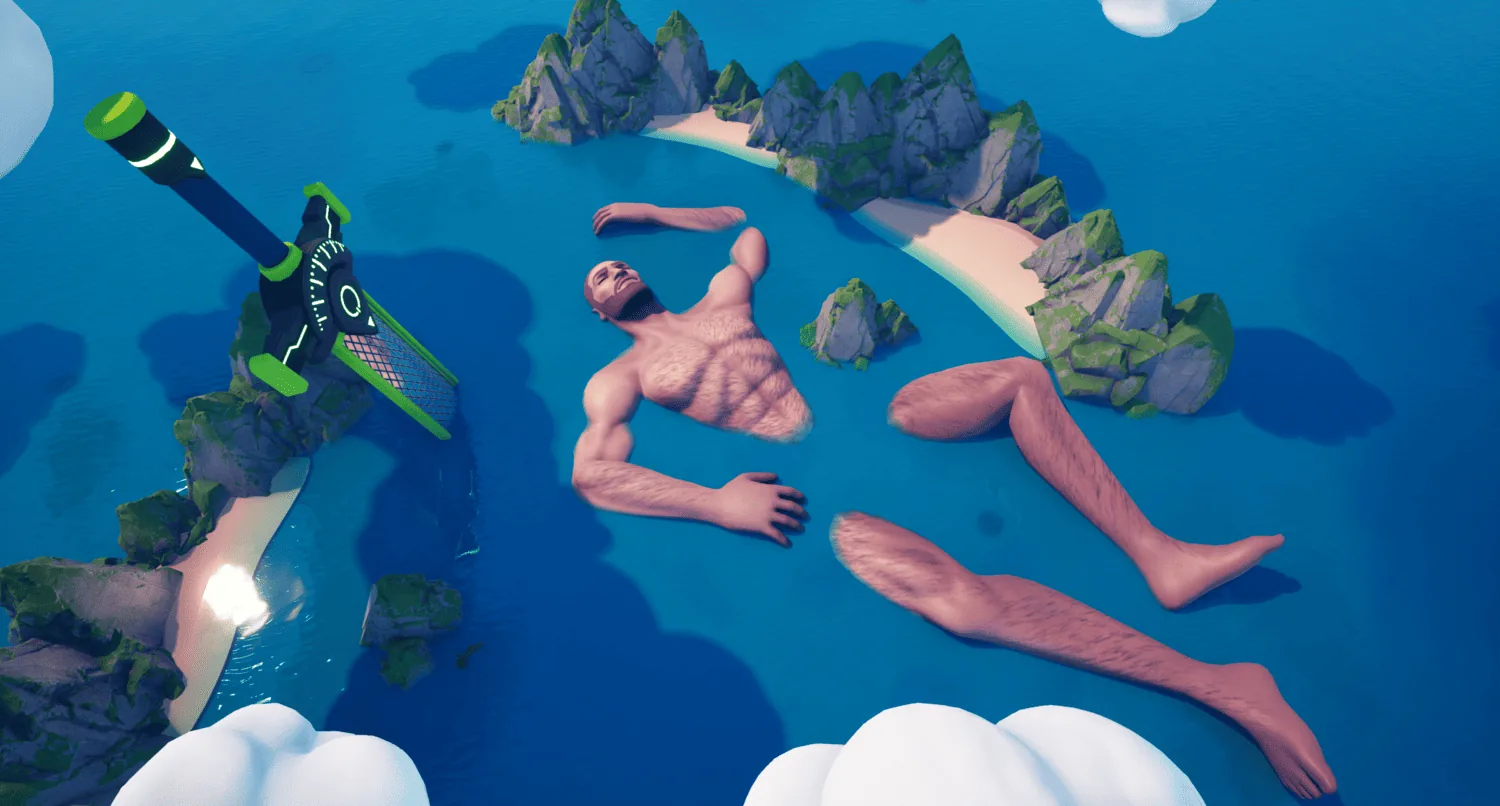
Before launch, Philips OneBlade set three brand-tracking targets: 74% awareness, a 5% rise in consideration and a 2% rise in preference. The campaign's vehicle was a Fortnite map in the form of a giant hairy body, where players carried a razor-shaped blade as their main tool. Shaving restored health and revealed shields and power-ups until one player was left.
Result: according to the award entry, which credits Ketchum UK and Fuse with the campaign, all three targets were beaten: awareness reached 81%, consideration rose 11% and preference 5%. Sales among men aged 18–30 grew 28% year on year over the campaign period (The Drum). The Gang reports a 12-minute average session (The Gang).
100% Winning Draw — Somfy (2026)
Agency: Drimify · Mechanic: Arcade & action · Platform: Web
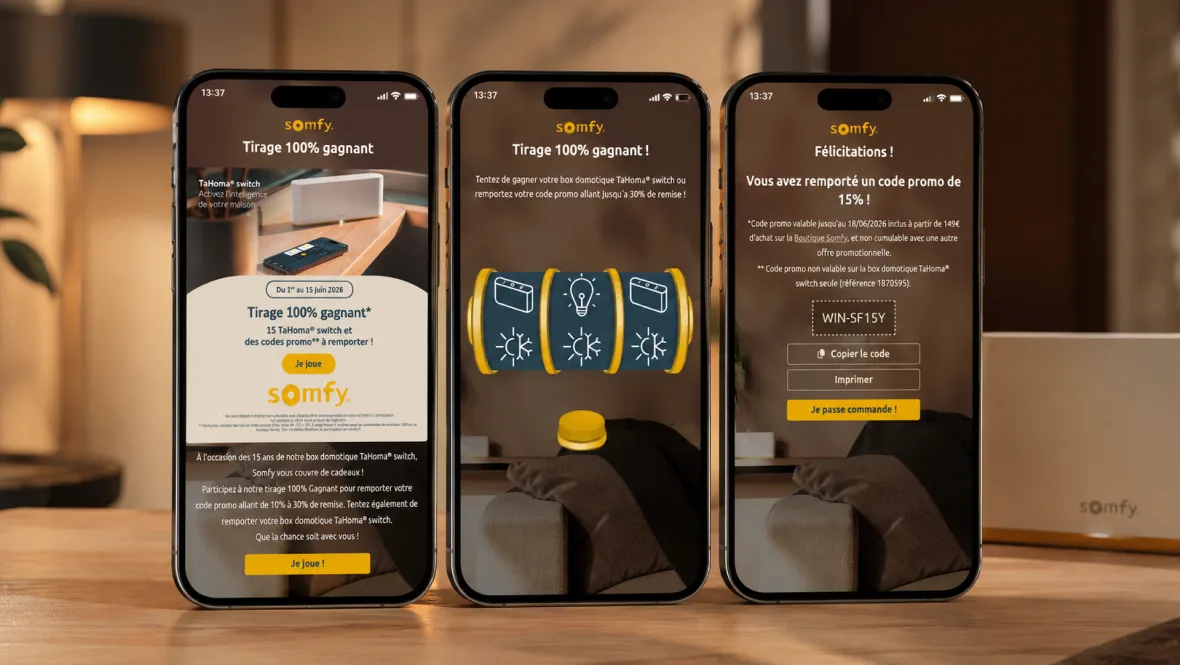
In Somfy's French online shop, players left a name and email and spun a slot machine marking 15 years of the TaHoma smart-home platform. Every spin won: a discount code of 10% to 30%, or, for 15 players, a TaHoma hub. More milestone campaigns are in our company anniversary guide.
Result: according to Drimify, 34,000 leads and 10,000 newsletter opt-ins. About 850 of roughly 33,000 players who finished went on to buy, a 2.57% conversion that Drimify compares with a 1.4% industry average, worth around €200,000 in attributed revenue (Drimify).
How many campaign games can you still play?
50 games, under 5% of the library, are live and still playable; 531 (49%) are recorded as offline. Survival tracks age: 2 of 90 pre-2010 games still run, 1 of 292 from 2010–2014, 10 of 237 from 2015–2019 and 37 of 435 since 2020. 44 of the 50 are web games. The oldest is The Quest for the Rest, made in 2004 for the band The Polyphonic Spree. See games you can still play.
What the numbers mean for your next campaign game
Choose the measure before the mechanic. Even games briefed to sell rarely report sales. If the game must sell, put a purchase step inside the loop, as M&M's did with pack barcodes.
Platform counters measure attention, not effect. Visits and minutes show that people played; Philips' brand tracking against targets fixed before launch shows what the game did for the brand.
Light formats are strong at data capture. Somfy's instant win put the sign-up form before the spin; a quiz, wheel or scratch card is quick to build and easy to measure. Deeper games earn longer visits, such as Capri-Sun's average of more than 16 minutes, but cost more to build and run.
Distribution comes first. Capri-Sun's TV spots sent viewers to its site, and the NFL placed its quest inside Roblox games people already played. With no media or existing audience to bring players in, and no reason to return, a game is the wrong tool. Plan hosting from day one as well: 49% of the library is already offline.
How we counted, and the limits
- Scope. 1,089 live game pages on 12 October 2026, each with one platform and, for nearly all, one mechanic, industry and objective set by our editors. The library is curated, not a census.
- Source bias. Records start from award entries, agency portfolios and trade press, mostly in English. Agencies publish successes, so results lean positive and big budgets are overrepresented.
- Results. A game counts as publishing results if its record has a results statement, and some statements include outcomes around the game. The keyword groups are a first pass, not a manual audit.
- Duplicates and lag. A few campaigns have more than one page, and recent years fill in slowly.
- Playability. A game counts as still playable only when our last check found the game itself playable and its campaign page live; a store listing or a case page is not enough.
FAQ
Do branded games work?
Some clearly do, but the published evidence is thin. In The Well Played Awards library, 517 of 1,089 campaign games (47%) publish any result, and only 98 mention sales or redemption. Where play is tied to a purchase, results are concrete: M&M's Take Home The Fun recorded 6,600 barcodes redeemed in six weeks. Most results come from agencies and award entries, which favour winners.
How do brands measure the success of a campaign game?
Mostly by participation. Of the 517 games in our library that publish results, 79% mention plays, visits or downloads, 32% reach, 28% time spent, 17% sales, 14% leads or sign-ups, 4% redemptions and 3% brand lift. The strongest cases set brand targets before launch and report against them, as Philips did with Body Royale.
Which platforms are most used for branded games?
The web: 659 of 1,089 games (61%) are browser games, followed by apps (141, 13%), in-game projects (107, 10%), installations (76, 7%), AR and VR (55, 5%) and social (50, 5%). In-game work makes up 23% of games from 2020–2026, mostly on Roblox or Fortnite; browse in-game worlds.
What are the key gamification trends in branded games?
Compared with 2010–2014, games from 2020–2026 show four shifts. In-game projects rose from 1% to 23% of games, mostly on Roblox or Fortnite. Mini-game formats doubled their share to 12%. Fashion and beauty grew to 15% while automotive fell to 5%. And results mention sales (20%) and data capture (18%) more often than before.
How many branded games report sales?
Fewer than one in ten. Of the 1,089 games in our library, 98 mention sales or redemption in their results, and only 14 of the 66 games briefed for sales do. Somfy's slot-machine instant win is one: about 850 players went on to buy, according to Drimify. Philips' Body Royale is another, with sales among men aged 18–30 up 28% year on year in its award entry. Thirteen more cases, with briefs and results, are in our playable marketing examples.
Filter the full library by platform, mechanic or objective to cut the data your own way, and submit any campaign game we have missed.