

Share rate is the number of times people pass content on, divided by the audience that saw or played it. In a campaign game it usually means shares per player: scores, results and invitations sent to friends. Every viral loop starts with it, but read the denominator before the number.
How it works
For the player, a share is one tap: the end screen shows your time, rank or personal result, with buttons to post it.
The formula is shares ÷ audience × 100. The top can be every share or only unique sharers; the bottom can be players, sessions, completed games or visits. For social posts, Avinash Kaushik's amplification rate counts shares per post: "the rate at which your followers take your content and share it through their network". Platforms count what passes through their own buttons: YouTube defines shares as the times users shared a video "through the Share button". In a web game, Google Analytics 4 has a recommended share event with method, content type and item ID.
Share rate is the first half of K-factor: invitations sent per player. K multiplies it by the proportion of those invitations that turn into new players.
Where brands use it
Sharing targets turn up in briefs for awareness and engagement: film releases, sports tie-ins, launches on social platforms. Each case counts it differently. In Gatorade's Serena Williams' Match Point, 36% of users shared the game to their own Snapchat Stories, according to the project page of Gatorade's brand manager on the campaign. The Xbox Vault counted more than 20,000 "bragging rights" on social media from over 230,000 players, Makemepulse says. A rank gives people something to post: 441 games in the library have a leaderboard.
When it fits
Track share rate when a viral marketing brief asks for reach beyond paid media and the game ends on something people want to show: a fast time, a high rank, a result that says something about them. Before launch, write down what counts as a share (a button tap, a hashtag post, a sent link), whether you count shares or sharers, the denominator and the period. Talenti's brief for Flavorize Me (below) set its target as a rate: sharing from 10% of active participants. Tag every shared link, so you can follow it to new players for K-factor, and log the press it brings as earned media. Read it next to completion rate, since share buttons usually sit on the end screen.
When not to use it
Don't set a share target for a closed audience such as staff or a trade-show stand; as our K-factor page explains, invitations have nowhere to go there. Don't read a low rate as silence. Links sent by email, messaging or copy and paste carry no referral data; RadiumOne research cited by Wikipedia put this dark social at about 69% of global sharing activity in 2014. The U.S. Army's Cryptaris Mission logged over 4,000 site link shares on Facebook while players traded tips on Reddit and YouTube, MediaPost reported. Be careful rewarding shares: Meta's promotion rules bar requiring or incentivising participants to share, repost or tag others, and the FTC expects a contest post to say so, as in #XYZ_Sweepstakes. Check with counsel. For sales or leads, a share is not a result; measure conversion rate.
Examples from the library
Deploy & Destroy — Expendables 2 (2012)
Agency: Soap Creative Australia · Platform: Web
Players picked a squad of three from the film's cast, then placed gun turrets at set points along the enemy path to hold back waves of infantry, tanks and helicopters. The trailer played before the first level, and a Buy Tickets button stayed on screen throughout. The game was also placed on sites that sold tickets and embedded on hundreds of other sites, according to IAB Australia. The campaign site is gone.
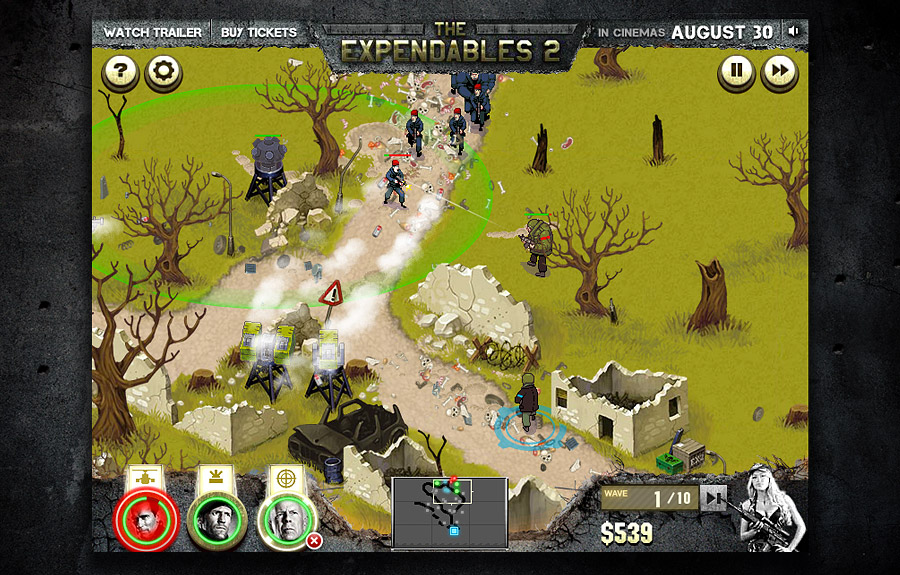
Result: More than 10 million visits in the first two months, sessions averaging over 13 minutes, 100,000 shares to Twitter and Facebook and 220,000 tickets bought, according to IAB Australia, which gave it a 2013 award. That is about one share per 100 visits, by our arithmetic; the share count covers Twitter and Facebook only, not the embeds.
Fast or Fail — adidas (2014)
Agency: Iris Worldwide, Monks · Platform: Web
You run as Lionel Messi in adizero f50 boots down a low-poly pitch towards Rio de Janeiro, dodging faceless defenders. The more Messi was mentioned on Facebook, Twitter and other channels while you played, the faster you ran. The end screen showed your time with buttons to tweet to go faster and to share your speed, and the fastest times went into a draw for a trip to the 2014 World Cup. The game is offline.
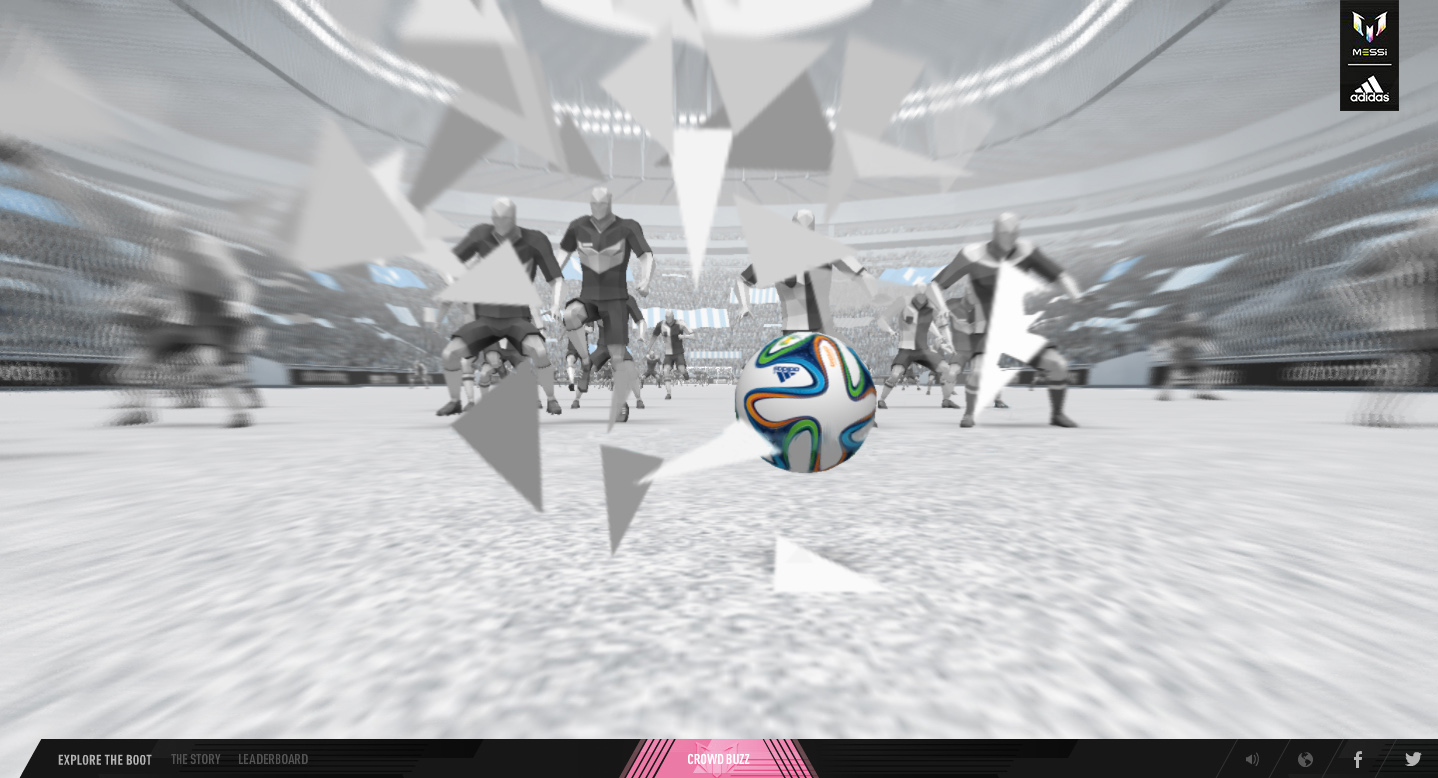
Result: Over 400,000 fans played and completed more than 250,000 games, with 50,000 shares and "a 20% social sharing rate", according to the Shorty Awards entry. The entry gives no denominator: 50,000 shares are exactly 20% of 250,000 completed games, but 12.5% of 400,000 players.
Flavorize Me — Talenti (2015)
Agency: Fallon, UNIT9 · Platform: Web
Visitors connected Facebook, Instagram or Twitter and let the site read their posts. It returned a taste profile in percentages (sweet, sour, salty, spicy, bitter), an invented gelato flavour and the real Talenti pint closest to it, then asked them to share the result and compare with friends. The six the team liked best went into small-batch production and were shipped to the fans who created them. The site has closed.
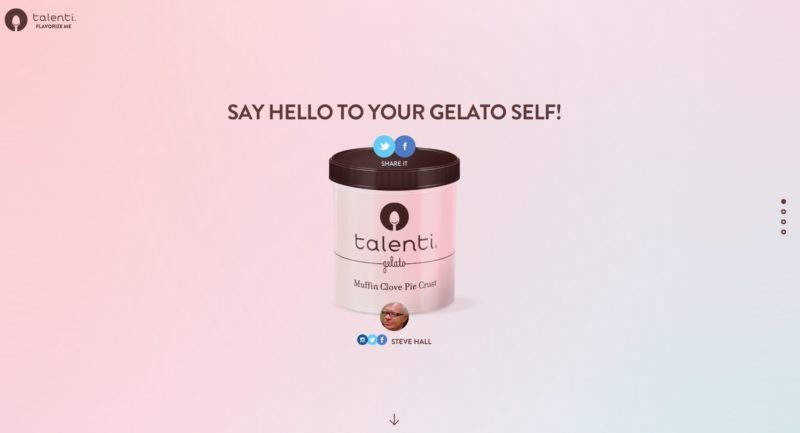
Result: The brief asked for sharing from 10% of active participants, "as predicted by industry best practices", against a target of 50,000 new users. About 10,000 people shared, doubling the goal, and nearly 120,000 flavours were created, according to the Shorty Awards entry. It measures sharers against the plan and gives no count of actual participants.
FAQ
How do you calculate share rate?
Divide shares by the audience and multiply by 100: 2,000 shares from 40,000 players is 5%. Then say what each number is: every share or unique sharers on top; players, sessions, completed games or impressions below. In Fast or Fail, the same 50,000 shares give 20% or 12.5%.
What is a good share rate?
We know of no published benchmark for campaign games. Fallon planned Flavorize Me around sharing from 10% of active participants, citing industry best practice. Cases in our library include about one share per 100 visits for Deploy & Destroy and 36% of users for Gatorade, counted differently. Compare a game with your own earlier campaigns, measured the same way.
Is share rate the same as a share price?
No. Search results for "share rate" are mostly stock quotes, and a share price is "the amount it would cost to buy one share in a company", as IG puts it. In marketing, share rate counts how often people pass content on.