

K-factor, or viral coefficient, is the number of new players each existing player brings in: invitations sent per player multiplied by the share of them that convert. Above 1, a brand game spreads by itself. Below 1, it still adds free players on top of the ones paid media buys.
How it works
For the player, K-factor shows up wherever the game asks them to bring someone in. Win a level and a button offers to post the result to your story. Lose a life and you are offered three more for inviting a friend, an example AppsFlyer uses. A head-to-head game needs an opponent. Each is an invitation; a friend who opens it and plays is a conversion.
Wikipedia gives k = i × c, where i is invites sent per user and c the share of invites that convert. The term comes from epidemiology's basic reproduction number: above 1, each wave of players is bigger than the last. Speed often matters more than size. In David Skok's worked example, cutting the viral cycle from two days to one turns 20,470 users after 20 days into more than 20 million.
Where brands use it
Invitations matter most inside social networks. The library holds 28 Facebook games and more built for Snapchat, Instagram, TikTok and WhatsApp, many of them filed under social and usually aimed at engagement or awareness. Sweepstakes reward invitations directly: in KLM's Claim Your Place in Space, each friend who backed a player's entry widened their claim in the sky and improved their odds. Multiplayer games build the invitation into play. Standard Chartered's My Majlis ranked players' Ramadan tents by guest turnout and ratings, and the Swedish Armed Forces' Team Test, a recruitment game, let applicants bring friends into a four-player test through a private link.
When it fits
K-factor is the right yardstick when the brief is reach on a small media budget and the audience already talks to each other: teenagers on Snapchat, puzzle fans, sports fans during a tournament. The game should be better with someone else in it (a rematch, a team, a score to beat), and the path from invitation to first play short. Skok advises cutting friction from inviting and rewarding both sides. Give every invitation and shared post a unique link, count conversions per cohort over a fixed period, and report K next to retention: First Round Review warns that weak retention turns viral loops into "leaky buckets".
When not to use it
Don't make K the target for a small or closed audience, such as staff or a trade-show stand: invitations have nowhere to go, and engagement rate or dwell time tell you more. Don't force the share. Meta's Pages, Groups and Events policies say a promotion "must not require or incentivise participants to share, repost, tag others", so "share to enter" is off the table on Facebook. The UK ICO advises against collecting friends' email addresses, since you cannot be sure the friends agreed, and a brand that asks players to forward its marketing still answers for it. A paid push can inflate K, First Round notes, so read it with care afterwards. Never plan a launch on virality alone either: AppsFlyer calls truly viral growth very rare.
Examples from the library
Disney Cruise Adventure — Disney (2012)
Agency: SYZYGY Warsaw, Disney's Yellow Shoes Creative Group, Nomadic Agency, PrizeLogic · Platform: Web
Players moved a ship token around five islands modelled on ports of call, beating Disney villains to win real upgrades such as dining, entertainment or a shore excursion. Upgrades filled the ship's cargo hold, and whatever sat there when the sweepstakes closed became the cruise a winner would take. Hold space was limited, and each friend invited as a crewmate, up to five, increased it, the Disney Cruise Line Blog reported.
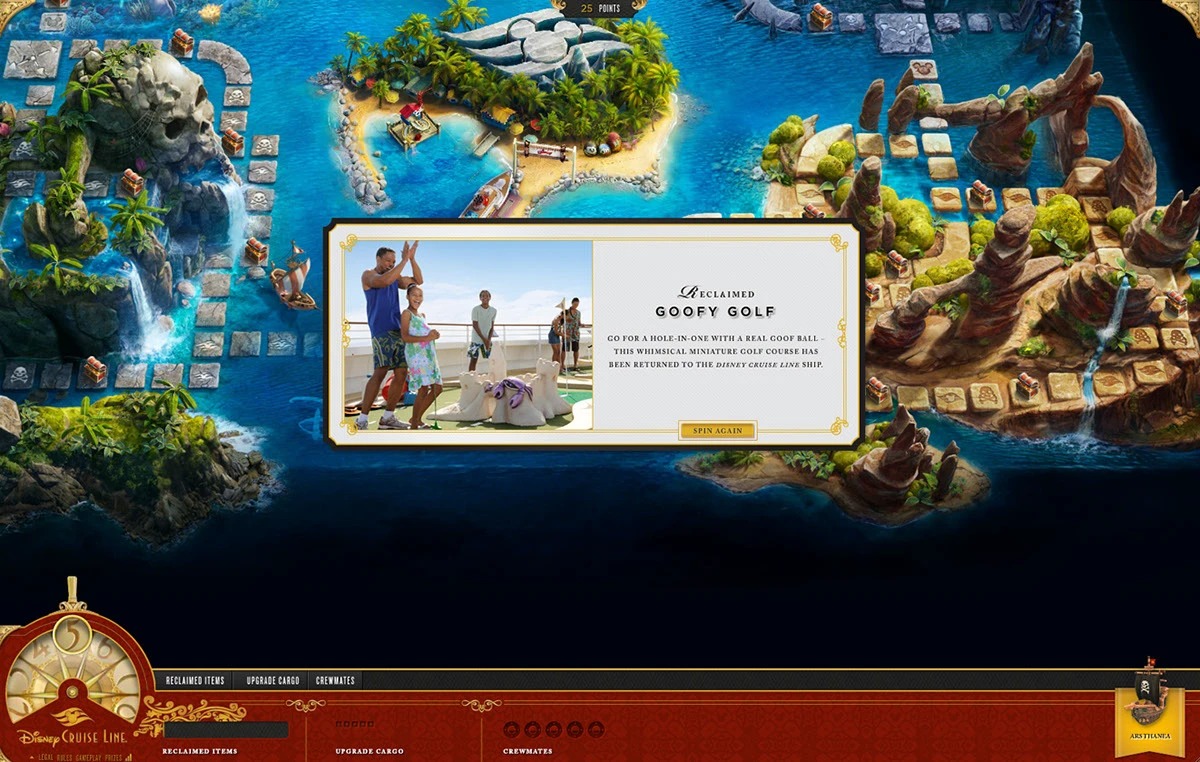
Result: The entry rate was about eight times the goal, players averaged 13 plays each and time on site was 300% higher than the brand's previous programmes, according to Chief Marketer, which listed the campaign as a 2012 PRO Award finalist.
Serena Williams' Match Point — Gatorade (2016)
Agency: TBWA\Chiat\Day, Ludomade · Platform: Social
Players swiped up from Gatorade's ad in ESPN's Discover channel on Snapchat, or opened the game's website on a phone or desktop. Each of 22 levels replayed a match point from one of Serena Williams' Grand Slam singles wins in 8-bit style: one tap to serve and return, aiming left or right to win the point. A win could be posted straight to the player's own Snapchat Story, the game's built-in invitation.
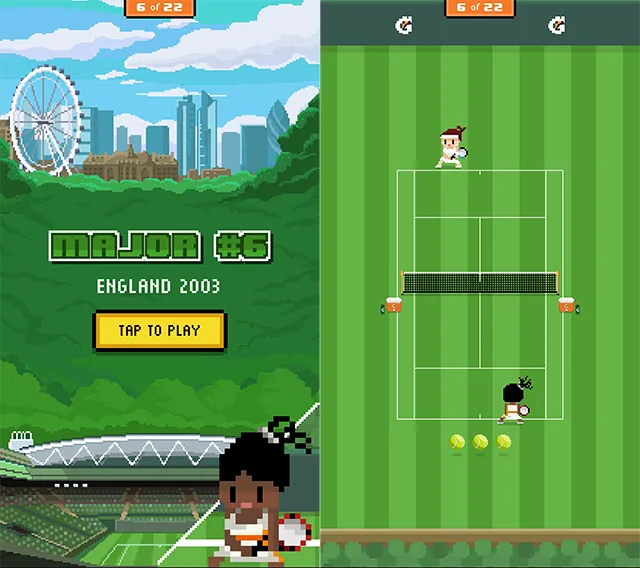
Result: 36% of users shared the game on their Snapchat Stories, sessions averaged over three minutes, and the game drew over 395 million impressions and over $16 million in earned media, according to the project page of Gatorade's brand manager on the campaign; the One Show entry puts sessions at 65 times longer than average.
Crackables — OnePlus (2018)
Agency: UNIT9, Le Polish Bureau, Google ZOO · Platform: Web
Players signed in with Google in their mobile browser and met Crax, an AI voice trapped behind six digital walls. Each wall was a timed cipher: a maze that spelled out letters, a tap-and-swipe rhythm sequence, an image or binary code. The fastest 1,000 solvers of the first three walls were mailed a circuit board for a hardware round, and the six fastest of those competed live for the grand prize.
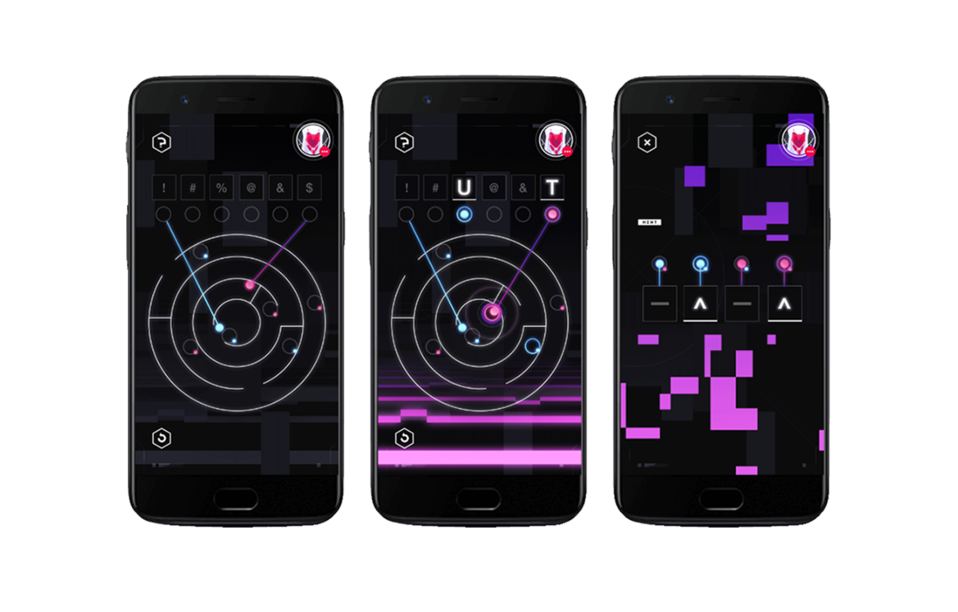
Result: 10,000 players arrived in the first second, 145,000 in the first day and 580,000 in total, spread "by only word-of-mouth and user accolades", according to OnePlus's press release for the 2020 sequel. Spread like this is hard to express as a K-factor, because word of mouth leaves no invitation count.
FAQ
How do you calculate the K-factor?
Multiply the average number of invitations each user sends by the share of those invitations that turn into new users: K = i × c. Five invitations per player with one in five accepted gives K = 1; two invitations at 20% give 0.4. Measure one cohort over a fixed period, with tracked links so shares to stories count as invitations.
What is a normal K-factor?
There is no single benchmark. Above 1, every user creates more than one new user and growth compounds; below 1, First Round Review says you need marketing to keep momentum. Wikipedia cites early k-factors of 0.7 for Dropbox and 0.4 for WhatsApp. For a campaign game, K = 0.5 still means every 100 paid players bring about 100 more across later waves.
Is this the same K-factor as in sheet metal or chess?
No. In metalwork, K-factor is the bending capacity of sheet metal and the formulae built on it. In the Elo rating system used in chess, it is the maximum change to a rating from a single game. Marketing borrowed its K-factor from epidemiology.