











Julekalender (Christmas Calendar)
- Brand
- Alka Insurance
- Year
- 2024
- Objective
- Engagement
- Industry
- Finance
- Mechanic
- Quiz & Trivia
- Platform
- Web
- Agency
- Playable


Objective
Insurance is a low-interest category: people only think about their policy when something goes wrong, and comparison sites make switching providers a two-click decision, so competition collapses to price. Alka needed a reason for customers to engage with the brand outside of a claim, a way to explain in plain terms what its policies actually cover, and a way to collect marketing opt-ins and build loyalty beyond price.
Solution
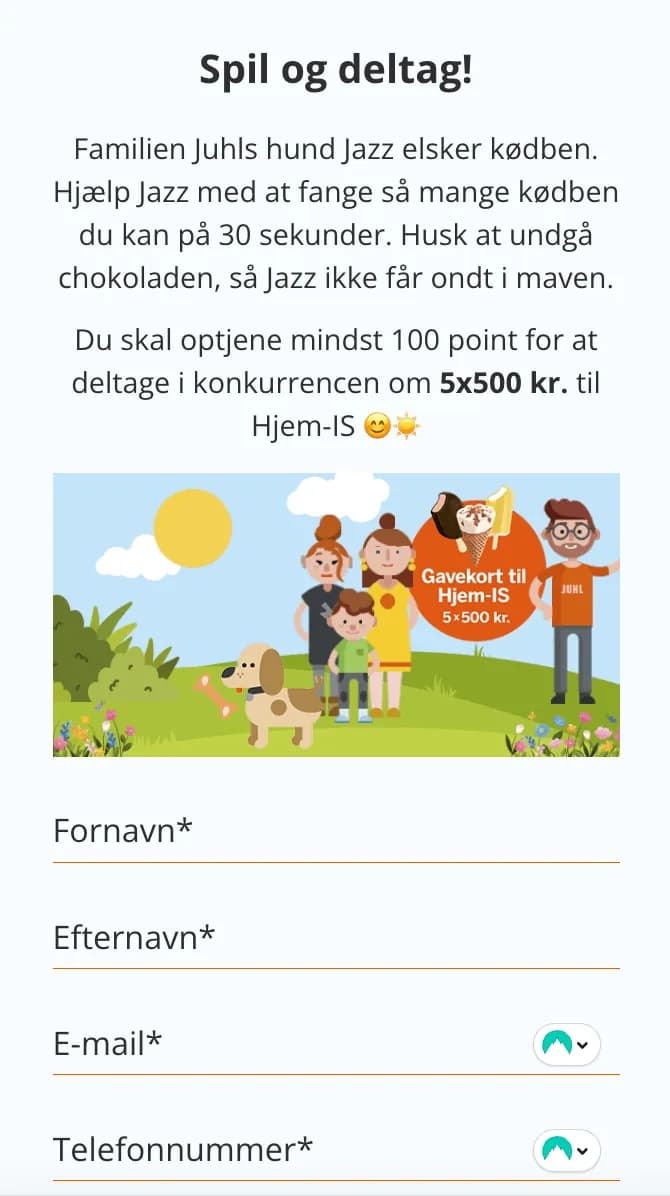
The game sits directly inside alka.dk rather than on a separate microsite. A player first fills in a short form — name, postcode, email, and consent to marketing messages — then gets access to an advent calendar they're meant to revisit daily through December. Each day unlocks a new door with a short story about the accident-prone Juhl family — stolen garden furniture, a dropped PlayStation — followed by a quiz question asking whether the incident would be covered by insurance. Submitting an answer reveals whether it's covered and why, then enters the player into that day's prize draw with partner Coolshop. Alka reused the same loop — seasonal story, a question about coverage, a prize draw — for an Easter game built around guessing an anonymous letter-sender and three summer games themed around the beach, a dog, and a caravan.
Results
The 2024 Christmas calendar drew 1.3M+ sessions and 1.2M+ registrations, with an average conversion rate of 93.9% and 15,000+ hours spent with the brand, ranking it top 3 among Danish Christmas calendars on the Playable platform that year. The Easter game brought 42,500+ sessions, 35,000+ registrations, 83% average conversion, and 500+ hours with the brand. The three summer games combined drew 110,000+ sessions, 85,000+ registrations, 76% average conversion, and 1,200 hours with the brand. An A/B test excluding 20,000 customers from the calendar's marketing emails showed markedly higher churn among that group at both 3 and 6 months, compared to customers who engaged with the game.
- 1
Players reach the game through an invitation in email, social media, radio, or a site banner, all pointing to a page embedded directly on the insurer's own website; the calendar will not run until the player accepts cookies.
- 2
Entry requires a one-time signup: name, postal code, and email address, plus consent to receive marketing messages from the insurer.
- 3
The signup page frames the game as a season-long series rather than a single quiz, promising daily episodes following a fictional family through December with a chance to win prizes along the way.
- 4
The core loop is a daily calendar door: each day reveals a new mishap befalling the family, the player answers a multiple-choice question on whether a given insurance policy would cover it, and then sees an explanation of how that coverage actually works.
- 5
Each day's answer also enters the player into a prize drawing run with a retail partner, which is what pulls players back to open a new door every day through the month.
- 6
A springtime variant swaps the quiz for a folk-tradition riddle: the player is shown a rhyming anonymous letter from the family and must guess who sent it, entering a drawing for a chocolate prize if correct.
- 7
Separate summer editions repeat the same coverage-quiz mechanic with new scenarios, such as stolen patio furniture or an insured caravan's contents, asking whether a given policy would pay out.
- 8
One summer edition replaces the quiz with a short arcade sequence in which the player steers the family dog to catch falling bones while dodging chocolate, closing on a reminder that pet insurance covers the dog if it eats chocolate anyway.