


An interactive billboard is an outdoor ad that responds to the person in front of it, through their movement, voice, gaze or phone; many are DOOH screens. These ten interactive billboard examples are posters, station screens and street sites that people actually played, with what players did, what the brand collected and, where published, the result.
We picked them mostly from the library's 47 billboard and DOOH games and 77 installations, and grouped them by how people play. Seven published results; agency figures are marked. For shops and fan zones, see our brand activation examples.
Which interactive billboards do you play with your body?
A camera or sensor reads the player, and the crowd sees every move.
Kicks-Off — Coca-Cola (2018)
Agency: Grand Visual, Top-Spot, MediaCom, Anthem · Mechanic: Racing & Sports · Platform: Installation
At the start of the 2018 World Cup, Coca-Cola Switzerland put passers-by at Zurich's main station on a big screen next to Switzerland star Xherdan Shaqiri. He showed a few skills, then gestured the player over to take shots against him. The round ended with a photo, and the photo did the data work: to get a copy and a chance to win an official World Cup match ball, players entered their details (Grand Visual).
Result: Over 1,000 interactions across two days, a week apart, according to Grand Visual, the DOOH studio that built it.
Interactive DOOH Game At Shanghai Metro Station — Nescafé (2018)
Agency: JCDecaux · Mechanic: Arcade & Action · Platform: Installation
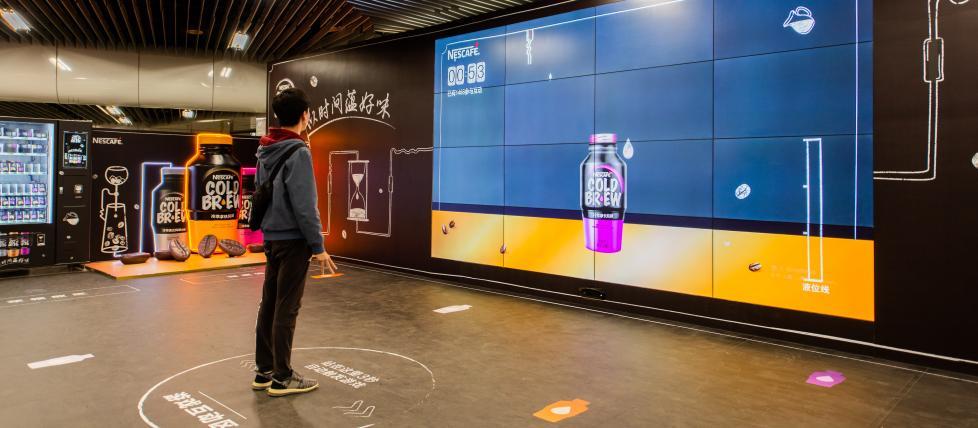
To promote its cold brew, Nescafé put a game on a screen wall at People's Square Station in Shanghai. Commuters stood in a marked area and moved their bodies to steer a bottle under falling coffee drops, filling it within 30 seconds. Finish, and the screen showed a QR code for a free bottle from the vending machine nearby (Ads of the World). The prize was the product.
Game Of Go — Nike (2018)
Agency: Monks, Wieden+Kennedy · Mechanic: Arcade & Action · Platform: Installation
A poster cannot show how a sole bounces, so Nike let people in Los Angeles run on its Epic React foam. Players raced 400 metres on treadmills while motion-capture sensors turned each stride into an avatar dashing through foam, bubbles and confetti on the giant L.A. Live screens. Anyone elsewhere could run the race in a Snapchat lens.
Result: 4.5 million TV and 1.5 million out-of-home impressions, plus 25.6 million digital impressions for the Snapchat game, according to the production agency, Monks.
Which billboards react to your voice or your stare?
All Eyes On The S4 — Samsung (2013)
Agency: HEIMAT, Perfect Fools, Who's McQueen · Mechanic: Other · Platform: Installation
Swisscom launched the Samsung Galaxy S4 with a phone set into a poster site at Zurich's main station and one rule: look at it for 60 minutes and it is yours. The phone's eye-tracking refereed. A hot-dog seller going up in flames, a street musician and two stuntmen on motorbikes tried to break each stare, while webcams streamed it and friends tweeted onto the screen (Horizont, in German).
Result: Five of the 28 players won a phone, according to the agency's release in Horizont. Rackfish, which hosted the stream, counts 1.5 million live-stream views and more than 12 million ad impressions in Switzerland.
Eye Test — ESPN (2015)
Agency: Africa, with Webcore (site) · Mechanic: Quiz & Trivia · Platform: Web
ESPN Brazil wanted men who think their eyesight is fine to check it before watching the Champions League in HD, so it swapped an eye chart's letters for footballers and club crests. At an interactive bus shelter and on a webcam microsite, players stood a set distance from the camera and called out what they saw; voice recognition told them whether to see an optician before the next games (Marketing Society).
Result: We found no published play figures. At Cannes Lions 2015 the bus shelter won a Cyber Silver Lion and the website a Cyber Bronze (Bizcommunity).
Which billboards do you play through your phone?
The phone recognises the poster, opens a game or becomes a controller, so many can play at once.
Giant AR Screen — Emaar (2018)
Agency: UNIT9 · Mechanic: Arcade & Action · Platform: Installation
Emaar Entertainment promoted the launch of its VR Park with a game on the giant OLED screen above the Dubai Aquarium in Dubai Mall. Passers-by connected their phones over WiFi and got their own crosshair colour. Aliens from The Raft, a park attraction, appeared over a live feed of the mall; players tilted to aim and tapped to shoot, teaming up or chasing the leaderboard (UNIT9).
Burn That Ad — Burger King (2019)
Agency: DAVID São Paulo · Mechanic: Other · Platform: AR & VR
Burger King Brazil turned the ads of McDonald's, which spends four times more, into its own, says the agency's D&AD entry. Pointing the Burger King app at a rival ad set it alight in augmented reality and revealed a free Whopper coupon for BK Express, the app's order-ahead service, or the nearest restaurant. Vouchers were limited to one per person (The Drum).
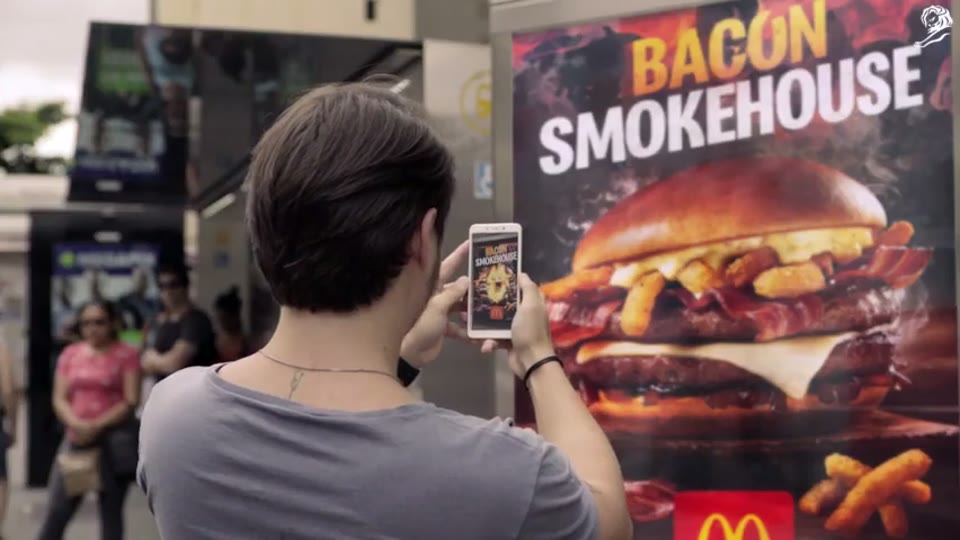
Result: One million app downloads in one month and a 54.6% increase in in-app sales, according to WARC's summary of the Cannes Lions entry.
Enter The Nether Lands — Doritos (2025)
Agency: Fitzroy Amsterdam, Livewall, Beyond · Mechanic: Adventure & Quest · Platform: AR & VR
For A Minecraft Movie, Doritos stood a Nether portal on Amsterdam's Museumplein for one day, 28 March 2025 (Dutch Cowboys, in Dutch). Visitors scanned an AR code on it and played on their phones: collect resources, craft weapons, sabotage a bridge to stop the Piglins, for a shot at an 18-carat gold Doritos chip worth €1,000 (Adformatie). The portal then travelled the country (Fitzroy), and more than 135 digital screens in the Netherlands and Belgium carried the game (Marketing Report).
Result: 400,000 unique interactions, 42.5 million impressions, a 185% rise in association with movie nights and a 27% uplift in brand preference, according to campaign figures published by Marketing Report alongside quotes from Doritos and Fitzroy; no period or baseline is given.
What if the street itself is the board?
Light Up Car Curling — Hyundai (2018)
Agency: INNOCEAN WORLDWIDE · Mechanic: Simulation & Strategy · Platform: Installation
During the PyeongChang Winter Olympics, Hyundai painted a curling target just before the stop line of a four-lane road beside Seoul's Dongdaemun Design Plaza and streamed the crossing on its Olympic website (Aju News, in Korean). Players picked which car would stop closest to the target; right calls earned donation points (Toyo Gyeongje, in Korean). Drivers never played: they were the curling stones.
Result: Stop-line compliance at the crossing rose from 73% on 1 February 2018 to a high of 92% on 18 February, and the game counted 1,835,480 participants, says the agency's Spikes Asia entry. The points raised KRW 99,698,100, all donated to Korea's curling association for disabled athletes, Aju News reported.
Fashion Shoot — Ariel (2011)
Agency: Saatchi & Saatchi, B-Reel, Atomgruppen · Mechanic: Arcade & Action · Platform: Installation
From 29 August to 3 September 2011, a glass box in Stockholm Central Station held an industrial robot loaded with ketchup, drinking chocolate and lingonberry jam (Ads of the World). Players on Ariel's Facebook page steered it live, three shots in 30 seconds at designer clothes moving past; computers outside let commuters join in. Every hit was washed on the spot with Ariel Actilift and posted to the player (case film).
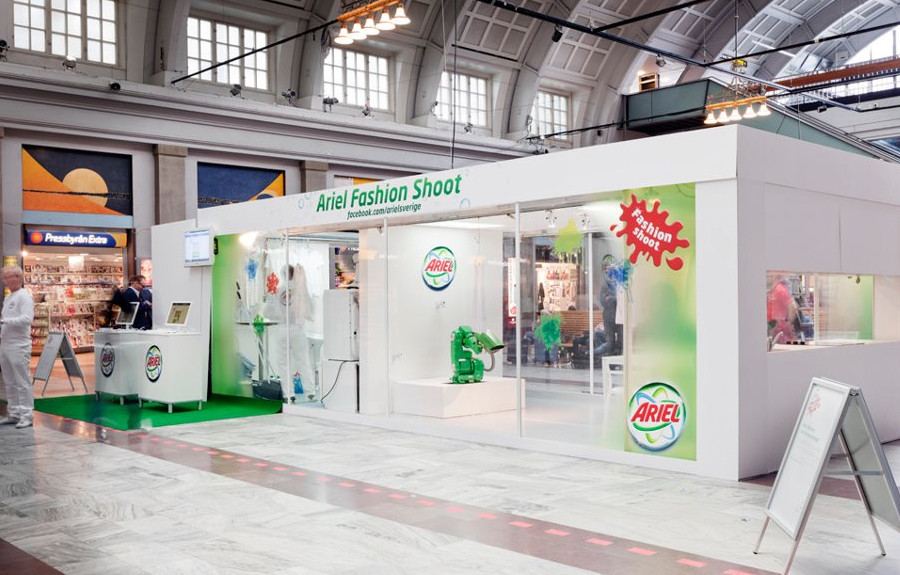
Result: 1.2 million people passed the box, every live slot across 36 hours of play was filled and 1,010 winners got a washed garment, according to the agency's case summary in Direct New Ideas.
Ten interactive billboards at a glance
| Game | Brand | Year | How people played | Result |
|---|---|---|---|---|
| Kicks-Off | Coca-Cola | 2018 | Shots against a star | 1,000+ interactions in two days |
| Shanghai metro game | Nescafé | 2018 | Body steers a bottle | Not published |
| Game Of Go | Nike | 2018 | Treadmill race | 1.5 million OOH impressions |
| All Eyes On The S4 | Samsung | 2013 | Hour-long stare | 5 of 28 players won |
| Eye Test | ESPN | 2015 | Call out footballers | Cannes Lions Cyber Silver |
| Giant AR Screen | Emaar | 2018 | Phones as controllers | Not published |
| Burn That Ad | Burger King | 2019 | AR on rival ads | 54.6% more in-app sales |
| Enter The Nether Lands | Doritos | 2025 | Portal opens phone game | 400,000 unique interactions |
| Light Up Car Curling | Hyundai | 2018 | Predict the stopping car | Compliance 73% to a 92% high |
| Fashion Shoot | Ariel | 2011 | Remote stain robot | 1,010 winners |
What do the interactive billboards that work have in common?
One action a stranger gets at once. Our rule of thumb: if a passer-by cannot tell what to do within ten seconds, they walk on. Nescafé marked the spot on the floor and capped the round at 30 seconds.
A prize within reach. A bottle from the machine beside the screen, the phone in the poster, a Whopper in the app.
The outcome captured before people leave. Coca-Cola traded the photo for contact details, Burger King sent the coupon to an order-ahead service and Hyundai turned right guesses into donations.
A phone hand-off when the screen cannot hold a queue. ESPN's storefront game peaked at 40 games an hour over lunch (Communication Arts). Doritos opened its portal on Amsterdam's Museumplein for one day, then toured it and ran the game on more than 135 screens; Nike's lens counted 25.6 million impressions. Our QR code games guide covers the phone side.
A show for the watchers. Samsung had 28 players and 1.5 million live-stream views.
When is an interactive billboard the wrong tool?
- When the audience is driving. Never ask a driver to play. In the US, signs along Interstate and federal-aid primary highways fall under State/Federal agreements, most of which bar off-premise signs in commercial and industrial areas from flashing, intermittent or moving lights, though States may interpret this for digital signs (Federal Highway Administration). Hyundai made drivers the stones, not the players.
- When people pass too fast. A game needs dwell time and the screen to itself, but standard slots are short: Lamar's digital billboards rotate ads every 6 to 8 seconds. Buy the screen outright or put the game on phones.
- When the site needs work you cannot finish in time. TELUS's urinal game meant drilling and work on wiring and pipes in each bar that could take it, so the campaign kept to one market, its media agency said (Strategy). Agree power, sound, crowds and hours with the media owner and venue first.
- When the camera does more than run the game. In the UK, the Information Commissioner's 2021 Opinion on live facial recognition notes that marketing uses tend to categorise people, usually in digital out-of-home, and that organisations must justify the technology, process data lawfully, fairly and transparently and should carry out a Data Protection Impact Assessment, the ASA summarises. If your board reads faces, tell people on site and finish that assessment before launch.
FAQ
Can you give me some examples of interactive billboards?
Samsung's All Eyes On The S4 gave a phone set into a Zurich poster to anyone who could look at it for an hour; five of 28 players did. Coca-Cola's Kicks-Off put commuters on a pitch with Xherdan Shaqiri. Nescafé's metro game gave a free cold brew to players who filled a bottle within 30 seconds, and Burger King's Burn That Ad turned rival posters into free Whoppers.
What is an electronic billboard called?
Usually a digital billboard; media owners such as Lamar sell them under that name. Screens in public places, from roadside boards to station and mall screens, form DOOH, digital out-of-home. An electronic billboard becomes interactive only when it responds to the person in front of it, through a camera, microphone, sensor or their phone.
How much does an interactive billboard cost?
There is no standard price, because media is only part of the bill. Budget for screen time, custom hardware such as cameras or sensors, software, staff, prizes, permissions and the film that carries the stunt further. We found few published budgets. Hyundai's 2018 Spikes Asia entry for Light Up Car Curling, a 29-day street game with live celebrity broadcasts, gives a total budget of USD 800,000 for the whole campaign, including pre-launch promotion and an offline Olympic mascot event.
More stations, shop windows and street screens that people played are in the Installations collection and installation games; if your agency built one, send it to us.