


Pepsiman is the silver superhero Pepsi-Cola Japan put on TV in March 1996, created by Takuya Onuki. In KID's PlayStation game of 4 March 1999, sold only in Japan, he runs by himself while you dodge obstacles and grab cans. Suntory, which runs Pepsi in Japan, says he has not been used since around 2000 because the brand's marketing strategy changed.
We used our library record, a 1997 Japanese marketing magazine, Sony's and Famitsu's catalogues, 1999 reviews and Suntory's statements. Where sources disagree, each date keeps its source.
What is the story behind Pepsiman?
He was made for Japan. The Broadcast Library lists Pepsi-Cola Japan as advertiser of his 1996 launch spot and Takuya Onuki as its creative director and planner (Broadcast Library). The trade monthly I.M. Press reported in August 1997 that he debuted in March 1996, with computer graphics by Industrial Light & Magic (I.M. Press).
In every ad Pepsiman rushes a Pepsi to someone thirsty, then suffers a slapstick accident, and the last shot shows a crumpled can (Kotaku). Citing Onuki's own account, Kotaku says his brief was a young, challenging, American Pepsi against Coca-Cola's traditional Japanese image, and that he decided "the talent has to be the product itself". The result was a brand mascot shaped like a can: a made-in-Japan hero posing as a stereotypical American, the Wall Street Journal wrote in May 1997 (WSJ).
Why did Pepsi Japan need a mascot?
I.M. Press wrote that Pepsiman's mission was to establish Pepsi-Cola's brand image, and beyond it the company's identity, among teenagers. Four of the first five spots topped CM Sogo Kenkyujo's monthly likeability survey, and Pepsi-Cola's 1996 sales volume rose 14% on the previous year, the magazine reported. A quiz for a Chevrolet Corvette, run from 1 April to 31 July, drew 964,769 entries, and an on-pack offer for watches about 390,000. Pepsiman U.S.A. merchandise followed, with T-shirts at Sony Plaza from 20 June 1997 and games among the categories planned for that autumn (I.M. Press).
How does the Pepsiman game play?
Pepsiman — Pepsi (1999)
Developer and publisher: KID · Brand: Pepsi · Mechanic: Arcade & Action · Platform: PlayStation, Japan only · Released: 4 March 1999
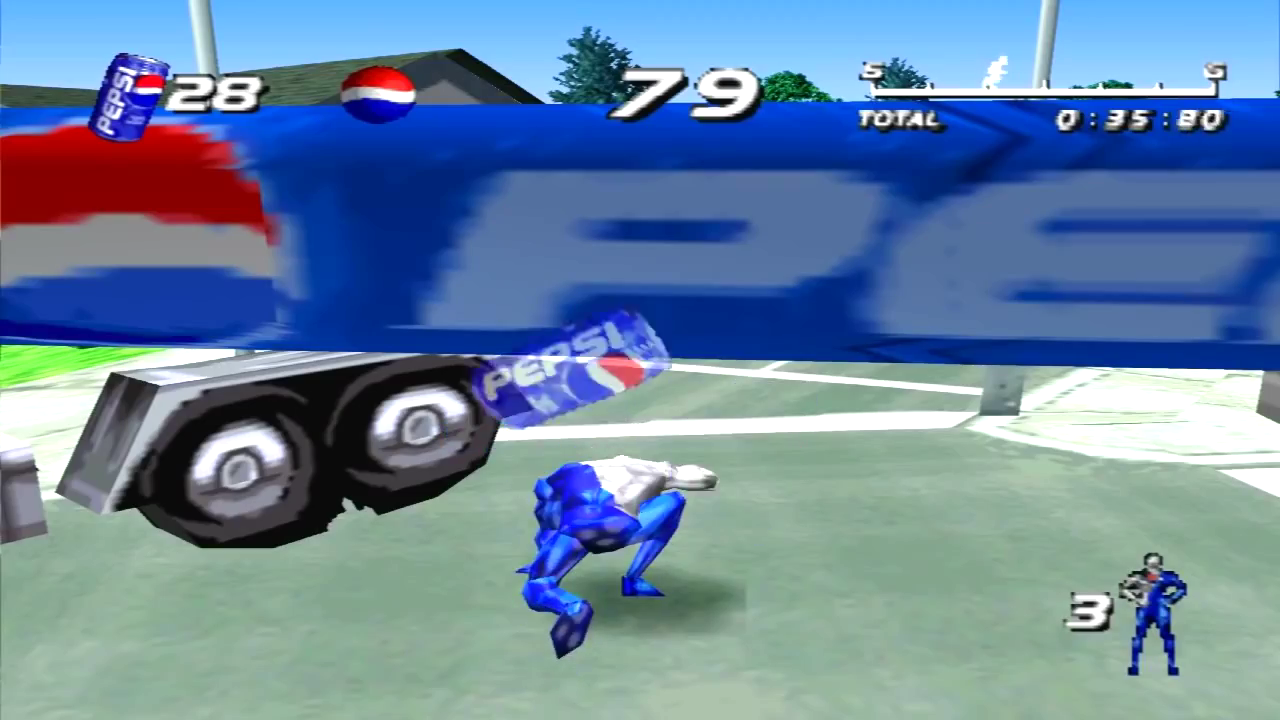
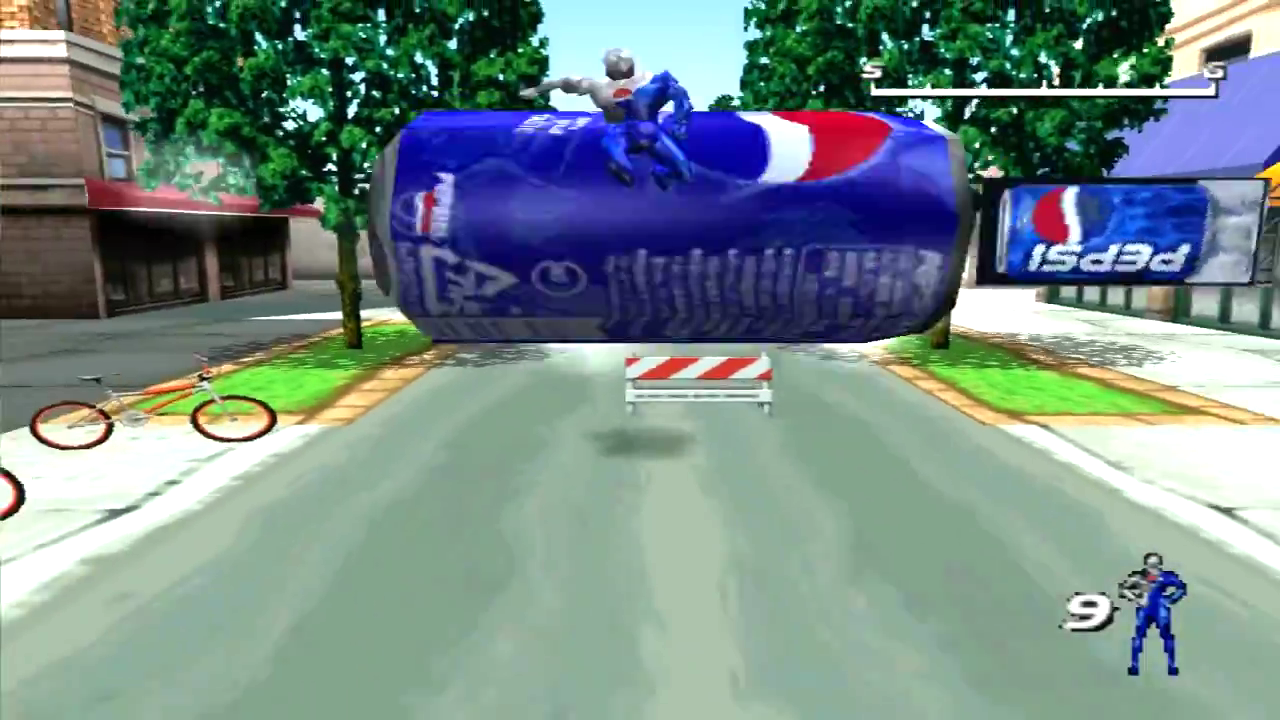
Pepsiman runs forward on his own. You move left and right, jump, slide and dash, with no way to fight anything (Cola Shikiho). The four stages, San Francisco, New York, Texas and the invented Pepsi City, each have three scenes: collect Pepsi on the way to a destination, deliver the drink, then run towards the camera to escape something huge, such as a Pepsi sign or a lorry (Cola Shikiho; Hardcore Gaming 101). Cans are the score, 100 per section by Hardcore Gaming 101's count, and a timer runs (Hardcore Gaming 101). Your health is a Pepsi logo at the top of the screen that shrinks as you take hits (our record).
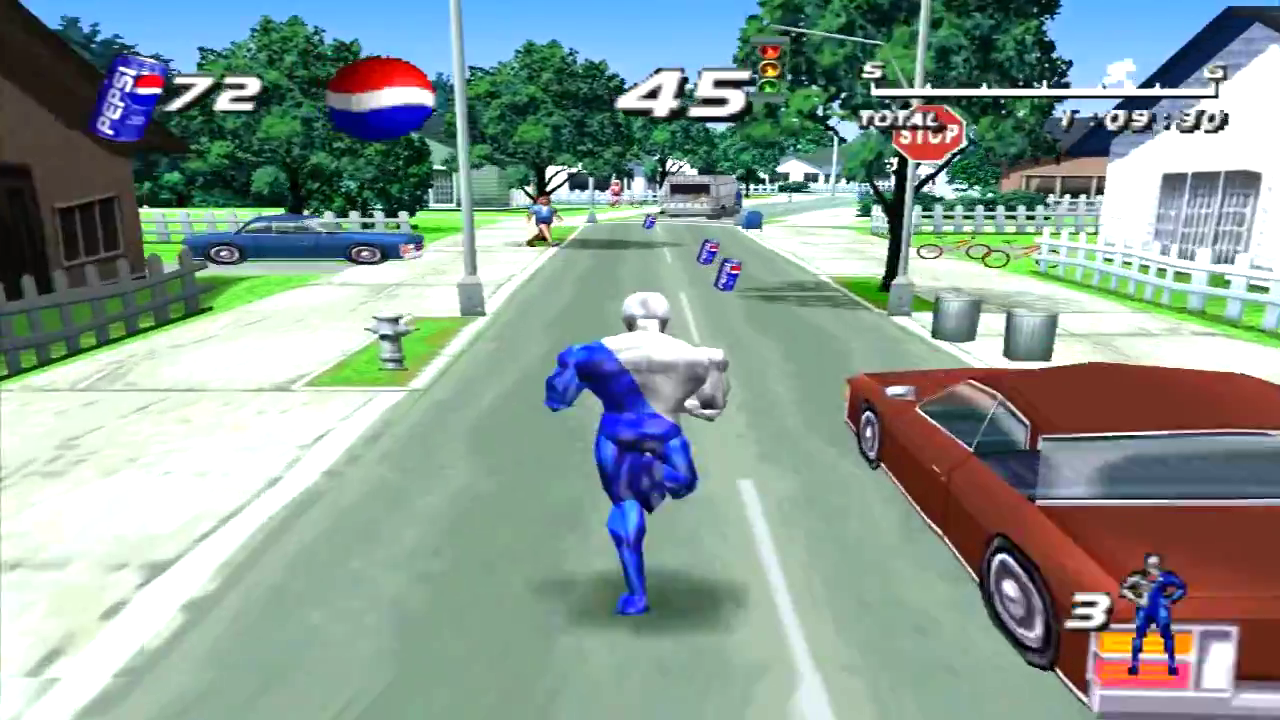
Some scenes change the rules: a steel drum over Pepsiman reverses the controls, others put him on a skateboard (Destructoid). Between stages, live-action clips show actor Mike Butters at home with Pepsi, crisps and pizza (Kotaku, Destructoid). Finishing every stage opens free play and an older, red Pepsiman, which Cola Shikiho calls the version from before the Suntory tie-up.
The box admitted what it was: its spine called the game a commercial from start to finish (Cola Shikiho), and Sony's catalogue said the Pepsiman of the TV ads gave it outstanding name recognition (PlayStation catalogue). It cost ¥2,800 (Famitsu). In April 1999 GameSpot reported that a notable US publisher was looking at the American rights, if a deal with Pepsi could be negotiated (GameSpot); it never reached the US (Kotaku). Our history of advergames counts it among 1990s mascot console games.
Is Pepsiman an endless runner?
Strictly, no. Wikipedia defines the genre by a never-ending level and a high score, yet cites Pepsiman as a 3D endless runner that predates the mobile trend (Wikipedia), as does Hardcore Gaming 101. It has the automatic run, but also fixed stages, destinations, time limits and an ending: a stage-based runner, and an ancestor of the endless runner.
Why is Pepsiman so popular?
The mascot was a hit in 1990s Japan; the game's fame came years later. GamesRadar puts its cult status down to a bizarre concept, absurd energy and better-than-you'd-think play (GamesRadar). At launch, Famitsu's cross review gave it 25 points out of 40, one reviewer calling it a super-simple game reminiscent of Namco's Metro-Cross (Famitsu). IGN found it not that bad and, as a $20 budget title, worth the money (IGN); GameSpot's James Mielke called it "a nifty little distraction". Kotaku says it was not a financial success.
It ran at the Summer Games Done Quick charity marathon in 2016, and Games Done Quick kept bringing it back (Kotaku). In May 2019 the Angry Video Game Nerd series played it with Mike Butters as a guest (Denfaminico Gamer).
Why doesn't Pepsi use Pepsiman anymore?
Suntory, which markets Pepsi in Japan, gave the only official answer we found. In September 2021 its Pepsi brand team told J-CAST Trend that Pepsiman had not been used since around 2000 because the brand's marketing strategy changed, and that a comeback was undecided (J-CAST).
The change of hands is the context. Pepsi-Cola Japan ran the 1996 launch (Broadcast Library); Suntory acquired master franchise rights for the Pepsi brands in Japan in late 1997, in October by its English timeline (Suntory) and in December by its securities filings (Suntory Beverage & Food), and began its own marketing there in 1998. The game came out in Suntory's second year with the brand.
English-language sources often date the end to 2003, when Kotaku says Pepsiman was retired; that year a lemon-headed spin-off, Pepsi Twist Man, fronted ads for Pepsi Twist (J-CAST). As with Millsberry, we found nothing more from the owner.
- March 1996Pepsiman's first TV spotPepsi-Cola Japan launches the silver superhero created by Takuya Onuki, with computer graphics by Industrial Light & Magic.
- 1996Sales volume up 14%I.M. Press reports that Pepsi-Cola's sales volume rose 14% on the previous year; by mid-1997, four of the five spots aired had topped a monthly likeability survey.
- June 1997Pepsiman U.S.A. goodsT-shirts go on sale at Sony Plaza from 20 June, with games among the merchandise categories planned for that autumn.
- Late 1997Suntory takes the franchiseSuntory acquires master franchise rights for the Pepsi brands in Japan (October 1997 in its English timeline, December 1997 in its securities filings) and begins its own marketing in 1998.
- 4 March 1999The PlayStation gameKID releases Pepsiman for PlayStation in Japan, priced at ¥2,800.
- April 1999US rights under discussionGameSpot reports that a US publisher is looking at the American rights, if a deal with Pepsi can be negotiated. The game never reaches the US.
- Around 2000The last Pepsiman adsSuntory later says Pepsiman has not been used since around 2000, after a change in the Pepsi brand's marketing strategy.
- 2003Pepsi Twist ManA lemon-headed spin-off fronts ads for Pepsi Twist; Kotaku dates Pepsiman's retirement to this year.
- 2016Summer Games Done QuickThe charity speedrun marathon runs Pepsiman and keeps bringing it back.
- May 2019Angry Video Game NerdThe web series plays the game, with actor Mike Butters from its live-action clips as a guest.
- October 2020Soundtrack on vinylChipped Records releases a 7-inch single with the permission of MAGES., which now holds KID's rights.
- September 2021Suntory: revival undecidedSuntory's Pepsi brand team tells J-CAST Trend that a Pepsiman comeback is undecided.
- August 2025Should we create a Pepsi video game?Pepsi's official account asks on Twitter and is flooded with Pepsiman replies.
Is Pepsiman still a thing?
As a fan favourite, yes; as a mascot, no. In August 2025 Pepsi's official account asked on Twitter whether it should make a video game and was flooded with Pepsiman replies. Kotaro Uchikoshi, a 3D modeller on the game at KID, offered to contact the original team; the offer appeared to go unanswered (GamesRadar).
The one licensed revival we found is music: in October 2020 Chipped Records put the soundtrack on a 7-inch single with the permission of MAGES., which now holds KID's rights (4Gamer). J-CAST reported a fan remake demo posted on YouTube in February 2021, with 270,000 views by that September.
Can you play Pepsiman today?
Only on the original disc, as far as we can tell. We found no official re-release: Sony's catalogue lists only a PlayStation disc, and the game never left Japan (GamesRadar). Second-hand copies appear on Mercari (J-CAST) and sell for hundreds of dollars on eBay (GamesRadar). We don't link copies of the game files.
What marketers can learn from Pepsiman
- Make the mascot out of the product. His body is the can and his health bar the logo, so every second of play shows the brand.
- Sell brand time, not a spot. At ¥2,800, players paid to spend time inside a game its own box called a commercial. Coca-Cola Japan did the same in 1994 with Coca-Cola Kid, starring its mascot Cokey on Sega's Game Gear (our record).
- Keep the loop simple and let it be strange. GameSpot counted two buttons; players remember the live-action clips.
- Put the game inside a programme. Quizzes, on-pack offers and T-shirts came first; the game was one licensed item among them.
When not to copy it:
- When the mascot belongs to a strategy, not the brand. The franchise changed hands in 1997; around 2000 the strategy changed and the hero went with it.
- When you hand the character to someone else. KID made and published the game, a US release depended on a deal with Pepsi, and KID's rights now sit with MAGES., so a re-release would likely need both sides. Mascots were often licensed out: Frito-Lay gave Chester Cheetah to the publisher Kaneko for Too Cool To Fool, and Virgin Games made Cool Spot for 7 Up (our records).
- When the brief is a sales number. We found no published sales figures for the game; the measured results came from the ads and promotions. Compare the Burger King Xbox games, sold at the till.
FAQ
Why doesn't Pepsi use Pepsiman anymore?
Suntory, Pepsi's franchise holder in Japan since 1997, told J-CAST Trend in September 2021 that Pepsiman had not been used since around 2000 because the brand's marketing strategy changed, and that a revival was undecided (J-CAST). A lemon-headed spin-off, Pepsi Twist Man, appeared in 2003, the year some sources give for his retirement.
What is the story behind Pepsiman?
Pepsiman is a superhero created for Pepsi in Japan by creative director Takuya Onuki, with computer graphics by Industrial Light & Magic. From March 1996 TV ads showed him delivering Pepsi to thirsty people before a slapstick accident. In 1999 KID released a Japan-only PlayStation game starring him, which became a cult favourite years later. View the case.
Is Pepsiman still a thing?
As a cult game, yes; as a mascot, no. Suntory said in 2021 that a revival was undecided. Fans keep him alive with Games Done Quick speedruns, a 2019 Angry Video Game Nerd episode and a fan remake. The soundtrack came out on vinyl in 2020 with the rights holder's permission, and in August 2025 Pepsi's account drew a flood of Pepsiman replies by asking about a video game.
Is Pepsiman an endless runner?
Not strictly. Pepsiman runs forward automatically, as in an endless runner, but the game has four fixed stages of three scenes, destinations, a timer and an ending. Wikipedia and Hardcore Gaming 101 still class it as an endless runner that predates the mobile craze. Stage-based runner is the more precise term.
Pepsiman is one of 27 games in our classic advergames collection, and Pepsi's brand page lists two Pepsi games; if you made a mascot game we are missing, send it to us.