


Millsberry was General Mills' free online town for children: you built an avatar called a Buddy, earned Millsbucks in mini-games, many of them cereal-branded, and fed your Buddy cereal. It ran from 2004 to 2010, and its farewell letter gave no reason for closing. Post Cereals' rival world, Postopia, went offline in the same weeks.
We rebuilt both stories from our library records, Wayback Machine captures, Yale Rudd Center research and press reports from 2004 to 2022. Audience figures come from different counters and years, so each keeps its source and scope.
What was the Millsberry game?
Millsberry — General Mills (2004)
Agency: not credited · Mechanic: Mini-games · Platform: Web · Online: 2004 to 2010
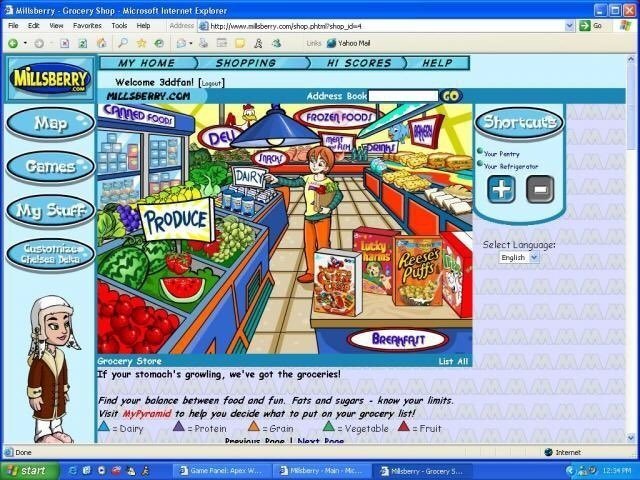
You signed up free and built a Buddy, choosing its hair, eyes, skin tone, clothes and personality. It lived in a town with a grocery store, a post office and a city hall. Games paid Millsbucks, the town's currency, which bought clothes, groceries, a house and furniture; at the post office you could send another player a greeting (Journal of Health Communication). The arcade held games such as Reese's Puffs Cereal Snowboard Slalom and Lucky Charms Charmed Life (General Mills). Between games you fed your Buddy "big bowls of branded cereal", in Salon's words (Salon), and players could collect a daily login bonus of Millsbucks (Games Finder).
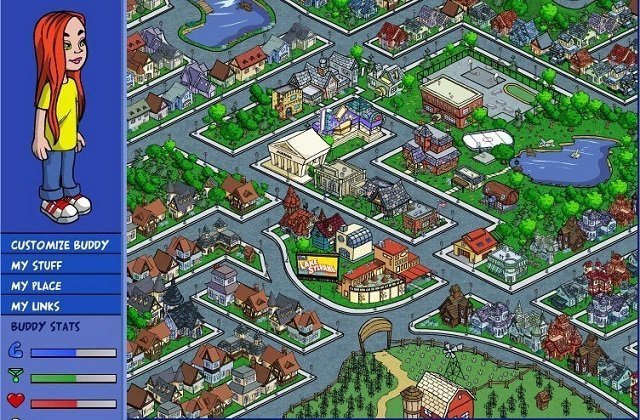
Result: In October 2009 Yale's Rudd Center reported that Millsberry.com averaged 767,000 unique young visitors a month, who stayed nearly 24 minutes per visit (Yale News). A 2013 paper using comScore data for January 2008 to March 2009 splits that into 386,800 visitors aged 2 to 11 and 380,200 aged 12 to 17, who viewed 103 pages per visitor on average (Journal of Health Communication). TIME reported more than 750,000 unique visitors a month under 18, who came 2.8 times a month on average (TIME). Both reports were critical of cereal marketing to children.
What was Postopia?
Postopia — Post Cereals (2001)
Agencies: Scient (first version), Razorfish (by 2004), Skyworks Technologies (games) · Mechanic: Mini-games · Platform: Web · Online: 2001 to 2010
Postopia was a portal, not a town. You picked one of four lands: gadget city Futuria, the snowy Ice Burbs, the orbiting Space Nation and the underwater Wet World, each with short browser games from races to dress-up and virtual pets (our record). By October 2003 the site listed "Postoken Powered" games (Wayback Machine): a Postoken was a password from a cereal box that opened secret levels, extra lives and bonus powers. In April and May 2004 a Justice League tie-in put Postoken cards in 15 million boxes of eight Post kids' cereals; the code opened a comic builder, and your finished story could be emailed to a friend or posted in the site's gallery (Chief Marketer).
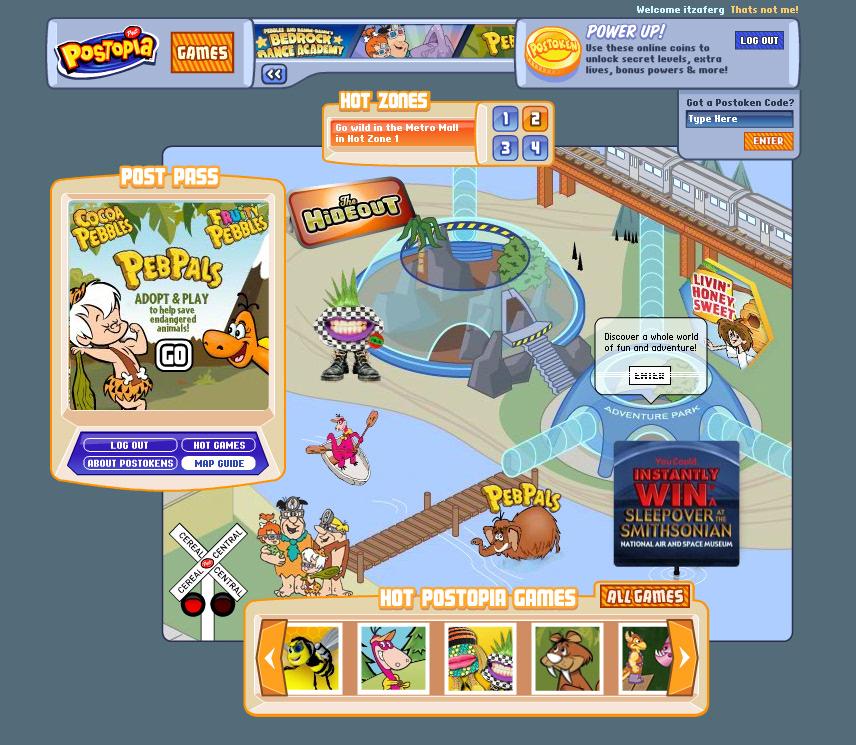
Result: Jim Fitts, creative director at Scient when the site was created, says TV ads and the backs of 17,000,000 cereal boxes promoted it (Jim Fitts). In June 2004 the Seattle Times reported that the Razorfish-built Postopia drew up to 2 million regular users, with children spending an average of 30 minutes per visit (Seattle Times). In October 2009 TIME put the average at 264,700 visitors a month (TIME).
Cereal box games: from Chex Quest to Postokens
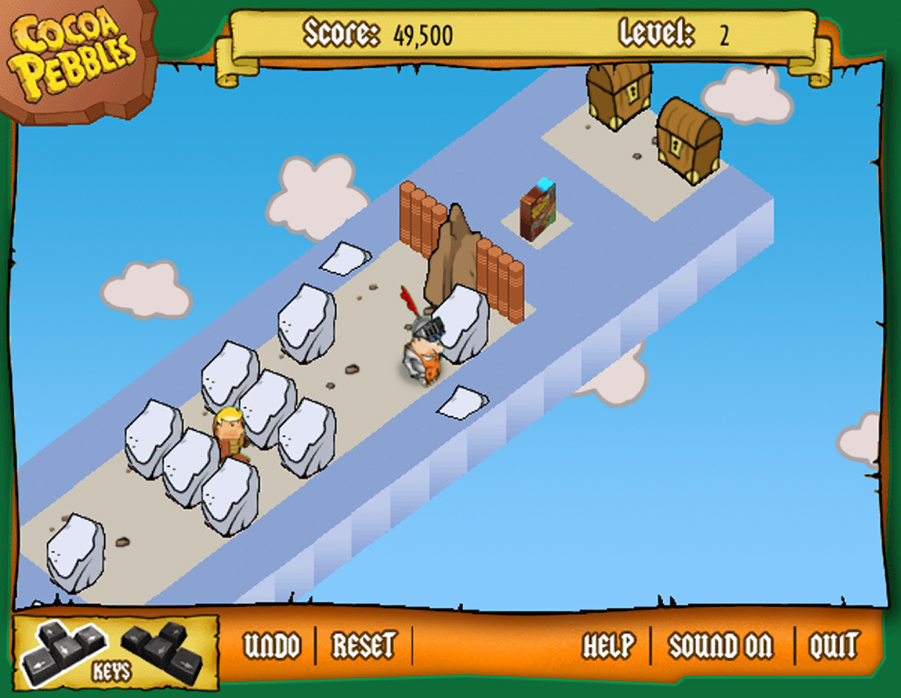
The box was media the brands already owned. In 1997 Ralston Foods packed a whole PC game, Chex Quest, into 5.7 million boxes of Chex; its 1998 Reggie award entry reports a 295% increase in incremental volume over base and a 48% rise in volume share on the previous year (PMA Reggie Awards). Postopia used the box twice: first as an ad on the back, then as a carrier for codes, so a new box could open something new, a classic on-pack promotion. Millsberry did the reverse and put the shelf inside the game: its grocery store stocked General Mills cereals for your Buddy.
Why was Millsberry shut down?
General Mills gave no public reason. Its farewell letter said the town was closing and its citizens graduating, and recalled $109,000 donated to charities over six years. A postscript dated 12 November 2010 said the team had weighed every option and found the decision very difficult (Wayback Machine). The site still showed 1,969 citizens online on 30 December 2010 (Wayback Machine); by 2 January 2011 its pages said farewell and offered downloads such as wallpapers and a history book (Wayback Machine), and the letter was captured on 5 January. In 2022 Salon quoted a fan's forum post claiming a company representative had blamed falling participation; General Mills did not answer Salon's request for comment (Salon).
The documents show pressure on the whole category. In November 2006 the Better Business Bureau and ten food companies launched a self-regulation scheme, the Children's Food and Beverage Advertising Initiative; a 2008 report noted that after announcing its pledge, General Mills had taken several products off Millsberry and removed games featuring Double Chocolate Cookie Crisp (CBBB). In October 2009 the Rudd Center named Millsberry in a report finding that the least healthy cereals were marketed to children most aggressively (Yale News), and in November the initiative extended its scope to new digital and mobile media (BBB National Programs). In 2012 the researchers noted that Millsberry and Postopia, the two most-visited children's advergame sites, had been discontinued, and that losing Millsberry had cut General Mills' banner advertising on children's websites by 43% (Yale News).
What happened to Postopia?
It went dark a little earlier. Wayback captures show its game pages running on 12 December 2010 (Wayback Machine) and returning "not found" from 22 December (Wayback Machine). On 2 January postopia.com showed a Pebbles page (Wayback Machine), and by 30 March 2011 it redirected to PebblesPlay.com (Wayback Machine).
We found no statement from Post on why. In the second half of 2007, under Kraft's pledge, the products in Postopia's games all met Kraft's nutrition criteria (CBBB). Ralcorp completed its purchase of Post cereals from Kraft in August 2008 (FoodIngredientsFirst), and a designer whose team Post asked to redesign Postopia says the project was defunded when Kraft sold the division (Tim Sheridan).
- February 2001Postopia is onlineThe earliest Wayback Machine snapshot of postopia.com. Scient built the first version; its creative director recalls TV ads and the backs of 17,000,000 cereal boxes promoting it.
- October 2003Postoken Powered gamesPostopia lists "Postoken Powered" games, with rewards unlocked by codes from cereal boxes.
- April–May 2004Justice League codesPostoken cards in 15 million boxes of eight Post kids' cereals open a comic builder on the site.
- June 2004Up to 2 million regular usersThe Seattle Times on the Razorfish-built Postopia: an average of 30 minutes per visit.
- July 2004Millsberry is onlineThe earliest Wayback Machine snapshots of General Mills' town for children.
- November 2006Industry self-regulationThe Better Business Bureau and ten food companies launch the Children's Food and Beverage Advertising Initiative.
- August 2008Post changes ownerRalcorp completes its purchase of Post cereals from Kraft. A designer later says the sale stopped a planned Postopia redesign.
- October 2009Rudd Center reportMillsberry.com averages 767,000 unique young visitors a month, staying nearly 24 minutes per visit. TIME puts Postopia at 264,700 visitors a month.
- 12 November 2010Millsberry postscriptThe Millsberry team tells fans it weighed every option before closing the town.
- 22 December 2010Postopia's games are goneA game page returns "not found"; by 2 January 2011 postopia.com shows a Pebbles page.
- 30 December 2010Last days of MillsberryThe site still shows 1,969 citizens online.
- 2–5 January 2011Millsberry farewell letterBy 2 January the site's pages say farewell and offer downloads such as wallpapers and a history book; the letter from the Millsberry team at General Mills is captured on 5 January.
- 30 March 2011PebblesPlay.compostopia.com now redirects to PebblesPlay.com.
- 2012Both sites discontinuedThe Rudd Center notes that Millsberry and Postopia, the two most-visited children's advergame sites, were discontinued.
Can you still play Millsberry or Postopia?
Not as they were. Both ran on servers that are gone, and Adobe blocked Flash content from 12 January 2021 (Adobe). The Wayback Machine keeps snapshots of millsberry.com from July 2004 and of postopia.com from February 2001 (Wayback Machine); you can look around but not log in. Flashpoint Archive, a web-game preservation project, keeps single games: on 19 October 2026 its search listed two from Millsberry, Lucky Charms: Charmed Life (credited to Neopets) and Millsberry 500 (Flashpoint Archive), and dozens from Postopia, among them the Justice League Comic Builder (Flashpoint Archive).
What marketers can take from Millsberry and Postopia
- A home the brand owns. Both sites gave children somewhere to return to: a house to furnish, a Buddy to dress, four lands to explore.
- Codes that change the game. Postokens tied a box to something new on screen, still the best reason to put a code on pack. QR code games are the modern version.
- A proper ending. Millsberry closed with a letter, a reply to fans and downloads to keep; General Mills still mentions the commemorative yearbook in 2026 (General Mills). Plan the goodbye before launch.
When not to copy it:
- Children under 13. In the US, COPPA puts requirements on sites and services directed to children under 13 (FTC), and a world of accounts, profiles and messages collects the personal information it covers. Check with counsel.
- Less healthy food. In the UK, ads for products high in fat, salt or sugar may not be directed at under-16s (CAP Code rule 15.20), and since 5 January 2026 less healthy food or drink has been barred from paid-for online advertising (GOV.UK). In the US, General Mills belongs to the industry initiative, whose members advertise to children only products meeting its nutrition criteria, or nothing (BBB National Programs). A sugary-cereal town for children would struggle under both.
- A daily bonus is not a daily habit. Millsberry paid a daily reward, yet its average young visitor came 2.8 times a month (TIME).
- Upkeep never ends. Postopia's producer says he launched more than 100 games in his ten years on the project (Ryan Bond). And a change of owner can stop the next version.
FAQ
Can you still play Millsberry?
Not officially. General Mills ran Millsberry from 2004 to 2010 and has not brought it back. The Wayback Machine keeps snapshots of millsberry.com that you can browse but not log in to, and Flashpoint Archive preserves single Millsberry games such as Lucky Charms: Charmed Life and Millsberry 500 (Flashpoint Archive). See the case.
Is there a game like Millsberry?
Not from a cereal brand. Children's virtual worlds that still run are entertainment products: Webkinz, from the toy maker Ganz, on Windows, Mac and Android, and Neopets on the web. Disney set Club Penguin, started in 2005, to close on 29 March 2017 (TechCrunch). A brand that wants its own world today can build it inside Roblox: see our Roblox collection of 50 games and our guide to brands on Roblox.
Why was Millsberry shut down?
General Mills gave no public reason; its farewell letter said only that every option had been weighed. The documented context is industry self-regulation from 2006, which General Mills applied to Millsberry, its extension to new digital and mobile media in 2009, and a 2009 Yale Rudd Center report that named the site in its criticism of cereal marketing. A fan's claim that participation had fallen has not been confirmed by General Mills.
What was the Millsberry game?
A free virtual town for children that General Mills ran at millsberry.com from 2004 to 2010. Players built an avatar called a Buddy, earned Millsbucks in mini-games such as Reese's Puffs Cereal Snowboard Slalom, spent them on clothes, food and a house, and fed the Buddy branded cereal. Yale's Rudd Center reported in 2009 that it averaged 767,000 unique young visitors a month. View the case.
What happened to Postopia?
Post Cereals' Postopia, online since February 2001, went offline at the end of 2010. The Wayback Machine shows its games running on 12 December 2010 and gone by 22 December; by March 2011 postopia.com redirected to PebblesPlay.com. Post gave no public reason we could find, and Flashpoint Archive preserves dozens of its games. See the Postopia case.
Millsberry, Postopia and Chex Quest sit among the 27 games in our classic advergames collection; if you made one we are missing, send it to us.