


Yes, Cool Spot was 7 Up. Spot was the red dot from the 7 Up logo, made into a cartoon mascot in 1987. Virgin first put him in a 1990 board game, then in Cool Spot, a 1993 platformer for the Sega Genesis that went on to six other systems and, by a Virgin executive's account, sold a million copies.
This case follows one character through two games in our library, using 1990s magazines, Hardcore Gaming 101, a Virgin executive's interview and a 1995 newspaper report. For the wider story, see our history of advergames.
Who was Spot, the 7 Up mascot?
The owner's own history says 7 Up introduced Spot in 1987 as a character derived from the red dot in the 7 Up trademark, and that he spread quickly to licensed items across the United States (Dr Pepper Snapple Group). The International Directory of Company Histories credits him with reviving the "uncola" theme of the 1970s (Encyclopedia.com). A red disc with sunglasses and sneakers, he was a brand mascot made for games: the logo already was the hero.
He was an American character. In 1986 Philip Morris sold 7 Up's international business to PepsiCo and the US business to the investors Hicks & Haas, according to the same company history. Elsewhere 7 Up used Fido Dido, a cartoon created in 1987 that, the Australian trade weekly B&T wrote in 2003, marketed the drink until the early 1990s (B&T). That split shaped Cool Spot.
Spot: The Video Game — 7 Up (1990)
Developer and publisher: Virgin Mastertronic · Brand: 7 Up · Mechanic: Simulation & Strategy · Platforms: NES, Game Boy, MS-DOS, Amiga and other home computers
The first Spot game was a board game. In November 1990 Compute! announced "SPOT the Computer Game" from Virgin Mastertronic of Irvine, California, at $29.99, with five difficulty levels and a board you could customise (Compute!).
You and up to three rivals take turns on a grid of squares. Move a piece one square and it clones itself; jump two squares and it moves. Every enemy piece next to the landing square switches to your colour (Hardcore Gaming 101). Spot does the moving: Computer Gaming World's December 1990 review watched him dive, cartwheel, moonwalk or pole-vault into the chosen square. Its reviewer counted nine levels of computer opponent and more than 500 board layouts, listed the price at $39.99 and the designer as Graeme Devine. Hidden squares opened a slot machine where three 7-Up logos, cherries, Spots or Virgin Mastertronic logos won a free turn, a free placement, extra time or a swap of pieces (Computer Gaming World).
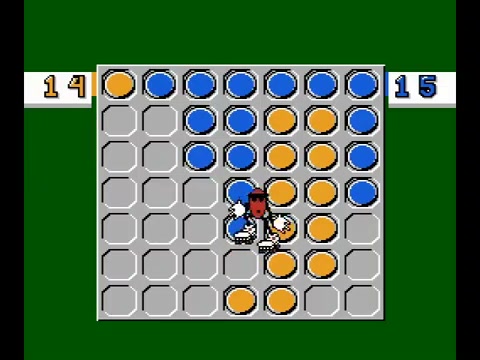
The British magazine The One reported in February 1991 that the game began as Infection, planned as the lead title of Virgin Mastertronic's budget label, until interest moved it to full price. The same rules had already reached arcades as Leland's Ataxx, and the US Amiga, PC and Nintendo versions came out as Spot, with added animation of the 7 Up character (The One). Hardcore Gaming 101 says Virgin added Spot to a board game it already had and raised the price. Still, Stephen Clarke-Willson, later Virgin's vice-president of product development, said Devine's Spot, whose character jumped off the screen, drew him to the company (Sega-16).
Cool Spot — 7 Up (1993)
Developer: Virgin Games · Brand: 7 Up · Mechanic: Arcade & Action · Platforms: Sega Genesis/Mega Drive, then Super NES, Game Boy, Game Gear, Master System, Amiga and MS-DOS
How was Cool Spot made?
Clarke-Willson told Sega-16 that Cool Spot started as a Super NES platformer inspired by Castle of Illusion and was struggling, until David Perry, fresh from Global Gladiators, put the Spot animations into that game's engine on the Genesis and it came to life. Bill Anderson, a former mechanic, designed all the levels, and David Bishop came over from Virgin's UK office to help with design. In May 1993 Sega Pro named the rest of the core team: animators Shawn McLean and Mike Dietz, Christian Laursen on backgrounds and Tommy Tallarico on music. It reported three months of programming, a month of testing and two months in Sega's quality checks, and said Sega of America was impressed enough to take the publishing rights from Virgin (Sega Pro). GamePro's April 1993 review duly credits the Genesis cartridge to Sega of America (GamePro).
As licensed games go, the deal was cheap. Clarke-Willson recalled paying something like 25 cents a unit for access to $10 million of 7 Up advertising at Christmas, adding that "most people said Seven-Up should be paying us" (Sega-16).
What do you do in Cool Spot?
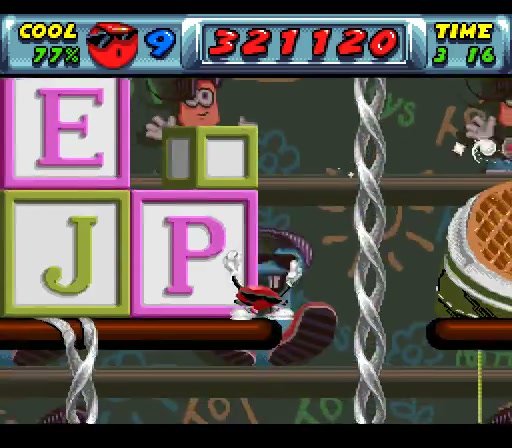
Some unseen villain has caged Spot's identical friends. In each level you collect the small red "cool points" scattered around it, and once you have enough, 60% on the standard setting, you can shoot open the cage (Hardcore Gaming 101). Spot fires fizzy bubbles in any direction, climbs ropes and rides balloons. The world is ours at giant scale: GamePro listed a beach, a pier, the space between the walls, a wading pool and a toy train set across 11 levels, with hermit crabs and cheese-throwing mice as enemies. Your health is Spot's own face in the corner, peeling away as you take hits, and a clock counts down. Water kills instantly.
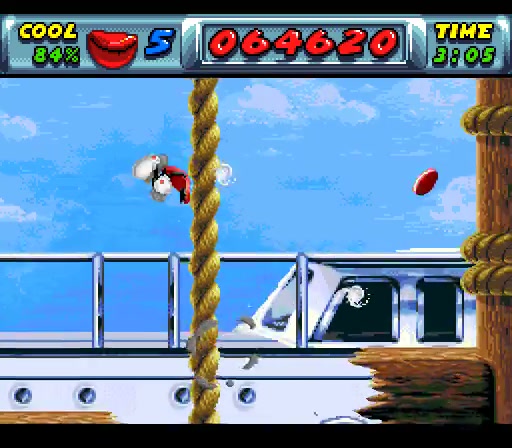
Collect 85% and you enter a bonus stage inside a 7 Up bottle, where bubbles carry you to extra points and a hidden letter. The letters spell UNCOLA, and each one is a continue (Hardcore Gaming 101). In GamePro's copy, a glass of 7 Up restored Spot's health. Sega Pro's review carried a UK offer: complete the game on the difficult setting without cheating and win a prize.
Why are the European versions different?
Because Spot belonged to the US. Perry told Sega Pro that 7 Up had Fido Dido in Europe and Spot in the States. Hardcore Gaming 101 found that all PAL versions remove 7 Up entirely: the title-screen bottle is blank, the health pickups are clear bottles with Virgin's logo, and the bonus letters spell VIRGIN.
How was Cool Spot received?
Well, at launch. GamePro gave the Genesis version 5.0 for graphics and 4.0 for sound, control and fun, at $54.99, praising the animation and finding the diagonal shooting fiddly. Sega Pro scored the Mega Drive version 93%. Nintendo Power covered the Super NES version in October 1993 as "the latest game from Virgin" (Nintendo Power). Hardcore Gaming 101's retrospective is cooler: a pretty game that wears on your patience, with the later Super NES version a little more enjoyable and the Amiga and Game Boy versions the weakest.
Result: "That game sold a million copies," Clarke-Willson told Sega-16 in 2006, a figure from the publisher's side. We found no audited sales number and no published effect on 7 Up's sales.
Why did 7 Up drop Spot?
Between them came Spot: The Cool Adventure (Game Boy, 1992), Virgin's McDonaldland platformer with new sprites, says Hardcore Gaming 101. One sequel followed Cool Spot. Spot Goes to Hollywood came out on the Genesis in 1995 and later on 32-bit consoles; Hardcore Gaming 101 notes that 7 Up appears only on its copyright screen. It is not in our library.
The same year 7 Up changed owners and direction. Cadbury Schweppes completed its acquisition of Dr Pepper/Seven-Up in March 1995 (Dr Pepper Snapple Group). In September the Dallas Morning News reported that a 1996 make-over would eliminate Spot: new ads by Young & Rubicam would use "lifestyle imagery" and the tagline "It's an Up Thing" to target younger drinkers and compete with Sprite (The Spokesman-Review). We found no statement from the company explaining the decision beyond that report.
- 19867 Up is splitPhilip Morris sells 7 Up's international business to PepsiCo and the US business to Hicks & Haas.
- 1987Spot is introduced7 Up turns the red dot in its trademark into a character. Fido Dido, later 7 Up's cartoon outside the US, is created the same year.
- November 1990SPOT the Computer GameCompute! announces Virgin Mastertronic's board game at $29.99; Computer Gaming World reviews it in December.
- February 1991From Infection to SpotThe One reports that the game began as Infection, a planned budget title that interest moved to full price; in the US it came out as Spot.
- 1992Spot: The Cool AdventureA Game Boy platformer that Hardcore Gaming 101 identifies as Virgin's McDonaldland with new sprites.
- April 1993Cool Spot on the GenesisGamePro reviews the Virgin Games platformer, credited to Sega of America, at $54.99.
- May 199393% in Sega ProThe UK magazine scores the Mega Drive version and interviews programmer David Perry.
- October 1993Super NES versionNintendo Power covers Cool Spot on the Super NES.
- March 1995Cadbury Schweppes takes overCadbury Schweppes completes its acquisition of Dr Pepper/Seven-Up.
- September 1995Spot to be eliminatedThe Dallas Morning News reports a 1996 make-over without Spot, built on the tagline "It's an Up Thing".
- 1995Spot Goes to HollywoodThe last Spot game appears on the Genesis, with 7 Up named only on its copyright screen.
Can you still play Cool Spot?
Not through any official re-release: we found no store, collection or console subscription that lists it. The Internet Archive's MS-DOS software library keeps both PC games as stream-only entries that run in the browser: Cool Spot and the 1990 Spot.
What marketers can learn from Cool Spot
- Make the game good first. Reviewers rated Cool Spot as a platformer, not an advert. The rebadged board game is a footnote.
- Let the logo be the character. The hero, the collectables and the health meter are all the red dot, so every second of play repeats the trademark. Pepsi's Pepsiman did the same with a can.
- Price the licence against the media. Virgin paid about 25 cents a unit and rode $10 million of 7 Up advertising; the brand got a product players paid for.
- Check the brand's map. Spot was a US character, so the European versions carried no 7 Up branding.
When not to copy it:
- When the mascot may not outlive the game. Two years after Cool Spot, the press reported 7 Up's plan to drop Spot in the year his sequel came out.
- When you need proof of sales lift. The only number is units sold, from the publisher.
FAQ
Was Cool Spot 7 Up?
Yes. Spot was 7 Up's US mascot from 1987, a cartoon version of the red dot in its logo. In Cool Spot (1993) bonus stages take place inside 7 Up bottles and the hidden letters spell UNCOLA. European versions removed the branding, because 7 Up used Fido Dido there. View the case.
What console was Cool Spot on?
It launched on the Sega Genesis (Mega Drive) in April 1993; US magazines credited that cartridge to Sega of America. Versions followed for the Super NES, Game Boy, Game Gear, Master System, Amiga and MS-DOS. The earlier Spot: The Video Game (1990) was a board game for the NES, Game Boy and home computers. For more games of that era, browse our classic advergames collection.
Who made Cool Spot?
Virgin Games in California. David Perry programmed it, Bill Anderson designed the levels with help from David Bishop, Mike Dietz and Shawn McLean animated and Tommy Tallarico wrote the music. Perry went on to make Earthworm Jim. See Virgin Games for its other brand games.
Where can I play Cool Spot?
We found no official modern re-release. The Internet Archive's MS-DOS software library lets you play the PC version, a 1994 European release, in the browser as a stream-only entry. Otherwise you need an original cartridge or disk and the hardware to run it.
Our classic advergames collection holds 27 console, arcade and PC brand games, and 7 Up's brand page lists both Spot games; if you made a mascot game we are missing, send it to us.