

Dumb Ways to Die is a rail-safety campaign that McCann Melbourne made for Metro Trains Melbourne in 2012: an animated song about cartoon characters dying in silly ways, then mobile games that millions chose to play. PlaySide Studios has owned the franchise since 2021, and its games were still in the app stores in October 2026.
We trace it from the song to the sale and the argument over whether it worked, using Metro's and the developers' statements, trade press, critics and store listings.
What is the Dumb Ways to Die ad campaign?
Metro Trains Melbourne runs the city's suburban rail network (PlaySide). In mid-November 2012 its agency, McCann Melbourne, put a three-minute music video on YouTube (YouTube, Mumbrella): 21 cartoon characters die of their own foolishness, and three are hit by trains (The Age). Metro's marketing manager, Chloe Alsop, said the brief was to show riders that Metro cared and change their behaviour, without blame or frightening images (Marketing-Interactive, 2014).
The video had 40 million views by February 2013 (Mumbrella) and more than 361 million on 26 October 2026. At Cannes Lions in June 2013 it won five Grands Prix, in Film, Radio, PR, Direct and Integrated, a record for one campaign (The Guardian). PlaySide's 2021 filing counts 28 Lions in all, though, as Mumbrella noted, Cannes adds categories every year (Mumbrella).
How did the first Dumb Ways to Die game work?
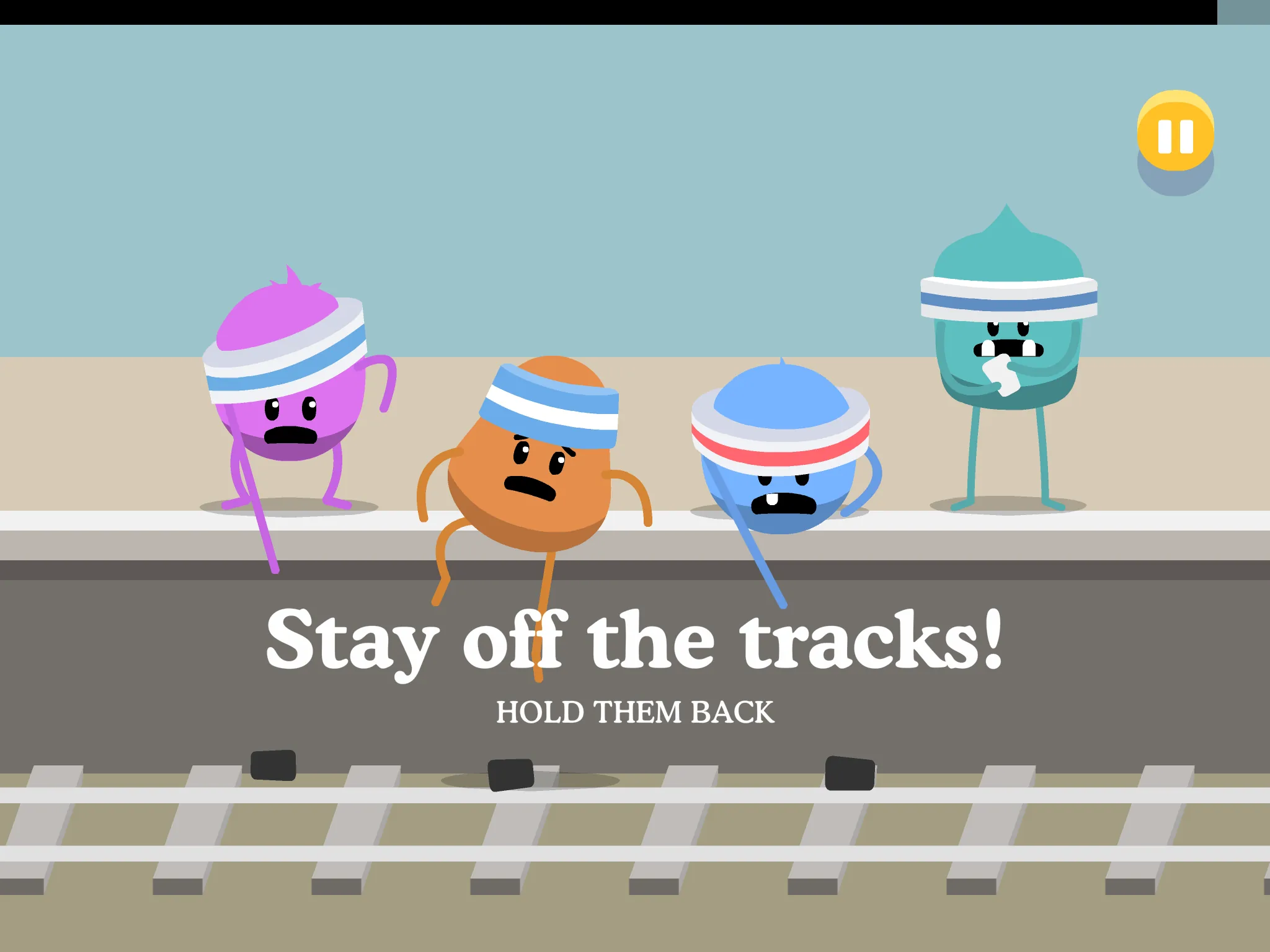
The app reached the App Store on 7 May 2013 (App Store), built by McCann Australia with the Australian developer Barrel Of Donkeys (Campaign Brief). The video's characters became quick tasks: flick piranhas away from one, fight off a snake attacking another, then pledge with one tap to behave around trains. It held the No. 1 free app spot in Australia for a week, and by November 2014, according to the agency, it had reached No. 1 on the App Store in 21 countries, with 71 million downloads and 1.2 billion plays (CMO). Today's version has 82 mini-games and a train station to fill with the characters you save. It is not in our library; its sequel is.
What was Dumb Ways to Die 2: The Games?
In November 2014 a sequel became the centre of a campaign refresh (CMO).
Dumb Ways To Die 2: The Games — Metro Trains (2014)
Agency: McCann Melbourne (creative), Millipede Creative Development (development) · Mechanic: Mini-games · Platform: App
It launched on iOS first, with Android to follow, CMO reported (CMO). You ride a train around a map with a Melbourne feel to themed sports arenas, each a run of short reflex games: goalie against an angry penguin, a 100-metre sprint with scissors, a dolphin rodeo (Millipede).
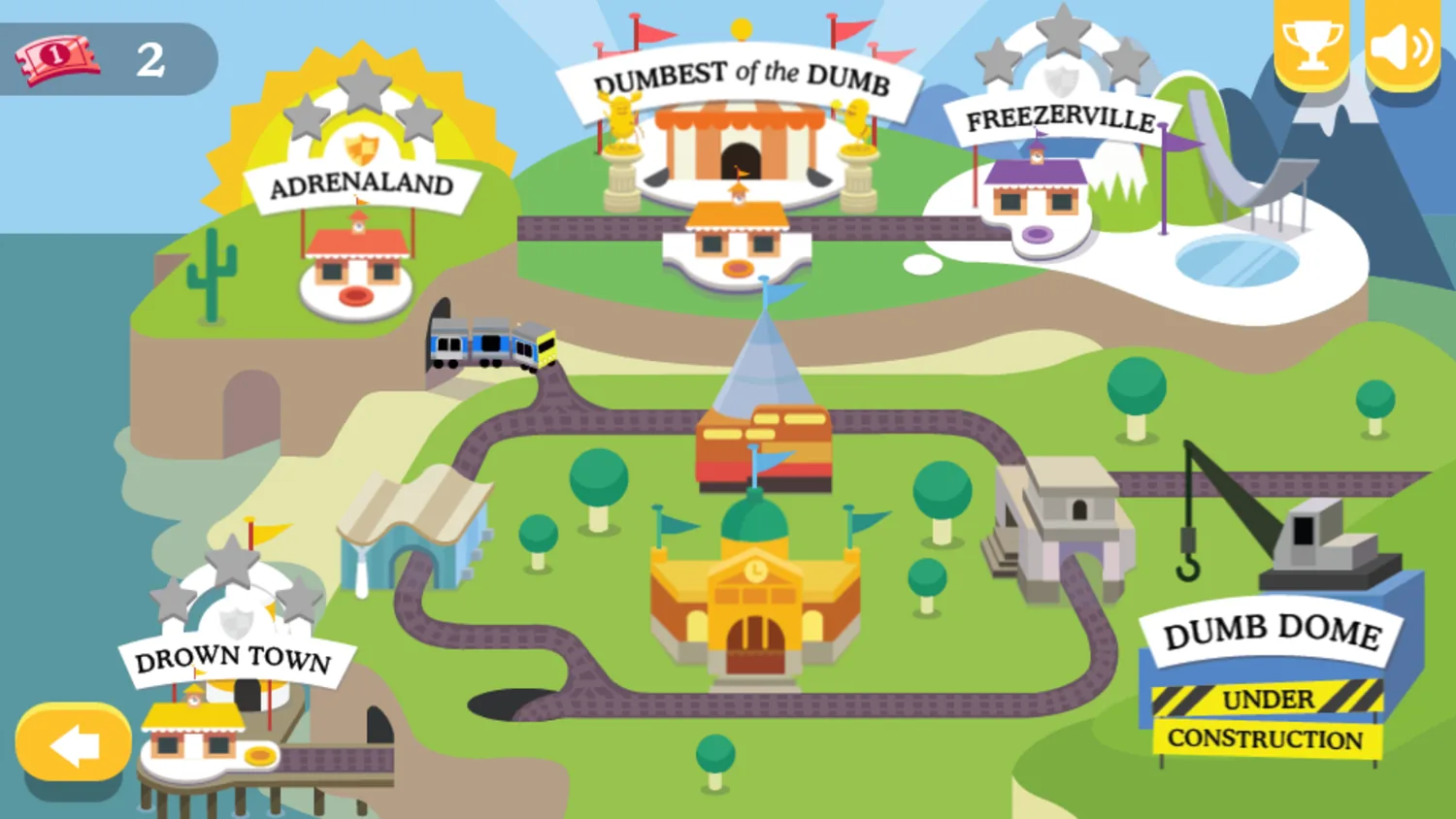
Between arenas you clear a train-safety game at a station before the next arena opens, and the best player is crowned Dumbest of the Dumb (CMO). Millipede says the game launched with four arenas and 28 mini-games and grew to 68 over three years of updates.
Result: By Millipede's count, it was the No. 1 iPad app in 86 countries and the No. 1 iPhone app in 54, passed 100 million downloads across five platforms, and logged 5.5 billion player deaths and 34 million unique safety pledges (Millipede). WARC's June 2017 summary, filed under the Creative Effectiveness Lions, says it was downloaded over 108 million times and played over 5.88 billion times (WARC). Both counts come from the campaign side.
Did Dumb Ways to Die make Melbourne's railway safer?
In February 2013 Leah Waymark, Metro's general manager of corporate relations, told Mumbrella that near misses at stations were down 20% against the annual average and 15% on a year earlier (Mumbrella). Six days later Metro told The Age that near misses across its suburban network were down by more than 30%, from 13.29 per million kilometres travelled in November to January 2011/12 to 9.17 a year later, with the biggest fall at level crossings. Waymark said it was "too early to be confident of a sustainable reduction in near misses", though "the early signs are encouraging" (The Age). In June 2013 Metro went further and said accidents and deaths had fallen 21% since the campaign began; the reports gave no period, no baseline and no figure for deaths alone (Marketplace, Reuters via Arab News).
Critics had doubted from the start what the numbers could prove. Two weeks after launch, Hugh Stephens of Dialogue Consulting argued on Croakey that views are not behaviour change (Croakey, November 2012); after Metro's February figures, Karalee Evans was sceptical of the 20% claim (Mumbrella). In 2015 Mumbrella noted that the campaign had won no metal in Creative Effectiveness at Cannes in 2014 and only a silver and two bronzes at the 2013 Australian Effies (Mumbrella). A 2019 academic case study by Jennifer Algie and Nicole Mead notes the debate over whether big view and download counts turned into safer behaviour (Springer, via RePEc). We found no independent evaluation of any of these figures.
What is the Dumb Ways to Die controversy?
Two more arguments followed. Some critics feared that jokes about death beside the tracks could encourage suicide; Alsop said in 2014 that the campaign was never about suicide, a subject Metro keeps out of its marketing because it is so sensitive (Marketing-Interactive). And in 2014 Metro licensed the characters to Empire Life Insurance, whose ads named having no life insurance as the dumbest way to die. Adweek said the Cannes winner had sold out (Adweek).
What happened to the Dumb Ways to Die games?
Dumb Ways to Die 3: World Tour reached the App Store in December 2017 (App Store). On 1 October 2021 PlaySide Studios, a listed developer in Port Melbourne, announced that it had bought the franchise from Metro for A$2.25 million in cash, 1.5 times its revenue for the 2021 financial year (ASX announcement). The deal covered six free-to-play games, five paid educational apps and fifty characters; PlaySide had built four of the six.
By early 2023 the song was back on TikTok, and the original game reached No. 1 among games on the US App Store, PlaySide told PocketGamer.biz. Dumb Ways to Die 4 followed on 2 May 2023 (PocketGamer.biz). In October 2025 Fortnite's Item Shop sold a Dumb Ways to Die back bling and emote, and buying the original game on the Epic Games Store for mobile unlocked the same bundle (Epic Games), cosmetics rather than a playable island (see brands in Fortnite). Dumb Ways to Build, a co-op game, launched on Steam, PlayStation 5 and Xbox Series X|S on 10 September 2026 (Dumb Ways to Die, Steam), and Dumb Ways to Party was still listed on Steam as coming in 2026.
On 26 October 2026 the App Store listed the original and its three numbered sequels, free with in-app purchases, sold under Metro's name with a PlaySide copyright line (App Store). On Google Play, PlaySide lists the sequel with more than 100 million downloads and a February 2026 update (Google Play). So Dumb Ways To Die 2 can still be downloaded, now with ads and paid extras; we have not checked how much of its station-safety layer survives.
- November 2012The music videoMcCann Melbourne puts the three-minute rail-safety song for Metro Trains Melbourne on YouTube.
- 7 May 2013The first gameThe app, built by McCann Australia with Barrel Of Donkeys, reaches the App Store; players can pledge with one tap to behave around trains.
- June 2013Five Grands Prix at CannesFilm, Radio, PR, Direct and Integrated, a record for one campaign.
- November 2014Dumb Ways To Die 2: The GamesMcCann Melbourne and Millipede's sequel takes players by train to sports arenas, with a train-safety game at each station.
- December 2017Dumb Ways to Die 3: World TourThe third game reaches the App Store.
- 1 October 2021PlaySide buys the franchiseMetro sells it for A$2.25 million in cash, 1.5 times its revenue for the 2021 financial year.
- 2 May 2023Dumb Ways to Die 4Released after the song's return on TikTok.
- October 2025Fortnite cosmeticsA Dumb Ways to Die back bling and emote go on sale in Fortnite's Item Shop.
- 10 September 2026Dumb Ways to BuildA co-op game launches on Steam, PlayStation 5 and Xbox Series X|S.
What can marketers learn from Dumb Ways to Die?
Entertainment came first. Alsop briefed against fear and blame; people shared and played for fun, and the safety line rode along. That is viral marketing on a public-safety brief, the same move Reporters Without Borders made with the Uncensored Library.
The pledge was the conversion. One tap turned an audience into a number: 34 million pledges in the sequel, by Millipede's count. A pledge costs nothing, which is why it scales and why it proves less than it seems.
The message sat on the route. The station game stood between you and the next arena, so safety was the price of progress rather than an interruption: a mini-game with one job.
A hit became an asset. A rail operator's safety campaign ended as a franchise a games company paid A$2.25 million for. Our library holds 143 app games and 6 road-safety projects, this one among them.
When not to copy Dumb Ways to Die
- When the joke can wound. For self-harm, addiction or grief, humour is the wrong tool; even Metro kept suicide out of its marketing. New Zealand's transport agency took the opposite route with its Flash Driving Game (2012), a racer that crashes and flashes the player's own Facebook photos (Campaign Brief NZ).
- When you must prove behaviour change. Fix the baseline, the comparison period and an independent reviewer before launch; effectiveness juries rated this campaign far below creative ones.
- When nobody will run a franchise. The sequel took three years of updates to reach 68 mini-games, and Metro eventually sold the IP. Decide early who owns the characters, what they may be licensed for and who pays to keep a mobile game alive.
FAQ
Did Dumb Ways to Die reduce train deaths?
No independent source shows that. In June 2013 Metro said accidents and deaths were down 21% since launch, in figures that did not separate deaths or give a baseline (Marketplace). It told The Age that near misses fell to 9.17 per million kilometres in November 2012 to January 2013, from 13.29 a year earlier. Critics questioned what the figures proved, and a 2019 academic case study calls the link to safer behaviour a matter of debate.
What happened to the Dumb Ways to Die game?
After the 2013 original came Dumb Ways To Die 2: The Games in 2014 and World Tour in 2017. PlaySide Studios bought the franchise from Metro for A$2.25 million in October 2021 (ASX announcement) and released Dumb Ways to Die 4 in May 2023. The original was still on the App Store and Google Play on 26 October 2026.
Does Dumb Ways to Die still exist?
Yes, as a PlaySide brand. On 26 October 2026 the mobile games were on the App Store and Google Play, Dumb Ways to Build was on Steam, PlayStation 5 and Xbox Series X|S, and Dumb Ways to Party was listed on Steam for 2026. The official video had more than 361 million views on YouTube.
Who sang Dumb Ways to Die?
Emily Lubitz, lead singer of the Melbourne band Tinpan Orange, sang it. Ollie McGill of The Cat Empire wrote the song, and John Mescall, McCann's executive creative director, wrote the lyrics (The Age, February 2013). Apple Music credits the single to Tangerine Kitty (Apple Music).
For more games built to change what people know or do, browse the app and awareness shelves, and if you made one, send it to us.