











The Mind Guardian
Read the story- Brand
- Samsung
- Year
- 2025
- Objective
- Awareness
- Industry
- Tech & Telecom
- Mechanic
- Quiz & Trivia
- Platform
- App
- Agency
- Cheil Worldwide Spain







Objective
Samsung Iberia and Cheil Spain built The Mind Guardian to close a diagnostic gap: an estimated 80% of early Alzheimer's cases in Spain go undetected, and adults over 55 rarely take cognitive tests, put off by clinical settings and by simply not knowing the process exists. Rather than run another awareness campaign, the brand wanted to hand people a working self-screening tool on a device many already own, and pull the 55+ generation back into a conversation it's usually left out of. The project also made the case for Samsung's 'Technology with Purpose' platform on its tenth anniversary — proving the idea through a real product instead of a message.
Solution
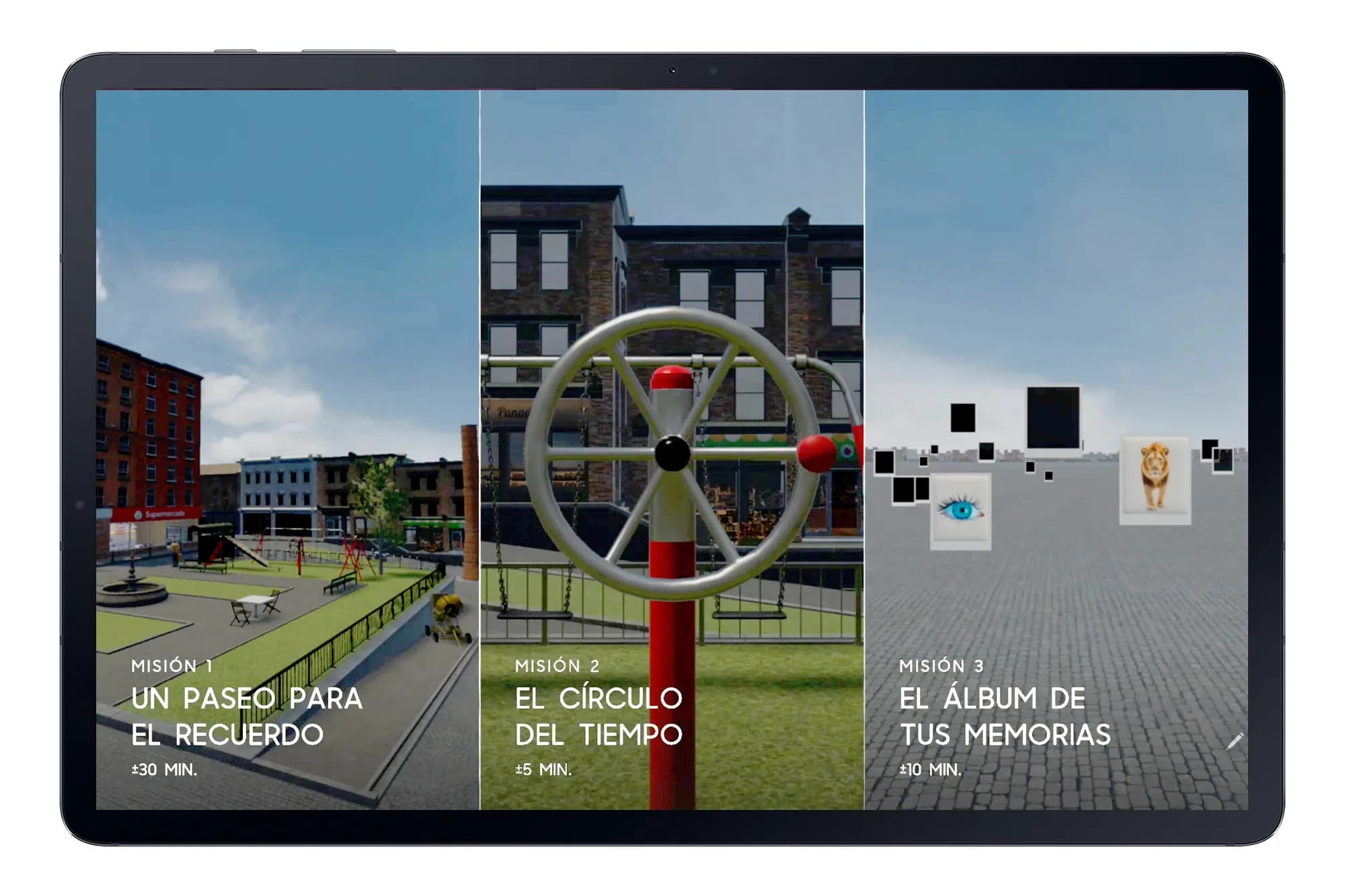
The Mind Guardian downloads like any other free tablet game, from Google Play or the Galaxy Store. After reading through warnings and an FAQ and agreeing to anonymous data processing, the player steps into a city built to represent their own mind and spends about 45 minutes walking its streets in first-person view, trying to remember the way. Other stretches of the session have them trace a rotating circle with a finger to test reaction time, or work through a deck of cards to spot which ones connect. Underneath, each activity is a real memory test — episodic, procedural, semantic — but it plays like a light adventure rather than an exam. At the end, the app hands back a personal report: whether it found signs of cognitive decline, what to do about it, and when to test again.
Results
The Mind Guardian passed 100,000 downloads in its first year, with more than 5,000 users completing the full test. Of those, 5% showed possible signs of cognitive risk — people who had never previously consulted a doctor about it. 86% of users who consented to data processing were between 55 and 69, the age group the campaign set out to reach. The underlying assessment reached 97% accuracy in cross-validation testing, and the launch generated 972,000 in media reach with more than €1M in earned media value.
- 1
Players find The Mind Guardian on Google Play or the Samsung Galaxy Store and download it for free; it runs only on Android tablets in Spain, in Spanish, with a Spanish-language-only interface.
- 2
On launch the app presents disclaimers and an FAQ: it is intended for people aged 55 and up with no clear signs of cognitive impairment, and it is explicitly not a medical or therapeutic product or a substitute for a doctor.
- 3
Before starting, the player is told to treat the session like a test: set aside at least an uninterrupted hour, remove distractions such as the phone, and consent to anonymized data use, optionally for research.
- 4
The game opens in a 3D city that represents the player's own mind, structured around three missions that together run about 45 minutes in one continuous session with a large, simplified interface.
- 5
In the first mission, testing episodic memory, the player studies a list of objects, people and places, then takes repeated automatic walks through the city across 16 elements and 12 passes, recognizing, recalling and distinguishing them while the app logs hits, errors, omissions, repeats and completion time.
- 6
In the second mission, testing procedural memory, the player traces a rotating ring with a finger across four rounds of varying speed and direction, while the app measures how far the finger deviates from the path and how quickly the player reacts to changes.
- 7
In the third mission, testing semantic memory, the player is shown a reference image alongside two options and picks the one meaningfully related to it, repeating this choice 52 times while accuracy and response time are recorded.
- 8
After 45 to 60 minutes the session ends and the app generates a personal report indicating whether it detected signs of cognitive decline or found results within normal range, broken down by episodic, procedural and semantic memory.
- 9
The report closes with recommendations: general tips for cognitive health on a normal result, or advice to consult a doctor and retest in six months on a result flagging risk, escalating to a specialist if the second test repeats the finding.