




Sexy Fingers
- Brand
- AIDES
- Year
- 2011
- Objective
- Awareness
- Industry
- Other
- Mechanic
- Music & Rhythm
- Platform
- Web
- Agency
- Frenzy
- With
- Flairs
- With
- JWT Paris
- With
- Anonymous


Objective
AIDES needed to introduce and destigmatize TROD, the finger-prick rapid HIV test that France allowed non-medical staff to administer for the first time in 2011, and to reach people who rarely engage with the healthcare system — gay men, migrants, sex workers, drug users. The brief was to strip the test of its clinical, stigmatized feel by leaning into a single idea: one finger is already capable of more than people give it credit for.
Solution
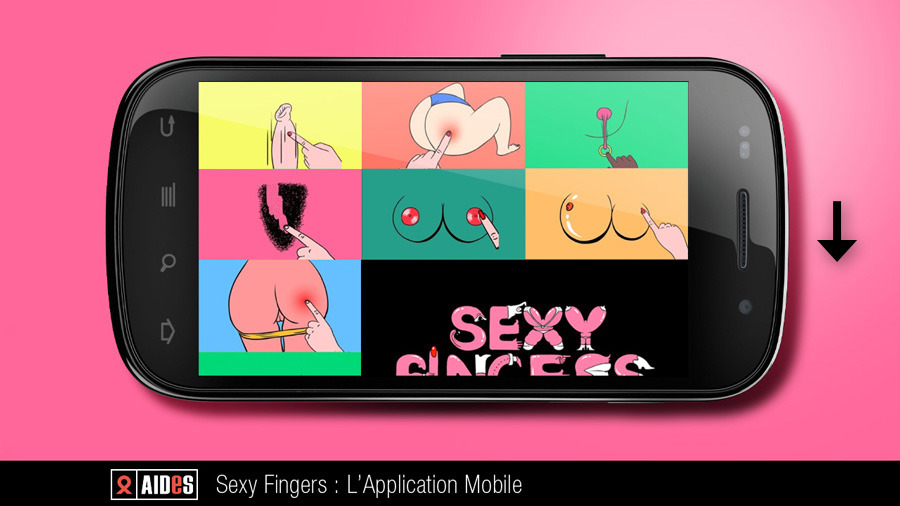
Sexy Fingers hands the player a single finger and a cast of cartoon body parts and objects, drawn in acid-bright colors — a pair of briefs, a chest, a rear. Poking, stroking, pulling or slapping each one triggers its own sound, guitar, percussion or keys, and stacking enough gestures together builds a looping dance track. Players can jam freely or switch to the "défi" mode, which plays a set rhythm and asks them to rebuild it by triggering the right instruments in the right order. Whichever mode they leave from, the session ends with a plain message: the finger that just played the track can also take an HIV test, with information on getting a free rapid test from an AIDES volunteer.
- 1
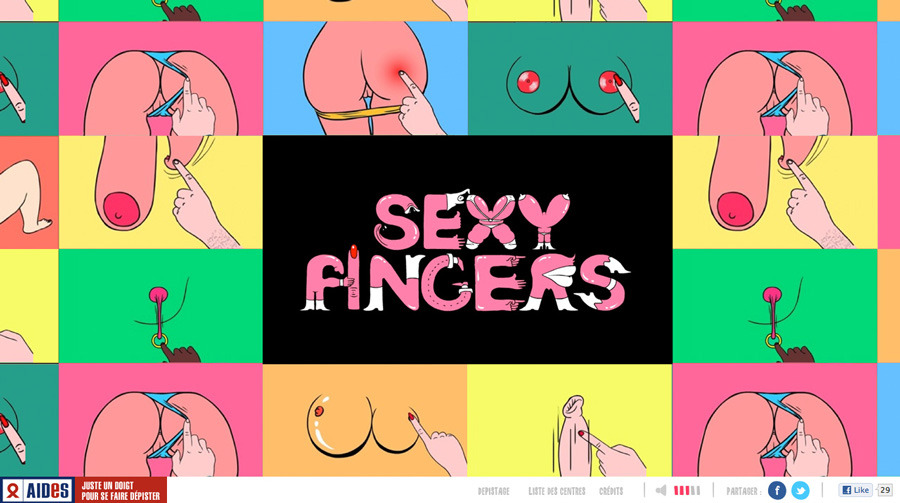
The player lands on the sexyfingers.org title screen and moves into the game mode, which opens on a start screen showing the available "instruments" — illustrated body parts and objects such as underwear, breasts, and buttocks.
- 2
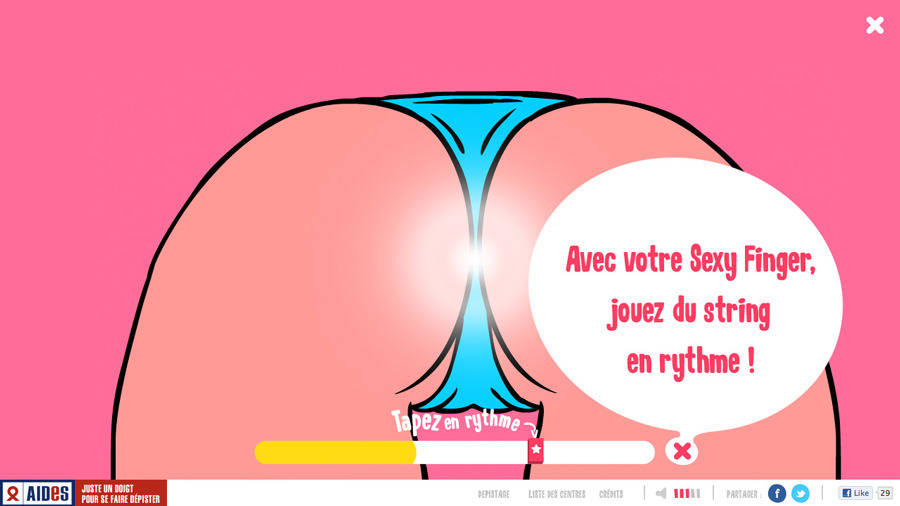
A help screen explains that the game is played with a single finger, using a small set of gestures: touch, pull, and slap.
- 3
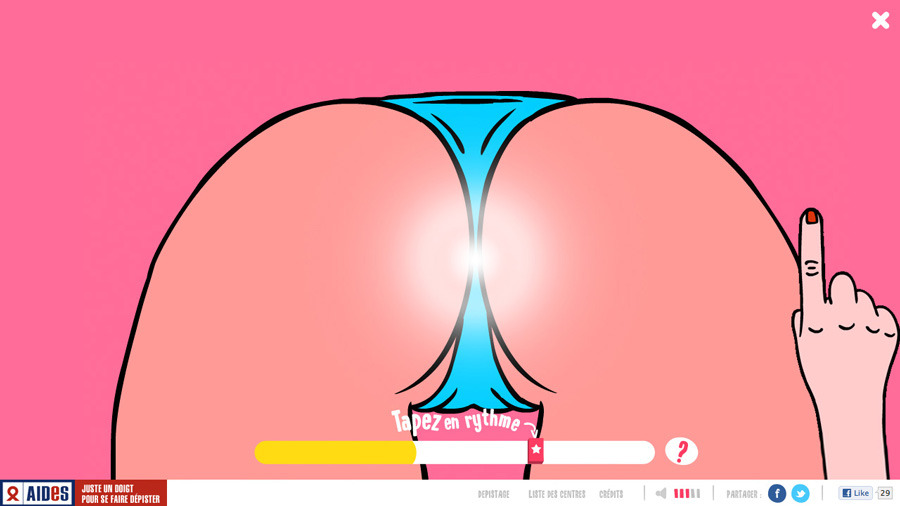
The player drags a finger across an object and performs one of the gestures — touching, pulling, or slapping — each of which animates that object differently and triggers its own sound, from percussion to guitar to keys.
- 4
Sounds do not replace one another: each instrument the player activates layers onto the ones already playing, so touch by touch a dance track builds up.
- 5
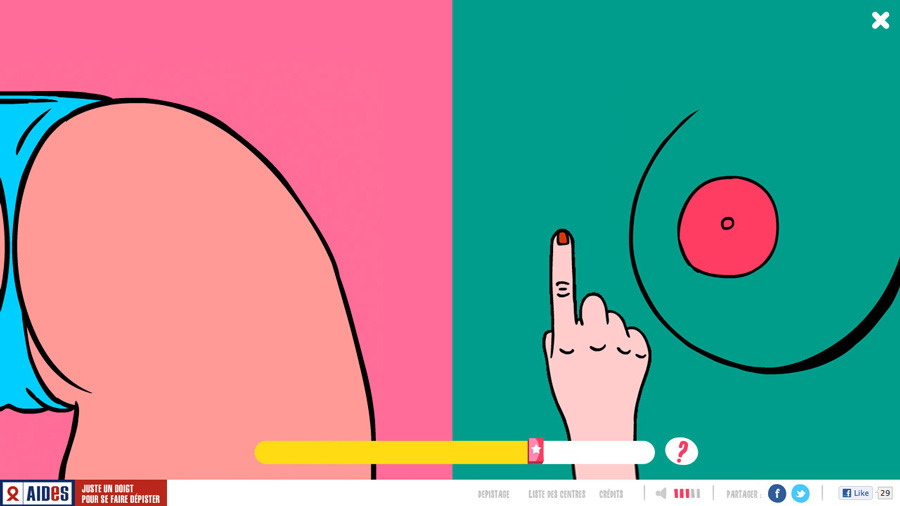
Between scenes the game transitions to a new set of instruments, widening the range of gestures and sounds available to the player.
- 6
A challenge mode plays a target sound loop and asks the player to reproduce it by triggering the right instruments in the right order.
- 7
A round ends on a results screen, with the option to replay or move on.
- 8
A separate free-play mode isolates a single instrument after a preload screen, letting the player improvise a rhythm on that one object alone.

- 9
Leaving the play section, the player reaches an informational screen linking the same single-finger idea to an HIV finger-prick rapid test offered anonymously by AIDES volunteers.
- 10
The Android app repeats the same one-finger touch-and-sound mechanic on a vertically scrolling home screen: players scroll through a list of interactions, select one, and play it by tapping and dragging directly on the phone screen, working through the set to build their own combination of sounds.