






The Google Puzzle
- Brand
- Year
- 2011
- Objective
- Engagement
- Industry
- Tech & Telecom
- Mechanic
- Puzzle
- Platform
- Web
- Agency
- FUTREK
- With
- SCRAP
- With
- HAKUHODO
- With
- Kaibutsu

Objective
Google Japan built The Google Puzzle to prove that modern HTML5 and CSS3, without any plugins, could carry a genuinely inventive piece of interactive design. The project doubled as a showcase for Chrome in the Japanese market, positioned by Google's own team alongside its earlier HTML5 showcase, the OK Go "All Is Not Lost" video, as proof of what the browser could do.
Solution
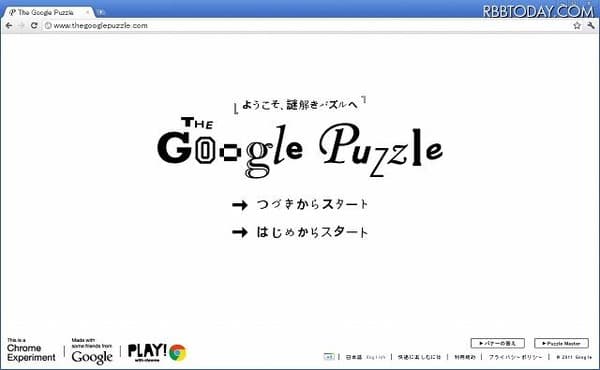
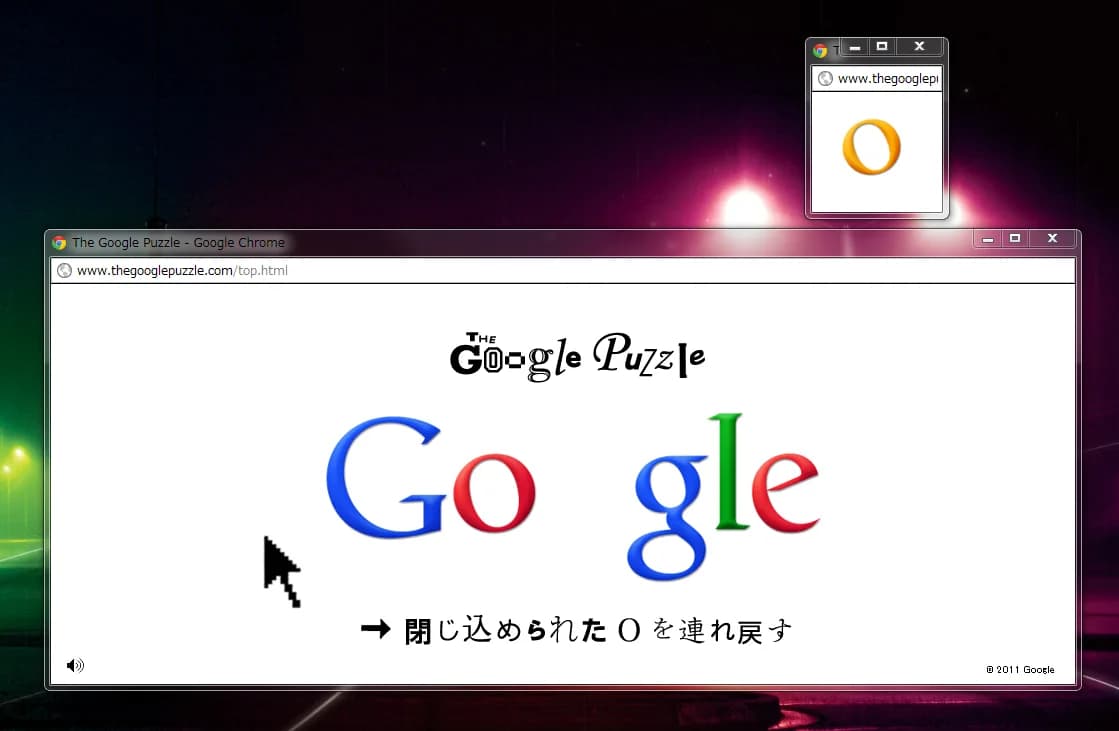
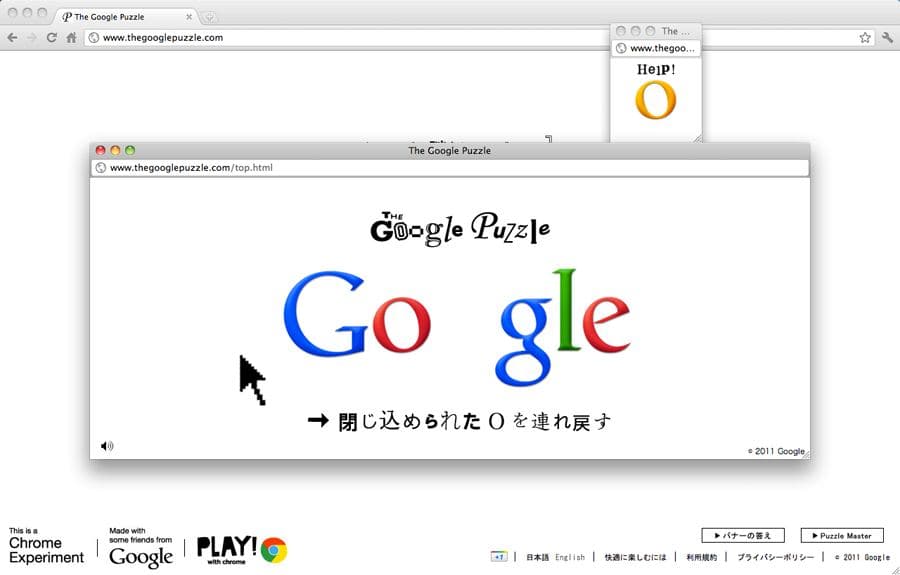
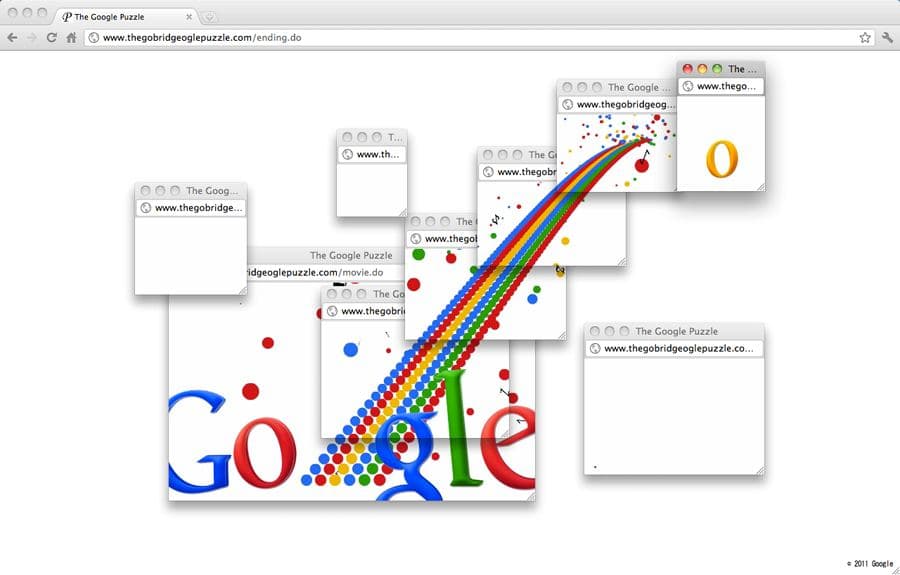
Players land on a page with the Google logo missing its yellow "o" and hit ENTER to start the hunt. Each clue opens as its own pop-up browser window, and solving it means using real web tools rather than anything inside a game screen: switching Google Maps to satellite view, running text through Google Translate to identify a language, reading a dated email in a mock Gmail inbox, dragging objects between open windows, resizing a window to reveal something hidden. Early puzzles come with hints; later ones don't, and progress is saved locally so players can leave and come back. The chase ends with the runaway "o" animating back into place in the logo, at which point players get a "Puzzle IQ" score they can share.
Results
Only 3–5% of players who played managed to solve every puzzle without using a hint.
- 1
The player lands on thegooglepuzzle.com, where a single ENTER button opens onto a burst of separate browser windows. A yellow "o" knocked loose from the Google logo lands trapped in one of them, and the goal is to solve a chain of puzzles scattered across the windows to send it home.
- 2
One puzzle presents six Google Maps fragments; toggling from map view to satellite view reveals building outlines that spell out a word, which the player types in as the answer.
- 3
Another puzzle shows phrases in several foreign languages; the player runs them through a language-detection tool and combines the first letters of the identified languages or countries into a word.
- 4
A third puzzle asks the player to click a set of animals in order from largest to smallest; each correct click reveals a letter in an accompanying video, spelling out an answer.
- 5
A fourth puzzle displays scrambled text that only resolves when the player resizes the browser window until the lines snap into a grid, letting the letters be read off to answer a riddle.
- 6
A fifth puzzle opens a Gmail-style inbox where the player cross-references a date and a sender's initials to identify the historical figure they point to.
- 7
Puzzles also require dragging elements between separate browser windows: an on-screen cursor is dragged onto a ticking timer, and later a shape is dragged onto a cube-shaped window to unlock a cryptic clue.
- 8
The clue is resolved outside the game itself: the player edits the browser's address bar, inserting the missing word into the site's own URL to navigate to a hidden page.
- 9
That page triggers a processor-heavy HTML5/CSS3 finale in which the "o" returns to the Google logo; the sequence is built for Chrome and can fail to render properly in other browsers.
- 10
On completion the player receives a "Puzzle IQ" score with an option to share it, and progress is saved throughout so a session can be resumed later on the same computer.