



The Camel Fabric Game
Open the game- Brand
- Max Mara
- Year
- 2025
- Objective
- Awareness
- Industry
- Fashion & Beauty
- Mechanic
- Adventure & Quest
- Platform
- Web
- Agency
- Adoratorio Studio



Objective
Max Mara wanted the origin story of its camel fabric and the coats built from it to be experienced, not read — turning product storytelling into something a shopper actually moves through. The game was built as the centerpiece of a global campaign around camel as the brand's signature: the fabric as proof of quality, the color as its mark of distinction, then adapted across physical, phygital and digital touchpoints for different markets.
Solution
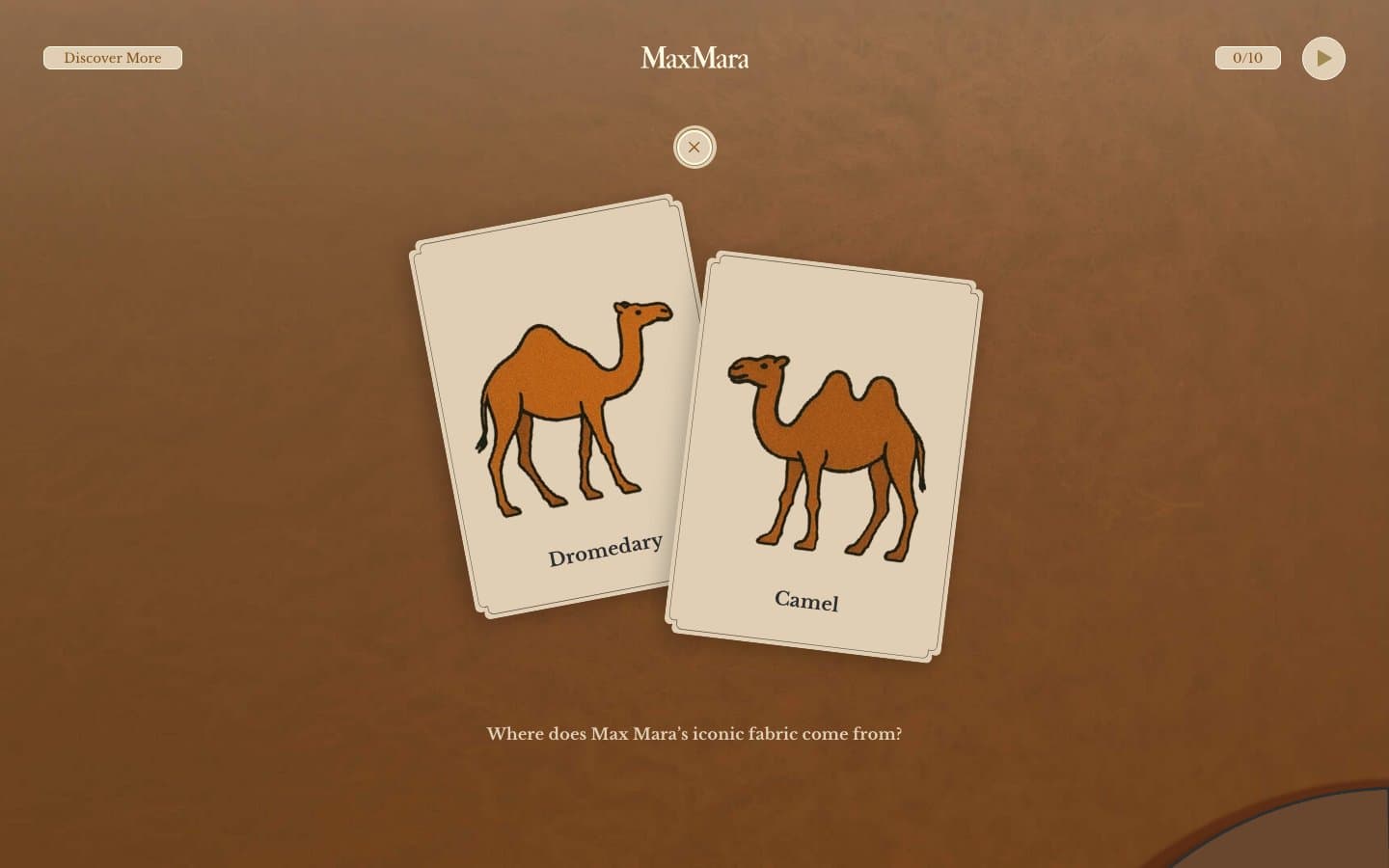
Players land on a standalone site staged as a board game and advance their own piece across it, scrolling through one continuous 3D scene. The route runs from the distant lands the raw wool comes from to the Italian workshops where it's woven and cut, and each stop along the way opens a short story about how a particular Max Mara piece is designed and made. There's no sign-up screen and no shop link — just scrolling or tapping onward to keep the piece moving and uncover the next fact, until the road ends. The Shanghai pop-up at Plaza 66 carried the same discovery loop into a physical space: visitors turned triangular prism panels by hand, and each turn revealed another secret of the camel fabric.
- 1
The game lives on its own dedicated domain rather than inside a retail site, opening straight into a branded title card — "The Camel Fabric Game by Max Mara" — before loading the game scene.
- 2
The premise frames play as a journey of discovery, routing the player from distant lands toward Italian landscapes with the stated goal of learning how Max Mara's iconic coats are conceived and made.
- 3
The core loop is a digital board game: the player advances across a game board that steers them through a fixed narrative about the origins of the brand's signature camel coats.
- 4
Progression unfolds as a sequence of story stages, tracing the material and the garment from the origin of camel fabric through to Italian manufacturing, where the coats become symbols of Italian elegance.
- 5
A physical, phygital counterpart appeared in a Shanghai pop-up at Plaza 66, where visitors approach a row of rotating triangular prisms displaying coats, accessories, knitwear, and the Whitney bag, and turn each one by hand in a "Flip Game" to reveal facts about the camel breed and the harvesting of its wool.