











AI Quests
View the case- Brand
- Year
- 2025
- Objective
- Awareness
- Industry
- Tech & Telecom
- Mechanic
- Adventure & Quest
- Platform
- Web
- Agency
- Phantom



Objective
Google set out to build AI literacy in the generation growing up alongside artificial intelligence — showing 11-to-14-year-olds how AI actually works and where it applies to real climate, health and science problems, while teaching them to own the consequences of a model's decisions. The project doubles as a way to bring Google's own research (flood forecasting, diabetic retinopathy detection, brain mapping) into the classroom, and to plant the Google name in school curricula through partners like Experience AI (Raspberry Pi Foundation) and Stanford's CRAFT, backed by lesson plans built to slot into a teacher's existing schedule with no extra prep.
Solution
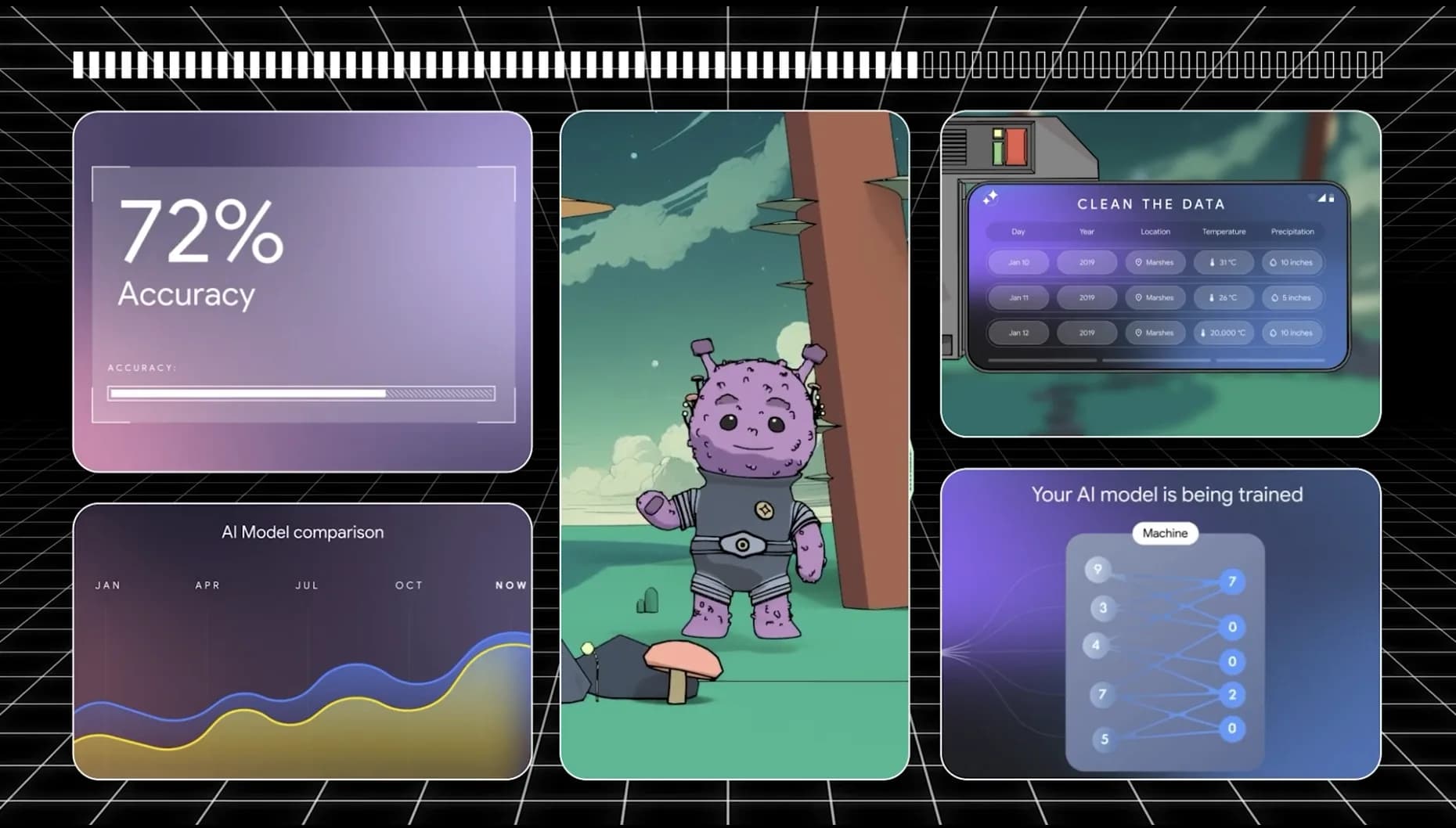
Players open AI Quests straight in the browser, no install or login, and choose a quest — the first is Market Marshes, a swampy trading town. There, Professor Skye and the local residents lay out a problem for the player to solve, and the player runs the actual research cycle themselves: sorting through datasets, choosing sources, training a model, then testing it and watching the outcome play out for the characters who depend on it. Periodically the game stops with a "learning ticket," asking the player to explain in their own words why they made a given choice before they can continue. A session runs about 45 minutes and closes with a video message from the real Google researchers behind the science the quest is based on.
- 1
Players open the game free in a browser at research.google/ai-quests, with no install, login, or account creation required; a start screen lets them choose among three quests, of which Market Marshes is available at launch.
- 2
An onboarding sequence introduces the quest's fantasy world and the social problem its residents face, then hands the player off to an in-game mentor, Professor Skye, who guides them through the full AI research cycle. In Market Marshes, the player meets Luna, a mossy amphibian creature whose community suffers from flooding, and takes on the role of an AI researcher tasked with building a flood-forecasting model for her.
- 3
Players enter a data-gathering phase, collecting sources such as rainfall, river flow, historical records, and infrastructure condition, then evaluate which of the collected datasets are usable and which are flawed, seeing how data quality shapes the model to come.
- 4
Periodic "learning tickets" pause the action and ask the player to explain in their own words why they chose particular data, building reflection into the pace of play.
- 5
In the training phase, players select data and use it to train their AI model, observing firsthand how their data choices introduce bias into the result.
- 6
Players test the trained model and get immediate, visible feedback — a poor data source yields poor predictions — and can return to change their data choices, retrain, and retest, an error-reflect-correct loop built into the game.
- 7
In a final resolution phase, the player applies the finished model to the real problem, helping the community anticipate the next event, while the game raises the ethical and social stakes and makes clear that a human ultimately makes the final call.
- 8
The quest closes with a look at how the player's model affected the characters' fate, followed by a recorded video message from real Google researchers describing their own AI work and what responsible AI use means.
- 9
A single quest runs roughly 45 minutes, after which players return to the quest-select screen to unlock further storylines, such as Dusky Dunes, where a new mentor and setting frame a model built for early eye-disease detection.