



PUSH For Ultrabook
View the case- Brand
- Intel
- Year
- 2014
- Objective
- Product Launch
- Industry
- Tech & Telecom
- Mechanic
- Arcade & Action
- Platform
- Web
- Agency
- PARTY
- With
- Birdman, Inc.


Objective
Intel wanted global buzz for its new Ultrabook category, including its convertible models, and needed to reach social audiences across Taiwan, South Korea, India, Indonesia, the Philippines, Thailand, Singapore, the US and the UK. Rather than a private hands-on demo, the brand wanted the product story to play out as a public spectacle that people could both play and watch unfold live.
Solution
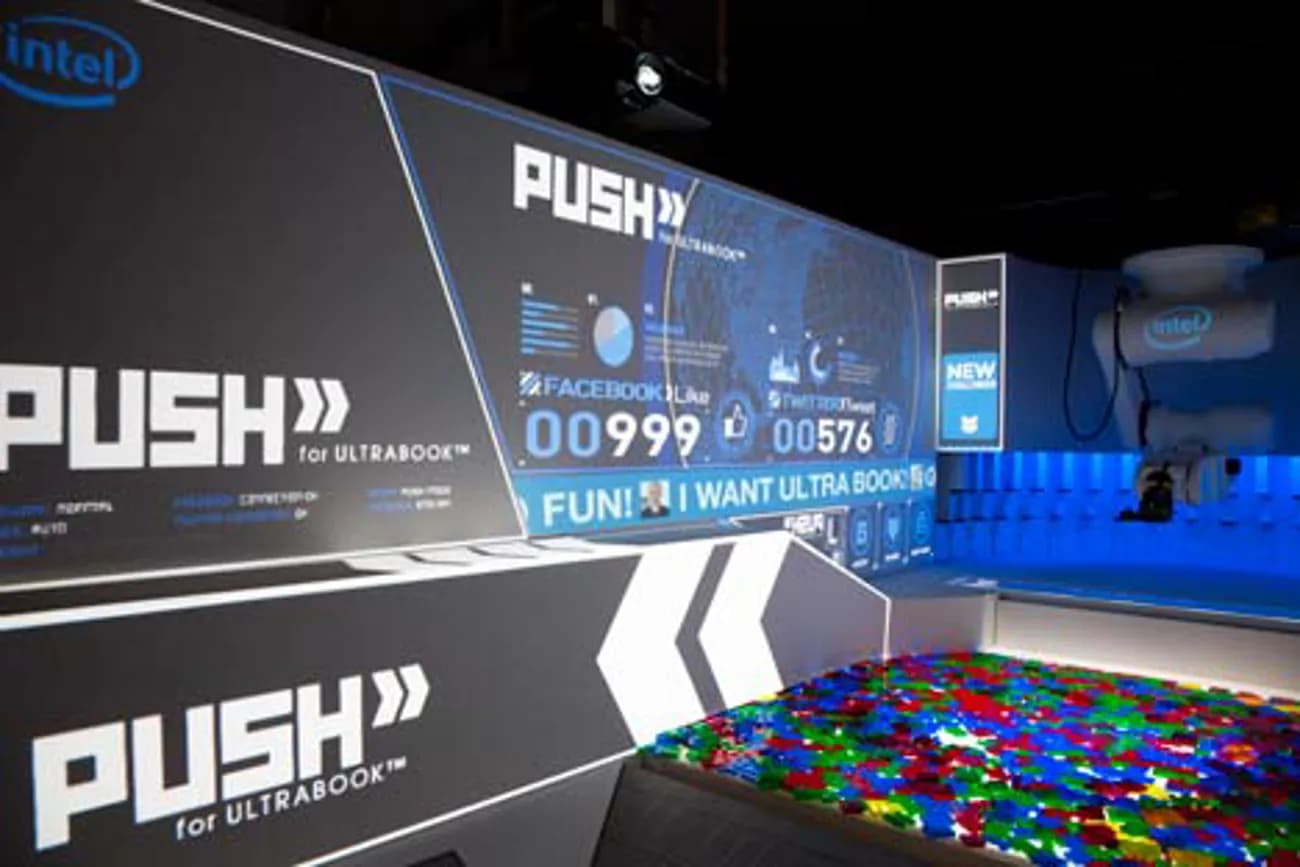
Players land on the campaign site and log in with Facebook or Twitter to join a live queue, watching real Ultrabooks perched on a ledge in a live video feed from the actual physical rig. Their name is turned into blocks of solid letters — their "coins" for the game. When their turn comes, those name-blocks drop onto the table and the player fires a real pusher arm, nudging the pile of blocks forward to try to shove a laptop off the edge. Everyone else waiting in line watches the same feed, and their names and social activity get projected onto the machine itself while they wait, so the queue doubles as part of the show. A session ends the moment a laptop tips over the edge — the player who pushed it off wins that exact device.
- 1
The campaign site opens on a live video feed of a real coin-pusher machine on a physical stage, with genuine Ultrabook laptops resting on its ledge; a stranger is already playing, visible to everyone watching.
- 2
Players sign in with Facebook or Twitter — there is no separate registration — and their social-media name is rendered as a 3D block, which becomes their personal "coin" in the pusher.
- 3
Since only one person can operate the machine at a time, players join a shared queue and can opt in to a Facebook or Twitter notification that alerts them when their turn arrives.
- 4
While waiting, players watch other people's turns on the live stream, which also projects site and social activity onto the physical set, so waiting players see their own actions reflected on stage.
- 5
On their turn, the player controls the real machine from the browser: their name-block drops onto the table and joins the pile left by previous players, and a pusher arm shoves the whole mass toward the ledge — all shown live, with no simulation involved.
- 6
If the push knocks a laptop off the ledge, the player wins that physical Ultrabook — drawn from a pool including the Lenovo IdeaPad Yoga, Acer Aspire P3, Samsung Series 7 Ultra, and Asus Taichi; if not, the pile stays put and the turn passes to the next person in queue.