






Map Dive
- Brand
- Year
- 2013
- Objective
- Engagement
- Industry
- Tech & Telecom
- Mechanic
- Arcade & Action
- Platform
- Installation
- Agency
- Instrument

Objective
Google Maps had just crossed one million API integrations, and the team wanted a way to mark that milestone in front of the developers who'd help push it further. Built for Google I/O 2013, the project was pitched internally as a technology show piece — proof that Maps' JavaScript API and the modern browser could carry an experience as physical and immersive as a game console title, using Google's own Pegman mascot as the star.
Solution
Standing in front of a curved wall of screens, the player becomes Pegman, Google Maps' yellow pin-man, free-falling from around 4,000 feet above real satellite imagery of the Earth. Leaning and turning their body steers the dive through a run of ring-shaped gates, with loose stars scattered along the way to grab as they fall. The ground below is an actual Google Maps location, and each run ends by sticking the landing on a famous real-world monument. Once the event was over, the same dive was rebuilt for a single browser window, so anyone online could steer the fall with just a keyboard and mouse instead of their whole body.
Results
The installation's debut at Google I/O 2013 engaged hundreds of conference attendees, and the browser build that followed went on to become a widely played Chrome Experiment.
- 1
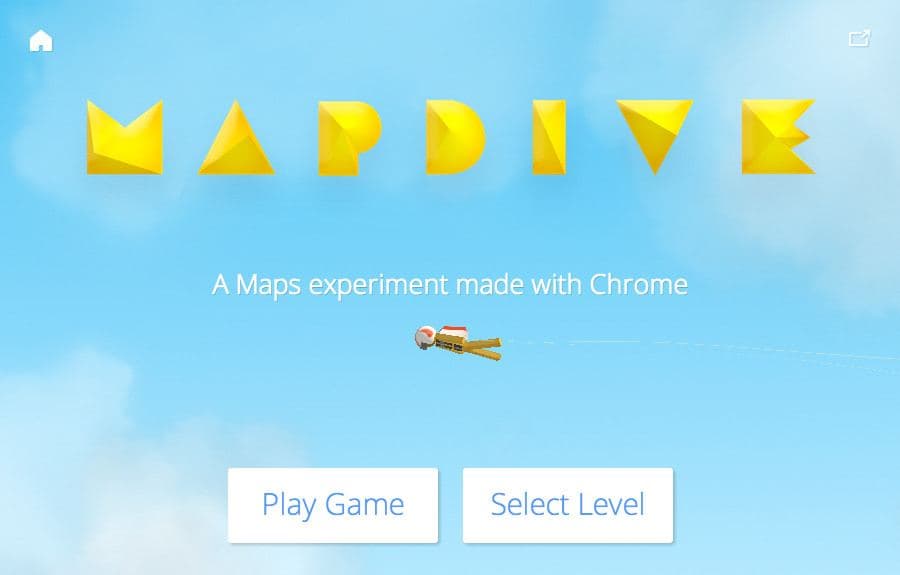
The game opens in an idle attract mode, with Pegman, the yellow Google Street View figure, drifting through clouds as the camera cycles between a few ambient angles and an overlay invites the player to wave to begin.
- 2
The player triggers the session by raising an arm in front of a motion-tracking camera (or, on desktop, using keyboard or mouse); losing tracking or lowering out of frame for too long returns the game to idle.
- 3
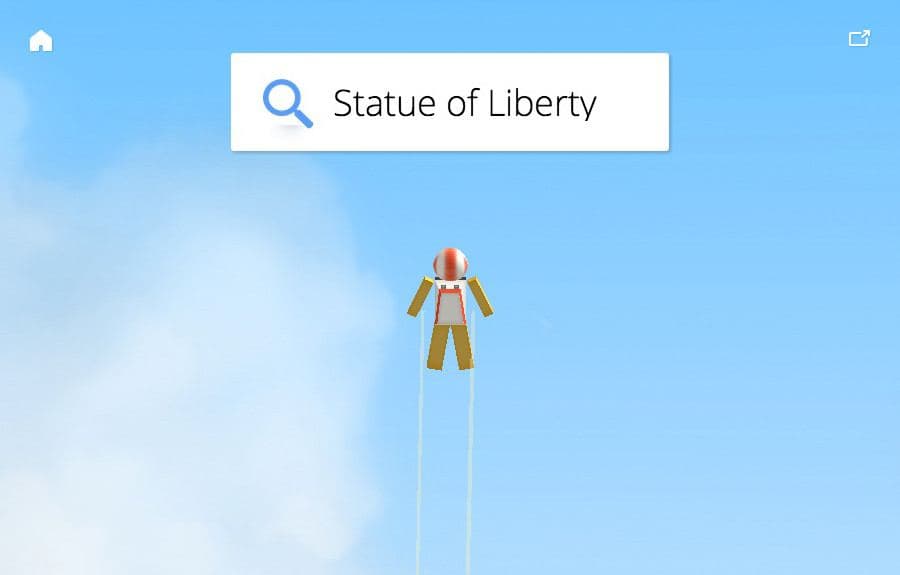
An intro sequence shows Pegman barrel-rolling in close-up while instructions appear, then climbing to altitude as Google's search bar animates open, types out the level's real-world landmark destination, and swaps in a result card with the location's name, address, and live coordinates and elevation on a mini-map.
- 4
The core loop is free-fall flight: the player steers Pegman's heading and controls dive speed and intensity through body angle (or keyboard/mouse on desktop), with gravity constantly pulling downward and tracking briefly retained if the sensor blinks.
- 5
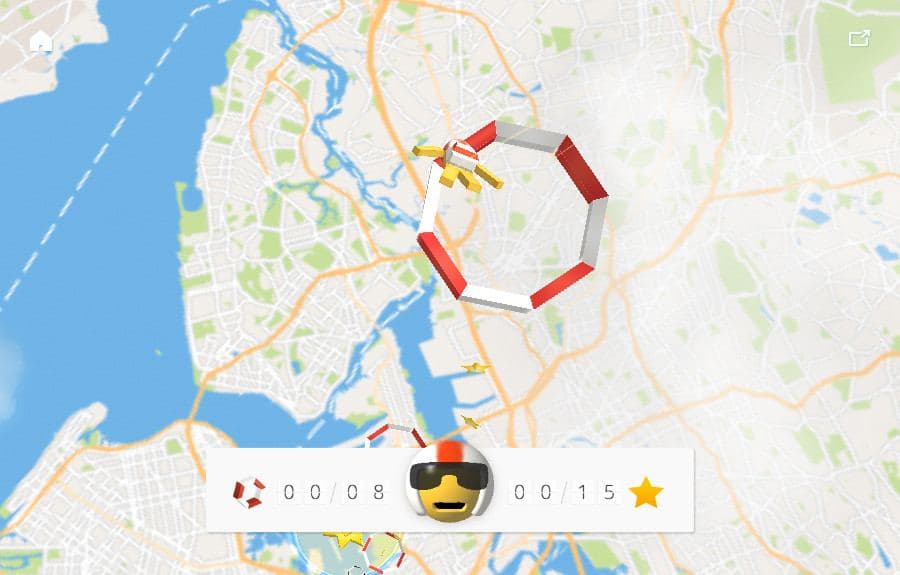
The dive plays out over real Google Maps satellite imagery, with the game's 3D models composited over the live map so the player is falling across an actual place on Earth.
- 6
Along the descent the player flies through colored gates and collects scattered stars, each registering with a sound cue, a small animation, and an increment to separate on-screen counters, while a bonus pickup temporarily reskins the level and Pegman into one of several visual themes; a mini-map continuously tracks position, heading, path, and cleared gates.
- 7
The session ends at a landing zone beside a famous landmark: landing successfully triggers fireworks and a celebratory flyover before fading back to attract mode, while missing the zone opens a parachute for an automatic, non-fatal descent and a shorter return to idle.
- 8
The game draws from a set of real-world landmark levels — including the Eiffel Tower, Statue of Liberty, Taj Mahal, Sydney Opera House, and others — each with its own destination, gate and star layout, and map styling, and the desktop version lets players restart into a different location after each run.