





World Quantum Readiness Day Crossword
- Brand
- DigiCert
- Year
- 2024
- Objective
- Lead Gen & Recruiting
- Industry
- Tech & Telecom
- Mechanic
- Puzzle
- Platform
- Web
- Agency
- Drimify

Objective
DigiCert was launching World Quantum Readiness Day, a brand-new B2B webinar franchise on a niche technical subject, and needed to establish it — and DigiCert — as an authoritative voice on quantum threats to encryption. The challenge was engaging a highly trained security audience without resorting to the 'endless PDFs and PowerPoint presentations' that format usually relies on, while also building a list of qualified leads for future events.
Solution
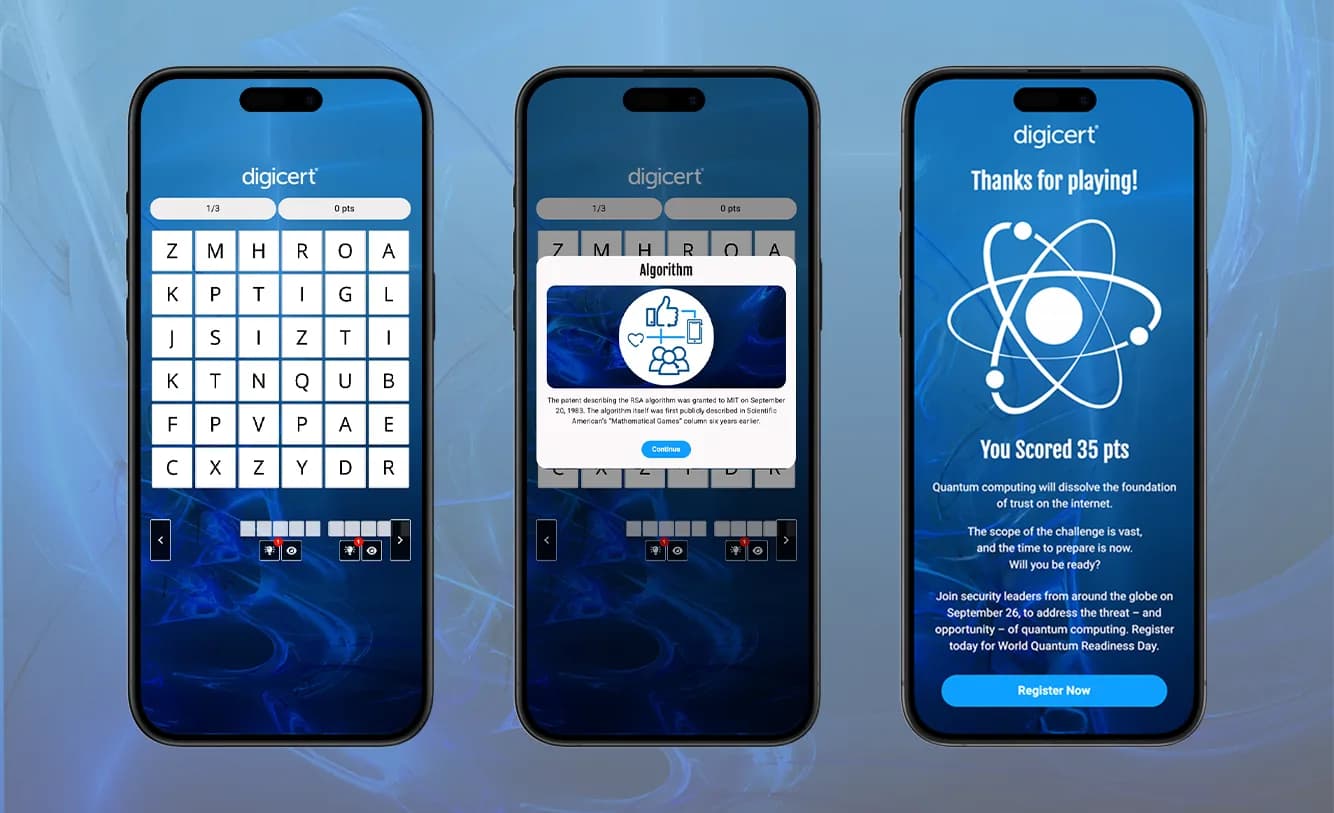
Attendees registering for the webinar are handed an online crossword before the talks begin. Each clue is a definition of a quantum-computing or cybersecurity term, and the player types answers straight into the grid, tapping a hint button on any square they're stuck on. Finishing the grid opens a short form to fill in, and submitting it enters the player into a draw for a tabletop escape-room game. A session runs just a couple of minutes, ending the moment the last answer locks into place.
Results
The crossword drew over 5,000 plays from security professionals, captured 488 qualified leads, and held an average session length of close to two minutes per player.
- 1
A security professional registered for DigiCert's inaugural World Quantum Readiness Day webinar is offered a branded crossword as a pre-show challenge, framed as a brain-teaser rather than a marketing pitch.
- 2
The game opens on a grid of empty squares in the event's branding alongside a list of clues, each clue defining a quantum-computing or cybersecurity term — so simply reading them primes the player on the vocabulary the webinar will use.
- 3
The player selects a clue and types the answer letter by letter, using a touchscreen keypad on mobile or a keyboard on desktop, confirming each guess with Enter; correct words lock into the grid while wrong guesses register as mistakes.
- 4
A light-bulb icon offers help when the player is stuck, revealing either a word's first letter or an errored entry.
- 5
Play continues until the grid is filled, with the score reflecting both the number of words solved and the number of mistakes made; a typical session runs about two minutes.
- 6
Finishing the puzzle leads into a data-collection form, and submitting it enters the player into a prize drawing for a tabletop escape room game, a prize picked to appeal to a technically minded audience.