




Cube Slam
View the case- Brand
- Year
- 2013
- Objective
- Awareness
- Industry
- Tech & Telecom
- Mechanic
- Arcade & Action
- Platform
- Web
- Agency
- Public Class
Objective
Google built Cube Slam to prove that WebRTC — the browser's new peer-to-peer video and data standard — was ready for real products, not just tech demos. As part of its Chrome Experiments push, the game paired a plugin-free video call with live multiplayer data, wrapping the pitch to developers in a game simple enough for anyone to pick up.
Solution
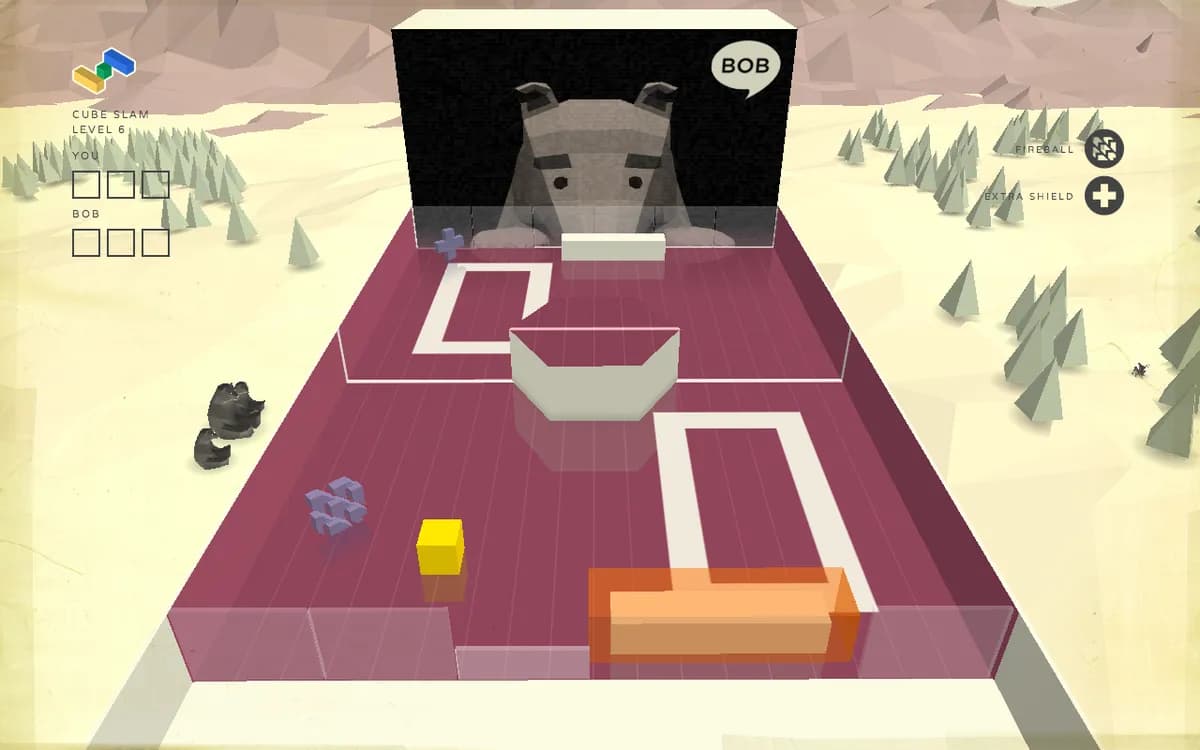
A player opens cubeslam.com in Chrome and picks an opponent: Bob the bear, or a friend, invited with a generated link. The match plays out as a 3D take on Pong, with the rival's live webcam feed streaming behind the court so both sides can see and talk to each other while they play. Players lob a cube back and forth, grabbing power-ups like fireballs, lasers, multi-balls and "death balls" as levels add shields, obstacles and gravity fields to dodge. Three hits past the opponent's screen wins the round. On phones and tablets a lighter version let players face only Bob, and a standalone Chrome app let him play offline.
Results
Cube Slam drew 2 million unique visitors in its first month, peaking at 10,000 concurrent players.
- 1
The player opens cubeslam.com in Chrome on a webcam-equipped computer with nothing to install, then picks a mode: a single-player match against a bear character named Bob, or a match against a friend, for which the game generates a unique link to send them.
- 2
For a friend match, the browser asks for webcam and microphone access; without granting it, the face-to-face match cannot start.
- 3
Once the match begins, the player sees the playfield in perspective with the opponent's live webcam video behind their side of the court, and can hear and talk to them throughout play.
- 4
Using the left and right arrow keys, the player slides a paddle along their own side of the court, returning a flying cube so it flies past the opponent instead of past themselves.
- 5
The court is scattered with obstacles, shields, and gravity fields whose arrangement changes with each new level, constantly deflecting the cube's path.
- 6
During a match the player picks up power-ups such as fireballs, lasers, multiball, mirrored controls, armor shields, fog, ghost balls, timed bombs, paddle resizing, and extra lives.
- 7
One power-up, the death ball, works against the player and is best avoided.
- 8
A match ends when a player lands three hits on the opponent's screen, shattering it on the third; at any point the player can press "0" to switch from the 3D scene to a flat, classic Pong view.
- 9
In single-player mode against Bob, the player advances through up to eleven scripted levels and then into randomly generated ones, aiming to get as far as possible; the game can also be installed from the Chrome Web Store to play against Bob offline.
- 10
On phones and tablets, a lightweight CSS3D version of the game offers only the match against Bob, since the friend mode's underlying technology did not yet run on mobile.