


Finprint Game
Open the game- Brand
- WWF
- Year
- 2019
- Objective
- Awareness
- Industry
- Other
- Mechanic
- Simulation & Strategy
- Platform
- Web
- Agency
- TUNNEL23

Objective
WWF Austria wanted European shoppers to grasp that a fish or seafood product's climate footprint isn't just about the species — it also depends on how it was caught or farmed and how it travelled to the shelf, making every supermarket pick an emissions choice. Built as the educational entry point to the EU-co-funded Fish Forward campaign, the game was meant to build broad, cross-European awareness of seafood's environmental footprint and hand players on to WWF's fish-buying guides.
Solution
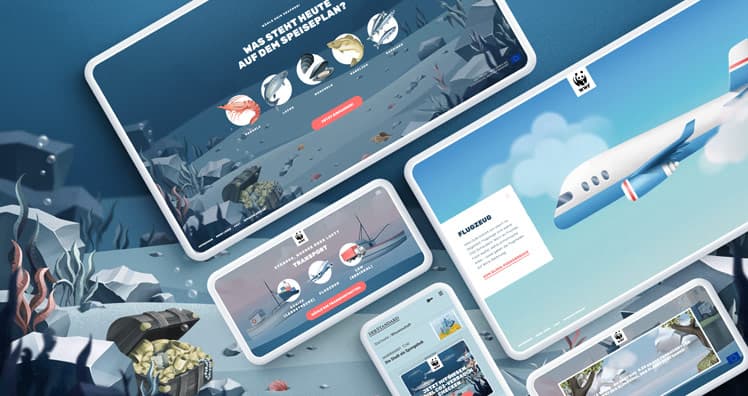
The site opens as a short, horizontally scrolling journey: the player first picks a seafood species, then a method of catching or farming it, then a mode of transport to market. Each choice animates the player through the corresponding production stage, so the route visibly changes with what they've selected. At the end, a result screen totals the CO2 per kilogram of that particular catch and translates it into a more tangible measure — the equivalent kilometres driven by car. From there, players can share their result to Facebook, Twitter or WhatsApp, or step back through their own route to see which stage added the most emissions. The whole path is playable on both desktop and mobile, in nine languages.
- 1
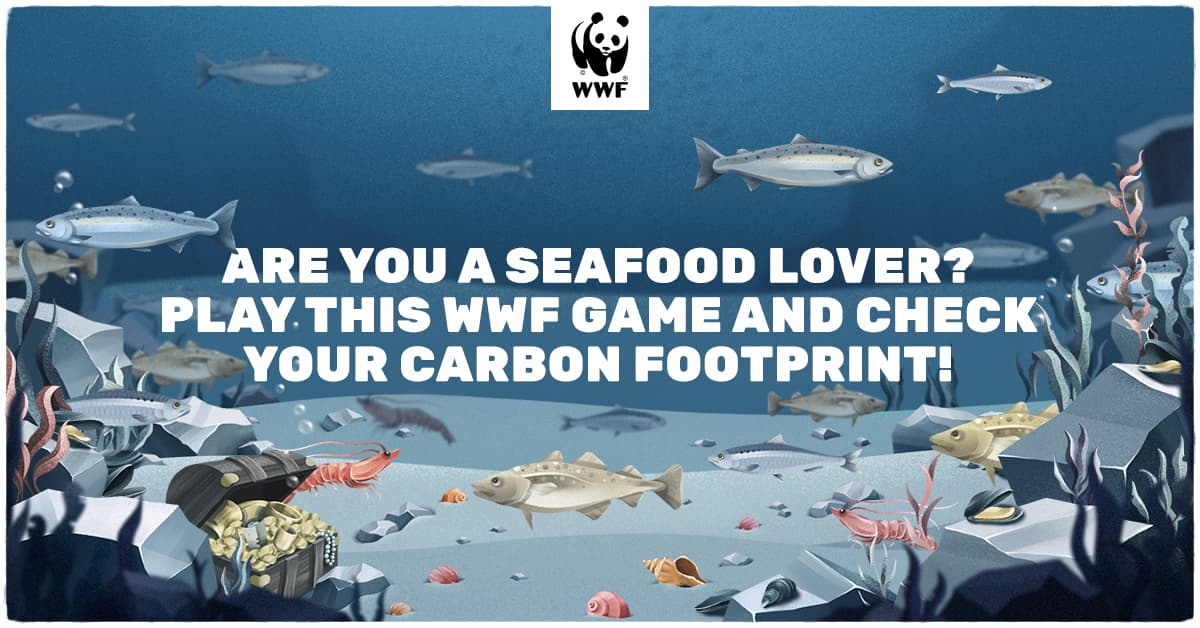
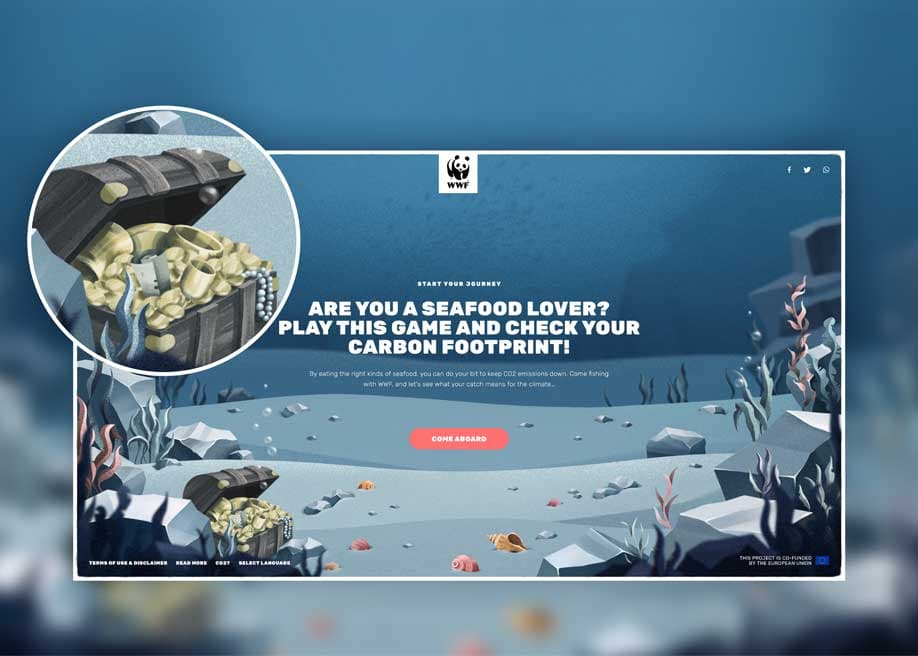
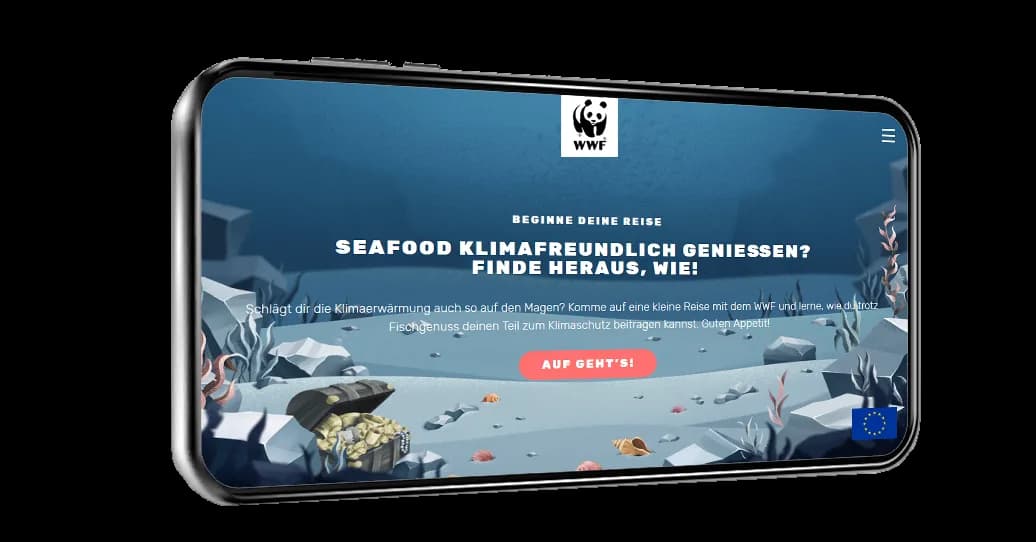
The site opens with a preloader, asks the player to rotate the screen to landscape and go fullscreen, then pitches the premise: choose your seafood and see what your catch means for the climate. A single button, "Come aboard," starts the journey, available in nine languages.
- 2
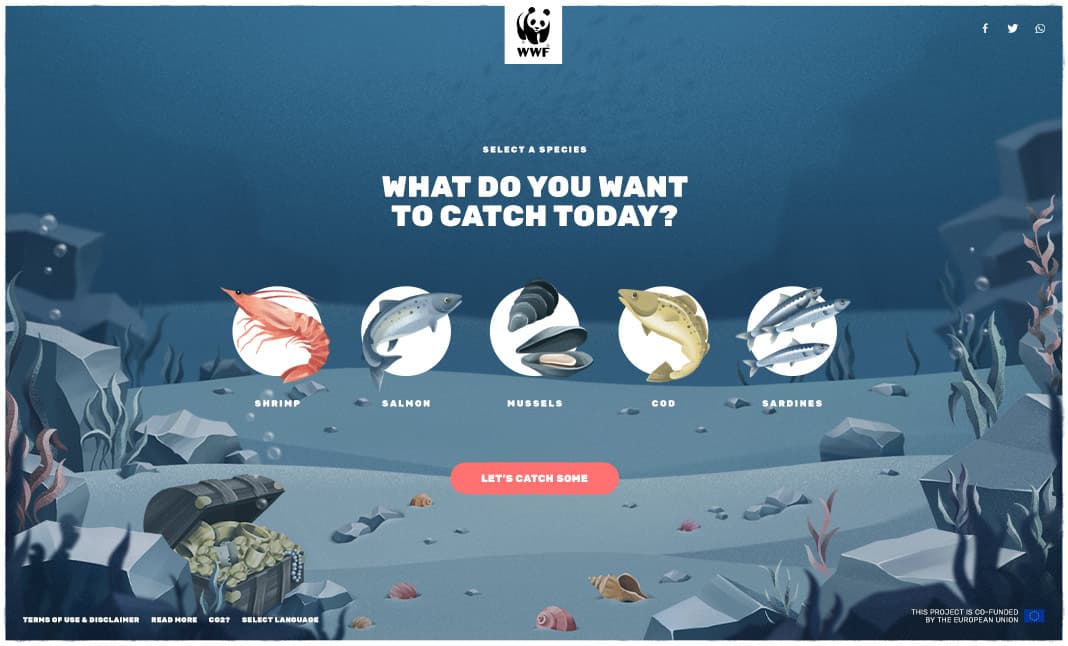
The player first picks one of five seafood species — shrimp, salmon, mussels, cod, or sardines — from illustrated cards, then confirms to move to the next stage.
- 3
Next the player chooses how the fish was caught, picking among methods such as purse seine, bottom trawl, gillnet, certified aquaculture, or non-certified aquaculture.
- 4
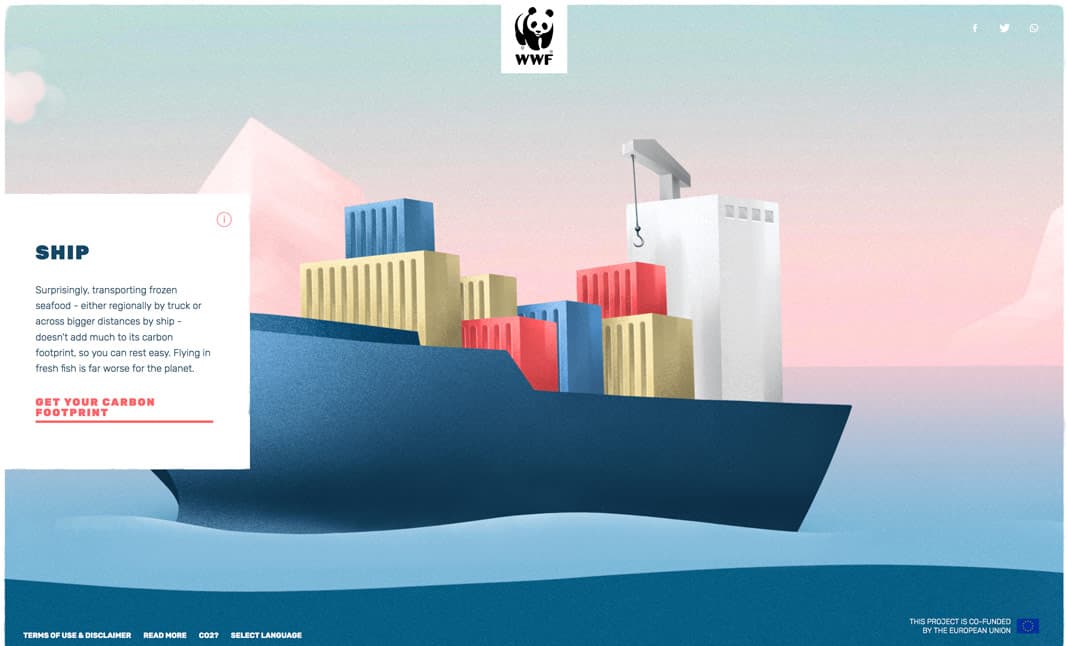
Finally the player selects how the catch travels to the plate — by ship, plane, or truck.
- 5
After each choice, an animated illustrated scene carries the fish through the next stage of production, tallying the carbon cost of the option picked.
- 6
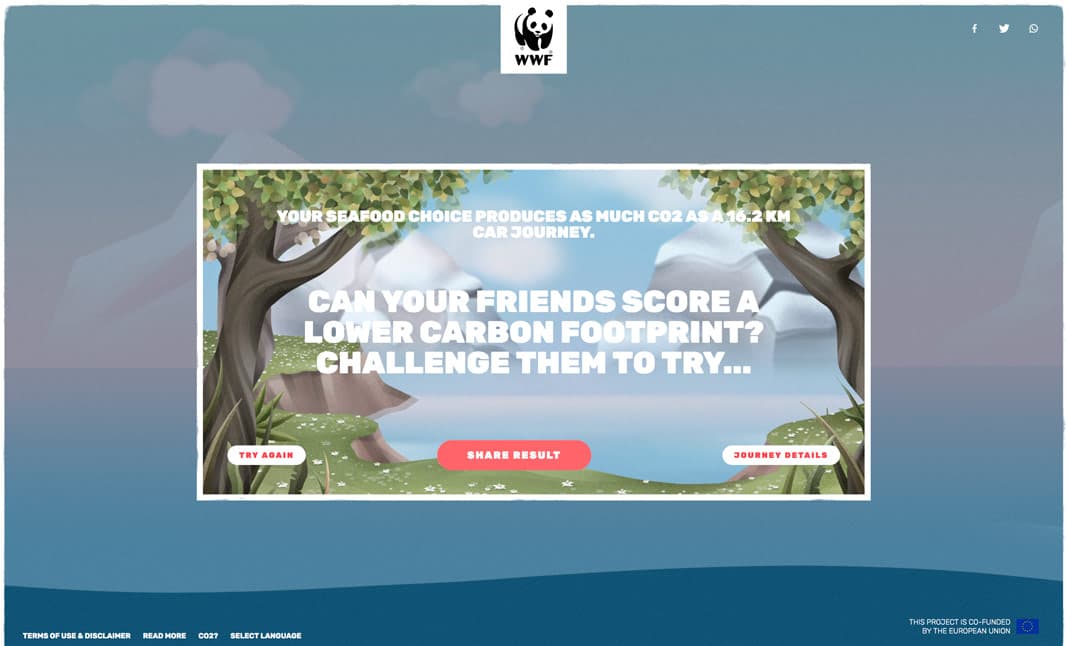
A results screen totals the carbon footprint of the chosen species, catch method, and transport combined for one kilogram of product, converting the greenhouse-gas total into an equivalent distance driven by car.
- 7
From the result, the player can open a detail view that breaks the journey down by each of the three choices made and links out to WWF's seafood buying guides, or hit "Try again" to replay with different choices.
- 8
The player can also share the result to Facebook, Twitter, or WhatsApp to invite others to play.