









Odyssey
- Brand
- Ebuyer
- Year
- 2013
- Objective
- Awareness
- Industry
- Retail
- Mechanic
- Arcade & Action
- Platform
- Web
- Agency
- Epiphany
Objective
Ebuyer launched Odyssey in early December 2013 to ride the wave of PS4 and Xbox One arriving weeks earlier, turning its retail moment into a piece of gaming culture rather than another product push. Managing director Stuart Carlisle framed it as a chance to celebrate everything the team loved about console gaming, giving players something worth sharing and giving the press a reason to write about the retailer.
Solution
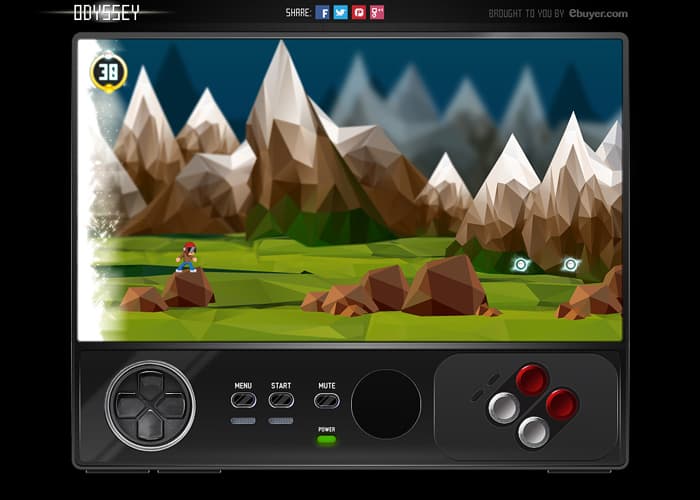
Odyssey opens as a side-scrolling run-and-jump platformer, no install required, playable straight from Ebuyer's site. The player steers a character sprinting and leaping through seven unlockable levels, each redrawn in the visual style of a different console generation, starting with blocky Atari-era graphics and working up to hand-painted seventh-generation backdrops. Along the way, consoles scattered through the level are auto-collected into an inventory, where each one unlocks a short write-up and an original illustration, building out into a browsable timeline of gaming history as the player clears more levels. A light sci-fi framing story — testing a VR headset that glitches and starts scattering memory fragments — ties the runs together, with a session ending each time the player finishes a level or loses a run and jumps back in.
- 1
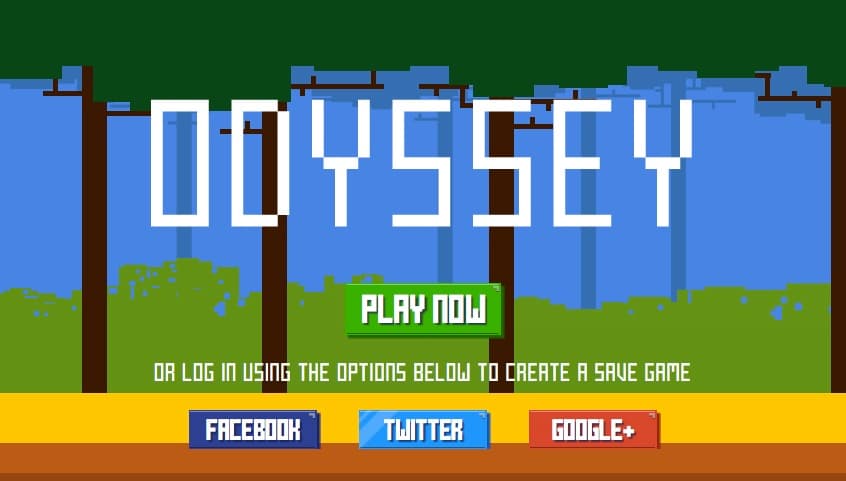
The player opens the game directly in a browser at ebuyer.com/odyssey, with no install and no registration required.
- 2
An intro sets up the premise: the player is invited to test a virtual-reality headset, and the test glitches, shattering the onboard AI into primitive fragments that have taken the shape of past game consoles, which the player is tasked with recovering.
- 3
The core loop is a side-scrolling runner: the player runs and jumps across platforms, collecting the console-shaped memory fragments scattered through each level.
- 4
Each console collected is added to an inventory the player can open to view its card, complete with an original illustration and background information.
- 5
Levels unlock in sequence, seven in total, each tied to one generation of console hardware, with the visual style shifting alongside it, from simple Atari-era graphics to painted seventh-generation backdrops.
- 6
The growing collection doubles as an interactive timeline of gaming history, letting the player browse through the seven generations and read reference entries on consoles from the Magnavox Odyssey to the Xbox 360 and PS3.
- 7
The overarching goal, posed by the game's own tagline "Can You Collect All The Consoles?", is to gather the full set: press coverage puts the total at 102 collectible consoles, ranging from mainstream hits like the NES, PlayStation and Xbox to rarities such as the Action Max and Sega Pico.