






Mind Matrix
- Brand
- Brain Games
- Year
- 2015
- Objective
- Product Launch
- Industry
- Entertainment
- Mechanic
- Puzzle
- Platform
- Web
- Agency
- Neo-Pangea



Objective
National Geographic Channel wanted Brain Games fans to keep engaging with the show between episodes, not just during broadcast. The site let viewers take the same cognitive tests featured on air and get a personal read on their own thinking, giving them a reason to come back after every episode and a reason to talk about it with friends on Facebook.
Solution
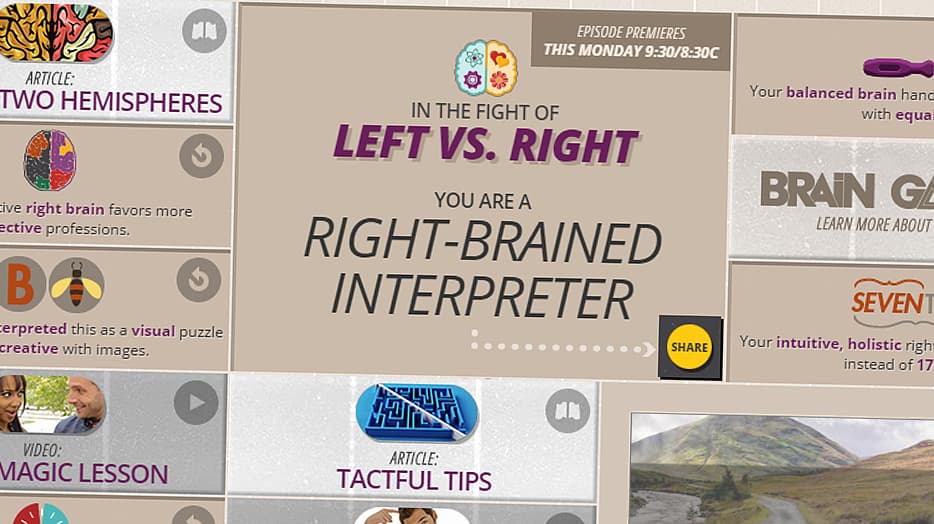
Players work through a string of short assessments — quizzes, optical illusions, ethical dilemmas, and more — answering by dragging and sorting objects, pulling sliders that drive an animated scene, or hunting for a hidden detail in an image. Each finished task fills in another piece of a personal "Mind Matrix," a profile of the player's cognitive strengths and weak spots that gets sharper the more assessments they complete. Every round is built to be quick, so a player can knock one out on a phone in a spare minute and come back later for more. Signing in with Facebook adds a social layer, letting players see how their results compare to friends'. Each topic also links out to extra articles and video before the player moves on to the next task.
- 1
The player lands on the show's site and is invited to reveal a personal "Mind Matrix" — a profile of cognitive strengths — with an optional Facebook login that later unlocks comparisons with friends.
- 2
The player picks a task from a set of themes tied to the season's episode topics; the site holds 80 distinct tasks in all, spanning puzzles, optical illusions, ethical dilemmas and other formats.
- 3
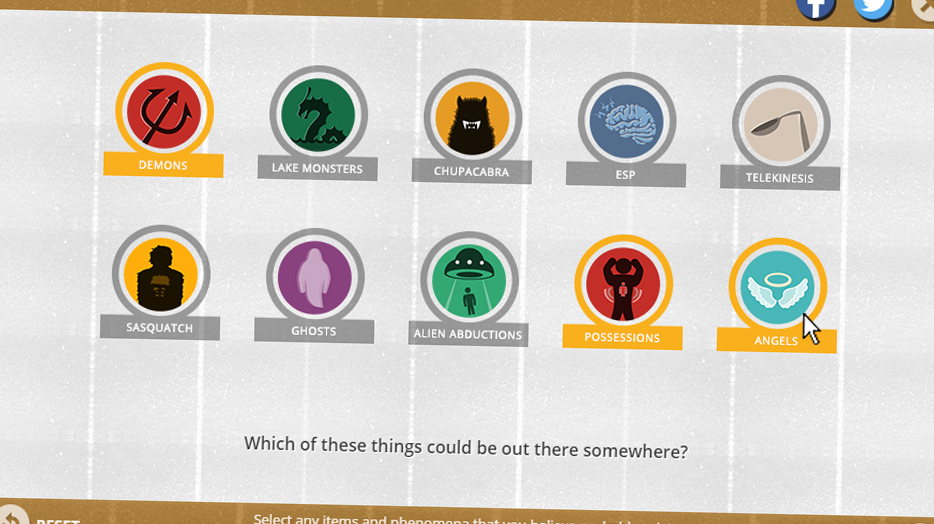
Some tasks are straightforward multiple-choice: the player is shown an illustration, scenario or photograph — such as a set of banknotes — and selects an answer from a few options.
- 4
Other tasks use drag-and-drop: the player sorts or arranges objects into groups or a sequence, answering through action rather than selection.
- 5
Slider-based tasks let the player set an answer by dragging a control that simultaneously drives an animation, such as a window view shifting from day to night as it moves toward a later hour.
- 6
Visual-search tasks show a single image and ask the player to spot as many hidden objects as possible, such as faces concealed in a scene.
- 7
Ethical dilemmas and optical illusions ask the player to make a judgment call rather than find a single correct answer, revealing traits of their thinking style; each task is short enough to finish in a spare moment, and completing it updates a running Mind Matrix profile of the player's cognitive strengths and weaknesses.
- 8
Players who signed in with Facebook see their results measured against friends, including who complements whom; each topic also offers bonus articles and video not aired on TV, tasks can be shared, and the site adds new tasks tied to each newly aired episode, drawing players back over the course of the season.